Pearson Edexcel · A-Level · History
Course version: 9HI0 · Version from Sept 2015
Ireland and the Union, c1774–1923 - 2 Industrial- isation in Ulster,…
Full specification wording
Paper 3, Option 36.2: Ireland and the Union, c1774–1923 - 2 Industrial- isation in Ulster, 1825–55: The importance of the textile industry in Ulster; the decline of the woollen and cotton industries; the impact of railways and mechanisation on the linen industry.
The textile industry was central to Ulster's economy, with linen becoming dominant.
Checked against the Pearson Edexcel 9HI0 specification (opens in a new tab) on .
- Point 1 of 3
Study notes
From the checked teaching notes for this specification point.
The idea
The textile industry was central to Ulster's economy, with linen becoming dominant. Woollen production declined due to competition from Yorkshire and lack of mechanisation. Cotton spinning initially grew but collapsed under English competition and the loss of protective tariffs. Railways, such as the Dublin and Belfast Junction Railway (1845), reduced transport costs and expanded markets. Mechanisation, including power looms and wet spinning, increased output but caused handloom weavers' wages to fall. By 1850, linen employed over 100,000 people. The decline of woollen and cotton shifted resources to linen, while railways and mechanisation transformed production, making Ulster a global linen leader.
What earns the marks
- Explains the dominance of linen in Ulster's economy and its export markets.
- Analyses the reasons for the decline of the woollen industry, such as competition from Yorkshire and lack of mechanisation.
- Assesses the decline of cotton spinning due to English competition and the removal of protective tariffs.
- Evaluates the impact of railways, like the Dublin and Belfast Junction Railway, on reducing transport costs and expanding markets for linen.
- Explains how mechanisation, including power looms and wet spinning, increased output but affected handloom weavers.
Common mistakes and how to put them right
Stating that the woollen industry declined because of a lack of wool.
Put it right: It declined due to competition from Yorkshire and failure to mechanise.
Claiming that cotton spinning continued to grow after 1825.
Put it right: It declined sharply from the 1820s due to English competition.
Saying railways had little impact on the linen industry.
Put it right: Railways significantly reduced transport costs and opened new markets, boosting linen exports.
Exam tips
- Use specific examples such as the Dublin and Belfast Junction Railway to illustrate the impact of railways.
- Link mechanisation to social changes, such as the decline of handloom weavers, to show deeper understanding.
Try the lesson
The start of the Paper 3, Option 36.2: Ireland and the Union, c1774–1923 - 2 Industrial- isation in Ulster, 1825–55: The importance of the textile industry in Ulster; the decline of the woollen and cotton industries; the impact of railways and mechanisation on the linen industry. lesson, made from checked teaching notes for this specification point.
Have a go first
Which textile became the dominant industry of Ulster during the period 1825–55?
Listen
The textile industry was central to Ulster's economy, with linen becoming dominant. Woollen production declined due to competition from Yorkshire and lack of mechanisation. Cotton spinning initially grew but collapsed under English competition and the loss of protective tariffs. Railways, such as the Dublin and Belfast Junction Railway (1845), reduced transport costs and expanded markets. Mechanisation, including power looms and wet spinning, increased output but caused handloom weavers' wages to fall. By 1850, linen employed over 100,000 people. The decline of woollen and cotton shifted resources to linen, while railways and mechanisation transformed production, making Ulster a global linen leader. A strong answer earns marks for these points. Explains the dominance of linen in Ulster's economy and its export markets. Analyses the reasons for the decline of the woollen industry, such as competition from Yorkshire and lack of mechanisation. Assesses the decline of cotton spinning due to English competition and the removal of protective tariffs. Evaluates the impact of railways, like the Dublin and Belfast Junction Railway, on reducing transport costs and expanding markets for linen. A common slip: stating that the woollen industry declined because of a lack of wool. Instead, it declined due to competition from Yorkshire and failure to mechanise. Exam tip: Use specific examples such as the Dublin and Belfast Junction Railway to illustrate the impact of railways.
See it
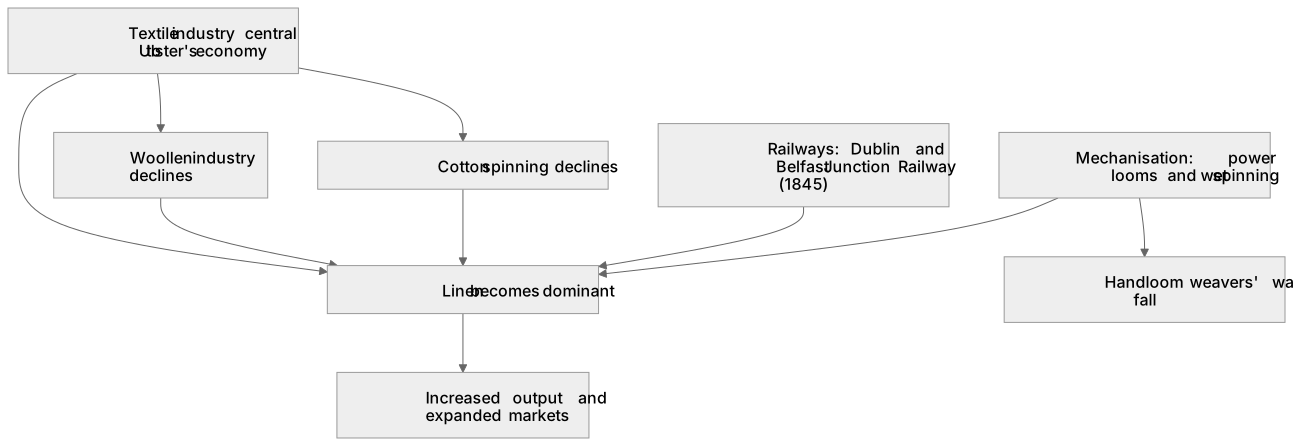
Label the diagram
Some boxes have lost their names. Pick the right name for each number.
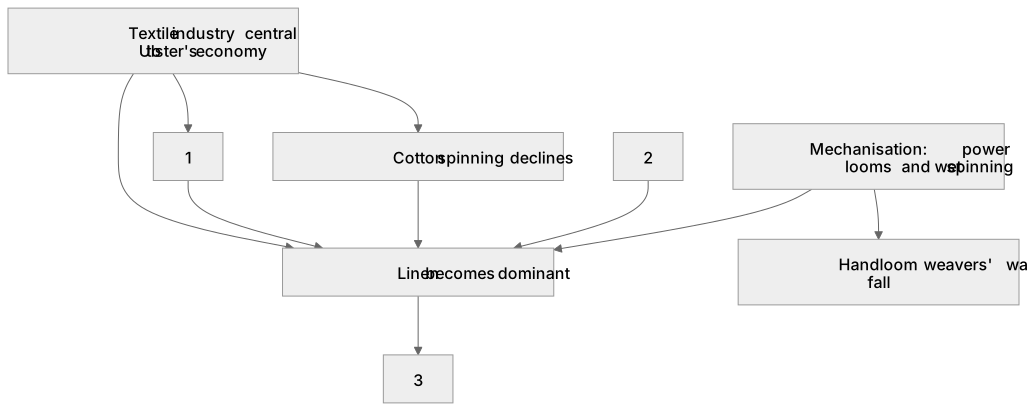
1Box 1
2Box 2
3Box 3
There is more to this lesson
The full lesson goes on to check your understanding and help you earn the marks. Create a free account to carry on, with your progress saved.
A week of Premium from your first lesson · Then the free plan continues · No card, no charge
Test your understanding of Paper 3, Option 36.2: Ireland and the Union, c1774–1923 - 2 Industrial- isation in Ulster, 1825–55: The importance of the textile industry in Ulster; the decline of the woollen and cotton industries; the impact of railways and mechanisation on the linen industry.
Active recall beats re-reading. Take an instant quiz now to test what you’ve learned and lock it into long-term memory.
A week of Premium from your first lesson · Then the free plan continues · No card, no charge