Pearson Edexcel · A-Level · History
Course version: 9HI0 · Version from Sept 2015
Ireland and the Union, c1774–1923 - 2 Industrial- isation in Ulster,…
Full specification wording
Paper 3, Option 36.2: Ireland and the Union, c1774–1923 - 2 Industrial- isation in Ulster, 1825–55: The development of shipbuilding; the importance of the Charles Connell and Sons and the Thompson and Kirwan yards; the work of the Belfast Harbour Commissioners.
Shipbuilding in Ulster developed steadily in the early 19th century, centred on Belfast.
Checked against the Pearson Edexcel 9HI0 specification (opens in a new tab) on .
- Point 2 of 3
- 3 key terms
Study notes
From the checked teaching notes for this specification point.
The idea
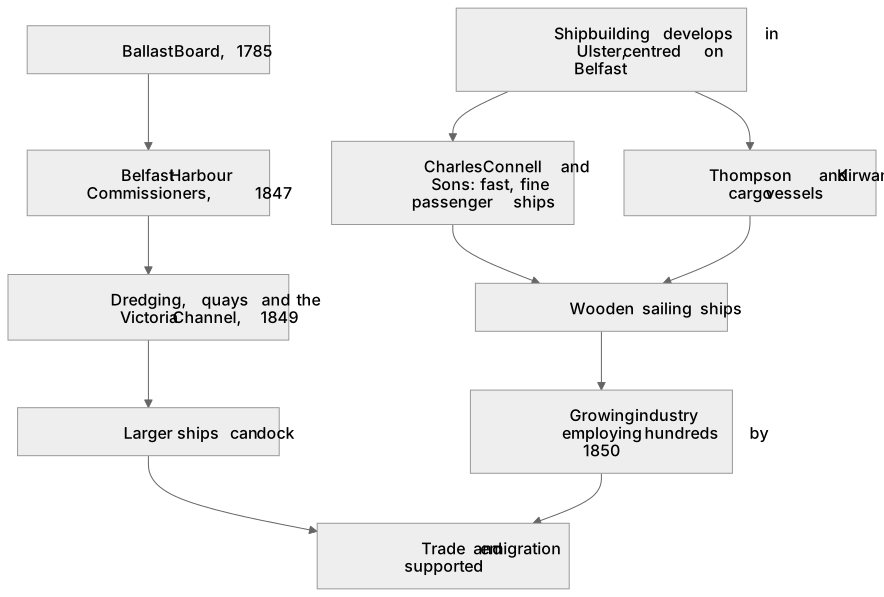
Shipbuilding in Ulster developed steadily in the early 19th century, centred on Belfast. Charles Connell and Sons and Thompson and Kirwan were prominent yards, primarily building wooden sailing ships. Connell's yard specialised in fast, fine passenger ships, while Thompson and Kirwan focused on cargo vessels. The Belfast Harbour Commissioners, established in 1847 (replacing the 1785 Ballast Board), improved the port with dredging, quays, and the Victoria Channel (1849), allowing larger ships to dock. These developments supported trade and emigration. By 1850, shipbuilding was a growing industry employing hundreds, laying the foundation for the massive expansion that followed with Harland and Wolff from 1861.
What earns the marks
- Explains the early development of shipbuilding in Belfast and its economic significance.
- Describes the role of Charles Connell and Sons in building wooden passenger ships and advancing ship design.
- Describes the role of Thompson and Kirwan in constructing wooden cargo vessels and contributing to trade.
- Assesses the work of the Belfast Harbour Commissioners (established 1847) in improving port infrastructure, such as the Victoria Channel.
- Evaluates how these developments facilitated trade and emigration, boosting Ulster's economy before the massive expansion of the 1860s.
Common mistakes and how to put them right
Claiming Charles Connell and Sons and Thompson and Kirwan built iron steamships.
Put it right: They primarily built wooden sailing ships.
Stating that shipbuilding employed thousands in Belfast by 1850.
Put it right: It employed hundreds at this stage; the massive expansion into thousands of workers occurred later with Harland and Wolff.
Stating that the Belfast Harbour Commissioners were established in 1785.
Put it right: The 1785 body was the Ballast Board; the Harbour Commissioners were created in 1847.
Exam tips
- Use specific examples like the Victoria Channel (1849) to show the Commissioners' impact.
- Distinguish between the two yards' specialities (Connell for passenger, Thompson and Kirwan for cargo) to demonstrate detailed knowledge.
Try the lesson
The start of the Paper 3, Option 36.2: Ireland and the Union, c1774–1923 - 2 Industrial- isation in Ulster, 1825–55: The development of shipbuilding; the importance of the Charles Connell and Sons and the Thompson and Kirwan yards; the work of the Belfast Harbour Commissioners. lesson, made from checked teaching notes for this specification point.
Have a go first
How did the infrastructural work of the Belfast Harbour Commissioners directly facilitate the expansion of private shipbuilding yards in the mid-nineteenth century?
Listen
Shipbuilding in Ulster developed steadily in the early 19th century, centred on Belfast. Charles Connell and Sons and Thompson and Kirwan were prominent yards, primarily building wooden sailing ships. Connell's yard specialised in fast, fine passenger ships, while Thompson and Kirwan focused on cargo vessels. The Belfast Harbour Commissioners, established in 1847 (replacing the 1785 Ballast Board), improved the port with dredging, quays, and the Victoria Channel (1849), allowing larger ships to dock. These developments supported trade and emigration. By 1850, shipbuilding was a growing industry employing hundreds, laying the foundation for the massive expansion that followed with Harland and Wolff from 1861. A strong answer earns marks for these points. Explains the early development of shipbuilding in Belfast and its economic significance. Describes the role of Charles Connell and Sons in building wooden passenger ships and advancing ship design. Describes the role of Thompson and Kirwan in constructing wooden cargo vessels and contributing to trade. Assesses the work of the Belfast Harbour Commissioners (established 1847) in improving port infrastructure, such as the Victoria Channel. A common slip: claiming Charles Connell and Sons and Thompson and Kirwan built iron steamships. Instead, they primarily built wooden sailing ships. Exam tip: Use specific examples like the Victoria Channel (1849) to show the Commissioners' impact.
See it
Put the events in order
Put these events in the order they happened, earliest first.
- 1. Harland and Wolff began expansion
- 2. The Ballast Board was established
- 3. The Victoria Channel was created
- 4. The Belfast Harbour Commissioners were established
Key words
Say what each word means before you turn the card.
Industrialisation
Try answering aloud or in your head before turning the card.
Maritime trade
Try answering aloud or in your head before turning the card.
Infrastructure development
Try answering aloud or in your head before turning the card.
See every definition
- Industrialisation
- The growth of industry in Ulster, shown by shipbuilding becoming a growing industry that employed hundreds by 1850.
- Maritime trade
- Trade supported by improved port facilities, which along with emigration was supported by these developments.
- Infrastructure development
- Improvements to the port by the Belfast Harbour Commissioners, including dredging, quays and the Victoria Channel, allowing larger ships to dock.
Label the diagram
Some boxes have lost their names. Pick the right name for each number.
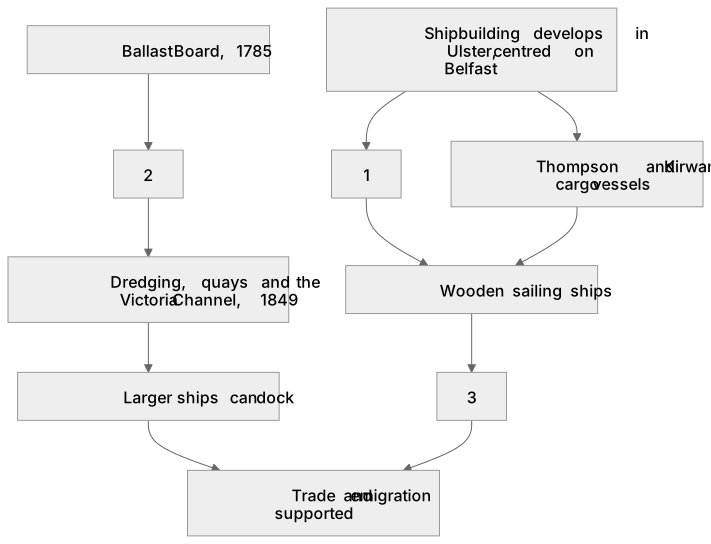
1Box 1
2Box 2
3Box 3
There is more to this lesson
The full lesson goes on to check your understanding and help you earn the marks. Create a free account to carry on, with your progress saved.
A week of Premium from your first lesson · Then the free plan continues · No card, no charge
Test your understanding of Paper 3, Option 36.2: Ireland and the Union, c1774–1923 - 2 Industrial- isation in Ulster, 1825–55: The development of shipbuilding; the importance of the Charles Connell and Sons and the Thompson and Kirwan yards; the work of the Belfast Harbour Commissioners.
Active recall beats re-reading. Take an instant quiz now to test what you’ve learned and lock it into long-term memory.
A week of Premium from your first lesson · Then the free plan continues · No card, no charge