Pearson Edexcel · A-Level · History
Course version: 9HI0 · Version from Sept 2015
Ireland and the Union, c1774–1923 - 2 Industrial- isation in Ulster,…
Full specification wording
Paper 3, Option 36.2: Ireland and the Union, c1774–1923 - 2 Industrial- isation in Ulster, 1825–55: The roles of Robert Hickson and Andrew Mulholland in the industrialisation of Ulster; its impact on working and living conditions; the Belfast cholera epidemic, 1848; discrepancies between Catholics and Protestants in employment.
Ulster industrialised unevenly, centred on Belfast linen and shipbuilding.
Checked against the Pearson Edexcel 9HI0 specification (opens in a new tab) on .
- Point 3 of 3
- 4 key terms
Study notes
From the checked teaching notes for this specification point.
The idea
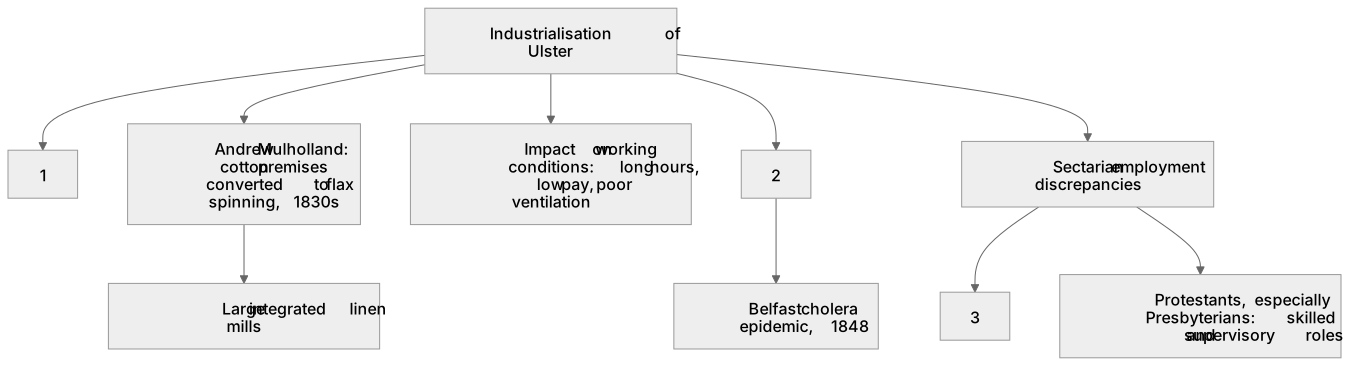
Ulster industrialised unevenly, centred on Belfast linen and shipbuilding. Robert Hickson pioneered Belfast's iron shipbuilding by opening a shipyard on Queen's Island in 1853, laying the foundation for the city's heavy industry before selling to Edward Harland. Andrew Mulholland converted his York Street cotton premises to flax spinning in the 1830s, driving the shift to large integrated linen mills. This industrialisation impacted working and living conditions: it created employment but brought long hours, low pay, poor ventilation, and overcrowded housing. In 1848, a severe cholera epidemic struck Belfast's crowded courts, exposing sanitary failures. Employment also divided along sectarian lines: Catholics were concentrated in unskilled and casual work, while Protestants, especially Presbyterians, dominated skilled and supervisory roles, creating lasting discrepancies.
What earns the marks
- Explains Robert Hickson's role in the industrialisation of Ulster by establishing the first iron shipbuilding yard on Queen's Island in 1853.
- Explains Andrew Mulholland's conversion of cotton premises to flax spinning and his expansion into large integrated linen mills.
- Assesses the impact of industrialisation on working conditions, including long hours, low wages, dust, heat and child and female labour in the mills.
- Assesses living conditions, including overcrowded housing, poor sanitation and disease in rapidly growing Belfast districts.
- Explains the 1848 Belfast cholera epidemic as a consequence of poor water supply, drainage and overcrowding, and notes its human cost.
- Analyses employment discrepancies, showing Catholics concentrated in unskilled or casual work while Protestants dominated skilled and supervisory positions.
- Reaches a supported judgement on how far industrialisation improved or worsened conditions and on the sectarian character of the labour market.
Common mistakes and how to put them right
Confusing the industries of Hickson and Mulholland.
Put it right by distinguishing Hickson's pioneering role in iron shipbuilding from Mulholland's large-scale linen mill expansion.
Assuming industrialisation automatically raised living standards.
Put it right by weighing wages and employment against overcrowding, disease and poor sanitation.
Describing sectarian employment differences as simply personal prejudice.
Put it right by linking them to skill networks, apprenticeship, migration and residential patterns.
Exam tips
- Anchor each paragraph on one named factor from the statement, then use specific evidence to support the point.
- When discussing the cholera epidemic, connect it explicitly to industrial urban conditions rather than narrating it in isolation.
- For the sectarian employment point, compare Catholic and Protestant experiences directly instead of describing only one group.
Try the lesson
The start of the Paper 3, Option 36.2: Ireland and the Union, c1774–1923 - 2 Industrial- isation in Ulster, 1825–55: The roles of Robert Hickson and Andrew Mulholland in the industrialisation of Ulster; its impact on working and living conditions; the Belfast cholera epidemic, 1848; discrepancies between Catholics and Protestants in employment. lesson, made from checked teaching notes for this specification point.
Have a go first
Which Ulster industrialist is associated with the development of flax spinning in Belfast during the early nineteenth century?
Listen
Ulster industrialised unevenly, centred on Belfast linen and shipbuilding. Robert Hickson pioneered Belfast's iron shipbuilding by opening a shipyard on Queen's Island in 1853, laying the foundation for the city's heavy industry before selling to Edward Harland. Andrew Mulholland converted his York Street cotton premises to flax spinning in the 1830s, driving the shift to large integrated linen mills. This industrialisation impacted working and living conditions: it created employment but brought long hours, low pay, poor ventilation, and overcrowded housing. In 1848, a severe cholera epidemic struck Belfast's crowded courts, exposing sanitary failures. Employment also divided along sectarian lines: Catholics were concentrated in unskilled and casual work, while Protestants, especially Presbyterians, dominated skilled and supervisory roles, creating lasting discrepancies. A strong answer earns marks for these points. Explains Robert Hickson's role in the industrialisation of Ulster by establishing the first iron shipbuilding yard on Queen's Island in 1853. Explains Andrew Mulholland's conversion of cotton premises to flax spinning and his expansion into large integrated linen mills. Assesses the impact of industrialisation on working conditions, including long hours, low wages, dust, heat and child and female labour in the mills. Assesses living conditions, including overcrowded housing, poor sanitation and disease in rapidly growing Belfast districts. A common slip: Confusing the industries of Hickson and Mulholland. Instead, distinguishing Hickson's pioneering role in iron shipbuilding from Mulholland's large-scale linen mill expansion. Exam tip: Anchor each paragraph on one named factor from the statement, then use specific evidence to support the point.
See it

Key words
Say what each word means before you turn the card.
Industrialisation and economic change
Try answering aloud or in your head before turning the card.
Urban living and public health
Try answering aloud or in your head before turning the card.
Sectarian division in the labour market
Try answering aloud or in your head before turning the card.
Role of individual entrepreneurs
Try answering aloud or in your head before turning the card.
See every definition
- Industrialisation and economic change
- Ulster industrialised unevenly, centred on Belfast linen and shipbuilding, with Robert Hickson and Andrew Mulholland playing key roles.
- Urban living and public health
- Industrialisation brought overcrowded housing and poor sanitation, and in 1848 a severe cholera epidemic struck Belfast's crowded courts, exposing sanitary failures.
- Sectarian division in the labour market
- Catholics were concentrated in unskilled and casual work, while Protestants, especially Presbyterians, dominated skilled and supervisory roles, creating lasting discrepancies.
- Role of individual entrepreneurs
- Robert Hickson pioneered Belfast's iron shipbuilding by opening a shipyard on Queen's Island in 1853, and Andrew Mulholland converted his York Street cotton premises to flax spinning in the 1830s.
Label the diagram
Some boxes have lost their names. Pick the right name for each number.
1Box 1
2Box 2
3Box 3
There is more to this lesson
The full lesson goes on to check your understanding and help you earn the marks. Create a free account to carry on, with your progress saved.
A week of Premium from your first lesson · Then the free plan continues · No card, no charge
Test your understanding of Paper 3, Option 36.2: Ireland and the Union, c1774–1923 - 2 Industrial- isation in Ulster, 1825–55: The roles of Robert Hickson and Andrew Mulholland in the industrialisation of Ulster; its impact on working and living conditions; the Belfast cholera epidemic, 1848; discrepancies between Catholics and Protestants in employment.
Active recall beats re-reading. Take an instant quiz now to test what you’ve learned and lock it into long-term memory.
A week of Premium from your first lesson · Then the free plan continues · No card, no charge