Pearson Edexcel · A-Level · History
Course version: 9HI0 · Version from Sept 2015
Ireland and the Union, c1774–1923 - 5 Improving working and living…
Full specification wording
Paper 3, Option 36.2: Ireland and the Union, c1774–1923 - 5 Improving working and living conditions: trades union militancy in Ireland, 1907–14: Events and significance of the Dublin general strike 1913–14; the lock-out and implications for workers and employers.
The Dublin general strike of 1913–14 began when tram workers, led by James Larkin and the Irish Transport and General Workers' Union (ITGWU), struck for better pay and union recognition.
Checked against the Pearson Edexcel 9HI0 specification (opens in a new tab) on .
- Point 2 of 3
- 4 key terms
Study notes
From the checked teaching notes for this specification point.
The idea
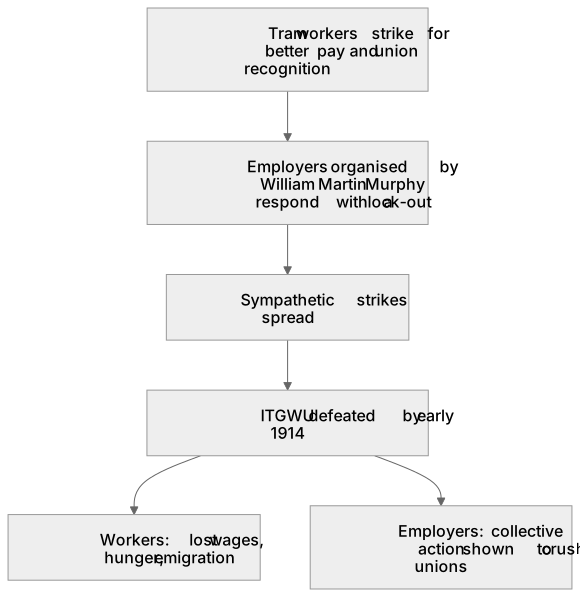
The Dublin general strike of 1913–14 began when tram workers, led by James Larkin and the Irish Transport and General Workers' Union (ITGWU), struck for better pay and union recognition. Employers, organised by William Martin Murphy, responded with a lock-out, refusing to employ union members. The dispute escalated as sympathetic strikes spread, but the ITGWU was defeated by early 1914. For workers, the lock-out meant lost wages, hunger, and emigration; for employers, it demonstrated the power of collective action to crush unions. The strike's significance lies in its exposure of poor working conditions and the limits of union solidarity in Ireland, shaping future labour and nationalist politics.
What earns the marks
- Demonstrates knowledge of the sequence of events: tram strike, sympathetic strikes, lock-out, and eventual return to work.
- Explains the roles of key figures such as James Larkin, James Connolly, and William Martin Murphy.
- Analyses the economic and social impact on workers, including poverty, emigration, and the failure to secure union recognition.
- Evaluates the implications for employers, such as the short-term defeat of the ITGWU but long-term changes in labour organisation.
- Assesses the significance of the strike in the broader context of Irish labour and nationalist history.
Common mistakes and how to put them right
Confusing the Dublin lock-out with a general strike across all industries.
Put it right: It was primarily a lock-out of ITGWU members by employers, not a universal strike.
Assuming the strike achieved immediate improvements for workers.
Put it right: It ended in defeat for the union, with many workers signing pledges not to join the ITGWU.
Overstating the role of British unions.
Put it right: While British unions provided some financial support, the dispute was fundamentally Irish in leadership and outcome.
Exam tips
- Use specific dates and names to show precise knowledge, e.g., the strike began in August 1913 and ended in early 1914.
- Link the events to the wider theme of improving working and living conditions, showing how the strike both highlighted and failed to resolve poor conditions.
- When discussing significance, consider short-term and long-term impacts on workers, employers, and the labour movement.
Try the lesson
The start of the Paper 3, Option 36.2: Ireland and the Union, c1774–1923 - 5 Improving working and living conditions: trades union militancy in Ireland, 1907–14: Events and significance of the Dublin general strike 1913–14; the lock-out and implications for workers and employers. lesson, made from checked teaching notes for this specification point.
Have a go first
In which year did the Dublin lock-out, centred on the dispute between William Martin Murphy and the Irish Transport and General Workers' Union, begin?
Listen
The Dublin general strike of 1913–14 began when tram workers, led by James Larkin and the Irish Transport and General Workers' Union (ITGWU), struck for better pay and union recognition. Employers, organised by William Martin Murphy, responded with a lock-out, refusing to employ union members. The dispute escalated as sympathetic strikes spread, but the ITGWU was defeated by early 1914. For workers, the lock-out meant lost wages, hunger, and emigration; for employers, it demonstrated the power of collective action to crush unions. The strike's significance lies in its exposure of poor working conditions and the limits of union solidarity in Ireland, shaping future labour and nationalist politics. A strong answer earns marks for these points. Demonstrates knowledge of the sequence of events: tram strike, sympathetic strikes, lock-out, and eventual return to work. Explains the roles of key figures such as James Larkin, James Connolly, and William Martin Murphy. Analyses the economic and social impact on workers, including poverty, emigration, and the failure to secure union recognition. Evaluates the implications for employers, such as the short-term defeat of the ITGWU but long-term changes in labour organisation. A common slip: Confusing the Dublin lock-out with a general strike across all industries. Instead, it was primarily a lock-out of ITGWU members by employers, not a universal strike. Exam tip: Use specific dates and names to show precise knowledge, e.g., the strike began in August 1913 and ended in early 1914.
See it
Key words
Say what each word means before you turn the card.
Trade union militancy and collective action
Try answering aloud or in your head before turning the card.
Employer resistance and lock-outs
Try answering aloud or in your head before turning the card.
Social and economic consequences of industrial disputes
Try answering aloud or in your head before turning the card.
The development of Irish labour politics
Try answering aloud or in your head before turning the card.
See every definition
- Trade union militancy and collective action
- Tram workers struck for better pay and union recognition, and sympathetic strikes spread as the dispute escalated.
- Employer resistance and lock-outs
- Employers organised by William Martin Murphy refused to employ union members, responding to the strike with a lock-out.
- Social and economic consequences of industrial disputes
- For workers the lock-out meant lost wages, hunger and emigration, while employers demonstrated the power of collective action to crush unions.
- The development of Irish labour politics
- The strike's significance lies in its exposure of poor working conditions and the limits of union solidarity in Ireland, shaping future labour and nationalist politics.
Label the diagram
Some boxes have lost their names. Pick the right name for each number.
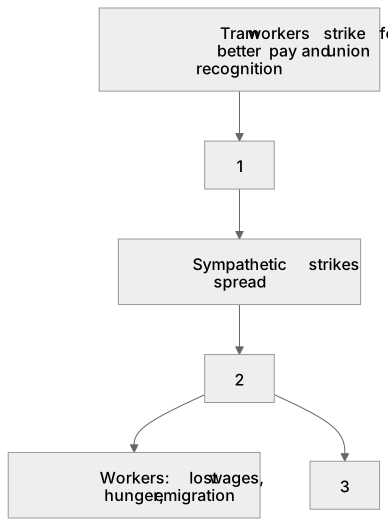
1Box 1
2Box 2
3Box 3
There is more to this lesson
The full lesson goes on to check your understanding and help you earn the marks. Create a free account to carry on, with your progress saved.
A week of Premium from your first lesson · Then the free plan continues · No card, no charge
Test your understanding of Paper 3, Option 36.2: Ireland and the Union, c1774–1923 - 5 Improving working and living conditions: trades union militancy in Ireland, 1907–14: Events and significance of the Dublin general strike 1913–14; the lock-out and implications for workers and employers.
Active recall beats re-reading. Take an instant quiz now to test what you’ve learned and lock it into long-term memory.
A week of Premium from your first lesson · Then the free plan continues · No card, no charge