Pearson Edexcel · A-Level · History
Course version: 9HI0 · Version from Sept 2015
Ireland and the Union, c1774–1923 - 5 Improving working and living…
Full specification wording
Paper 3, Option 36.2: Ireland and the Union, c1774–1923 - 5 Improving working and living conditions: trades union militancy in Ireland, 1907–14: Working and living conditions for unskilled urban workers; the significance of the founding of the National Union of Dock Labourers 1907, and the ITGWU 1909; the roles of Jim Larkin, James Connolly and William Martin Murphy.
Unskilled urban workers in early 20th-century Ireland endured poor living and working conditions: low wages, long hours, casual employment, and overcrowded slums.
Checked against the Pearson Edexcel 9HI0 specification (opens in a new tab) on .
- Point 1 of 3
- 4 key terms
Study notes
From the checked teaching notes for this specification point.
The idea
Unskilled urban workers in early 20th-century Ireland endured poor living and working conditions: low wages, long hours, casual employment, and overcrowded slums. The specification highlights the founding of the National Union of Dock Labourers 1907; historically founded in 1889, 1907 marks Jim Larkin's founding of its Belfast branch, organising dockers and winning concessions. The Irish Transport and General Workers' Union (ITGWU), founded in 1909 by Larkin, aimed to unionise all unskilled workers and was central to the 1913 Dublin Lockout. Larkin led militant strikes; James Connolly, a socialist theorist, became a key ITGWU organiser and later led the Irish Citizen Army; William Martin Murphy, a prominent employer, opposed unions and led the lockout. Their roles highlight the conflict between labour and capital.
What earns the marks
- Describe working conditions: low pay, irregular work, long hours, and lack of safety for unskilled urban workers.
- Describe living conditions: overcrowded tenements, poor sanitation, and high disease rates in Irish cities, especially Dublin.
- Explain the significance of the ITGWU (1909): it expanded unskilled unionism, led by Larkin, and played a key role in the 1913 Lockout.
- Analyse Jim Larkin's role: his leadership, oratory, and militant tactics in strikes and the ITGWU.
- Analyse James Connolly's role: his socialist ideology, his work as an ITGWU organiser (returning to Ireland in 1910), and his leadership of the Irish Citizen Army.
- Analyse William Martin Murphy's role: as an employer, he organised opposition to unions, leading to the 1913 Lockout.
Common mistakes and how to put them right
Stating the NUDL was founded nationally in 1907.
Put it right: Clarify that 1907 refers to the Belfast branch's establishment.
Claiming James Connolly co-founded the ITGWU in 1909.
Put it right: Attribute the founding solely to Larkin and describe Connolly's subsequent leadership role.
Underestimating the role of William Martin Murphy.
Put it right: Explain his active organisation of employers against unions.
Exam tips
- Use specific examples of strikes, such as the 1913 Dublin Lockout, to illustrate the roles of key figures.
- Compare the approaches of Larkin and Connolly to show their different emphases (militant action vs. socialist theory).
- Link the union movement to broader themes of social and political change in Ireland.
Try the lesson
The start of the Paper 3, Option 36.2: Ireland and the Union, c1774–1923 - 5 Improving working and living conditions: trades union militancy in Ireland, 1907–14: Working and living conditions for unskilled urban workers; the significance of the founding of the National Union of Dock Labourers 1907, and the ITGWU 1909; the roles of Jim Larkin, James Connolly and William Martin Murphy. lesson, made from checked teaching notes for this specification point.
Have a go first
Which union was founded in 1909 by James Larkin to organise unskilled Irish workers?
Listen
Unskilled urban workers in early 20th-century Ireland endured poor living and working conditions: low wages, long hours, casual employment, and overcrowded slums. The specification highlights the founding of the National Union of Dock Labourers 1907; historically founded in 1889, 1907 marks Jim Larkin's founding of its Belfast branch, organising dockers and winning concessions. The Irish Transport and General Workers' Union (ITGWU), founded in 1909 by Larkin, aimed to unionise all unskilled workers and was central to the 1913 Dublin Lockout. Larkin led militant strikes; James Connolly, a socialist theorist, became a key ITGWU organiser and later led the Irish Citizen Army; William Martin Murphy, a prominent employer, opposed unions and led the lockout. Their roles highlight the conflict between labour and capital. A strong answer earns marks for these points. Describe working conditions: low pay, irregular work, long hours, and lack of safety for unskilled urban workers. Describe living conditions: overcrowded tenements, poor sanitation, and high disease rates in Irish cities, especially Dublin. Explain the significance of the founding of the National Union of Dock Labourers 1907 (referring to Larkin establishing the Belfast branch): it was crucial for organising unskilled workers and using strikes to improve pay and conditions. Explain the significance of the ITGWU (1909): it expanded unskilled unionism, led by Larkin, and played a key role in the 1913 Lockout. A common slip: Stating the NUDL was founded nationally in 1907: while the specification references 1907, the union was founded in 1889, and 1907 marks Larkin's founding of the Belfast branch. Instead, clarify that 1907 refers to the Belfast branch's establishment. Exam tip: Use specific examples of strikes, such as the 1913 Dublin Lockout, to illustrate the roles of key figures.
See it
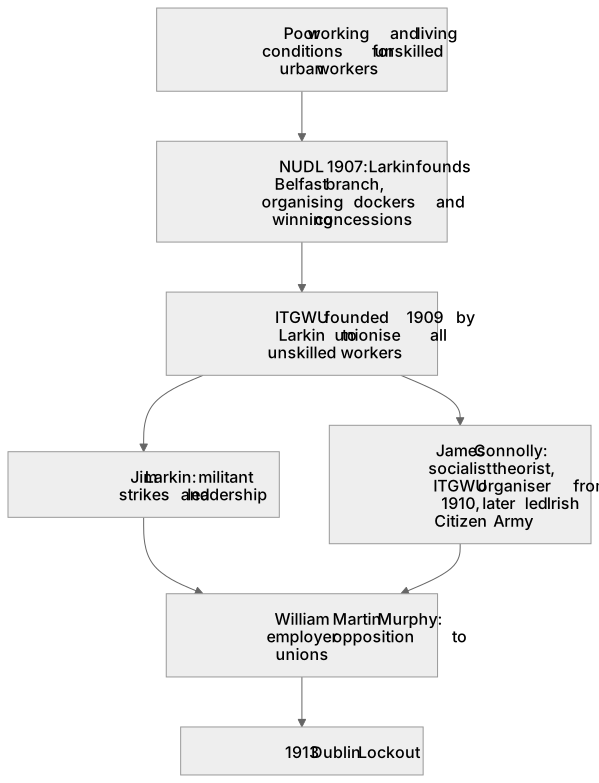
Put the events in order
Put these events in the order they happened, earliest first.
- 1. The Dublin Lockout took place
- 2. Larkin founded the Belfast branch of the National Union of Dock Labourers
- 3. James Connolly returned to Ireland to become an ITGWU organiser
- 4. Larkin founded the Irish Transport and General Workers' Union
Key words
Say what each word means before you turn the card.
Urban poverty and class conflict
Try answering aloud or in your head before turning the card.
The rise of unskilled unionism
Try answering aloud or in your head before turning the card.
Leadership and ideology in the labour movement
Try answering aloud or in your head before turning the card.
Employer resistance and industrial conflict
Try answering aloud or in your head before turning the card.
See every definition
- Urban poverty and class conflict
- Unskilled urban workers endured low wages, long hours, casual employment and overcrowded slums, highlighting the conflict between labour and capital.
- The rise of unskilled unionism
- The National Union of Dock Labourers 1907 and the ITGWU 1909 were crucial for organising unskilled workers and expanding unskilled unionism.
- Leadership and ideology in the labour movement
- Larkin led militant strikes and the ITGWU, Connolly was a socialist theorist and organiser, and Murphy organised employer opposition.
- Employer resistance and industrial conflict
- William Martin Murphy, a prominent employer, opposed unions and led the lockout, showing conflict between labour and capital.
Label the diagram
Some boxes have lost their names. Pick the right name for each number.
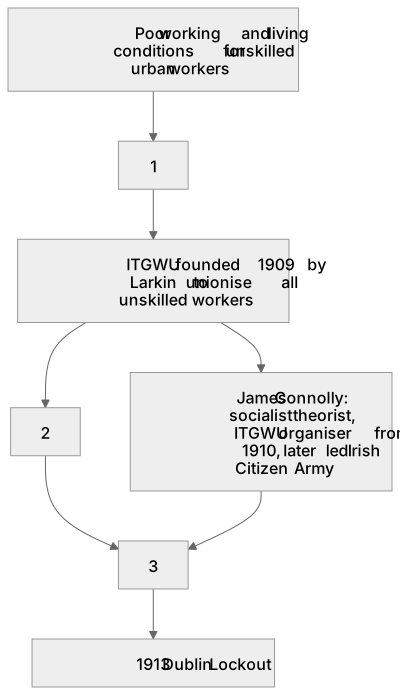
1Box 1
2Box 2
3Box 3
There is more to this lesson
The full lesson goes on to check your understanding and help you earn the marks. Create a free account to carry on, with your progress saved.
A week of Premium from your first lesson · Then the free plan continues · No card, no charge
Test your understanding of Paper 3, Option 36.2: Ireland and the Union, c1774–1923 - 5 Improving working and living conditions: trades union militancy in Ireland, 1907–14: Working and living conditions for unskilled urban workers; the significance of the founding of the National Union of Dock Labourers 1907, and the ITGWU 1909; the roles of Jim Larkin, James Connolly and William Martin Murphy.
Active recall beats re-reading. Take an instant quiz now to test what you’ve learned and lock it into long-term memory.
A week of Premium from your first lesson · Then the free plan continues · No card, no charge