Pearson Edexcel · A-Level · History
Course version: 9HI0 · Version from Sept 2015
The changing nature of warfare, 1859–1991: perception and reality - 1…
Full specification wording
Paper 3, Option 37.1: The changing nature of warfare, 1859–1991: perception and reality - 1 Increased firepower and steam power, 1859–70: The use of railways and steam boats to move and supply armies: the mobilisation of French and Austrian armies in 1859 and problems encountered in the initial deployment.
Railways and steam boats transformed military logistics by enabling rapid movement of troops and supplies, but their effective use required careful planning.
Checked against the Pearson Edexcel 9HI0 specification (opens in a new tab) on .
- Point 1 of 3
Study notes
From the checked teaching notes for this specification point.
The idea
Railways and steam boats transformed military logistics by enabling rapid movement of troops and supplies, but their effective use required careful planning. In 1859, France mobilised forces to support Piedmont against Austria. French troops travelled by rail to the coast, then by steam boat to Genoa, before marching to the front. Austria relied more on rail and road, but its mobilisation was slower and less coordinated. Initial deployment problems included bottlenecks at railheads, insufficient rolling stock, and poor coordination between rail and sea transport. These issues delayed troop concentrations and highlighted the need for integrated transport planning. The example shows how steam power increased strategic reach but also created new vulnerabilities, such as dependence on fixed rail lines and timetables.
What earns the marks
- Explains how railways enabled faster concentration of armies, e.g. France moved troops to the Mediterranean coast by rail before sea crossing.
- Describes the role of steam boats in moving troops and supplies across water, e.g. French transport from Marseille to Genoa.
- Identifies specific problems in French mobilisation, such as rail congestion, shortage of carriages, and delays at ports.
- Identifies specific problems in Austrian mobilisation, such as slower rail network, reliance on road, and coordination difficulties.
- Assesses the overall impact of steam transport on the 1859 campaign, noting both increased speed and persistent logistical friction.
Common mistakes and how to put them right
Assuming railways alone solved all supply problems.
Put it right: Railways created new bottlenecks and required coordination with other transport modes.
Confusing the direction of French naval transport.
Put it right: French troops sailed from Marseille to Genoa, not the reverse.
Overstating Austrian rail efficiency.
Put it right: Austria had fewer rail lines and its mobilisation was slower than France's.
Exam tips
- Use specific place names (e.g. Marseille, Genoa) to show precise knowledge of the 1859 mobilisation.
- Link transport problems to their consequences, such as delayed arrivals affecting the timing of battles.
- Compare French and Austrian experiences to demonstrate understanding of relative effectiveness.
Try the lesson
The start of the Paper 3, Option 37.1: The changing nature of warfare, 1859–1991: perception and reality - 1 Increased firepower and steam power, 1859–70: The use of railways and steam boats to move and supply armies: the mobilisation of French and Austrian armies in 1859 and problems encountered in the initial deployment. lesson, made from checked teaching notes for this specification point.
Have a go first
In 1859, which transport technology did both the French and Austrian armies rely on to concentrate their forces in northern Italy?
Listen
Railways and steam boats transformed military logistics by enabling rapid movement of troops and supplies, but their effective use required careful planning. In 1859, France mobilised forces to support Piedmont against Austria. French troops travelled by rail to the coast, then by steam boat to Genoa, before marching to the front. Austria relied more on rail and road, but its mobilisation was slower and less coordinated. Initial deployment problems included bottlenecks at railheads, insufficient rolling stock, and poor coordination between rail and sea transport. These issues delayed troop concentrations and highlighted the need for integrated transport planning. The example shows how steam power increased strategic reach but also created new vulnerabilities, such as dependence on fixed rail lines and timetables. A strong answer earns marks for these points. Explains how railways enabled faster concentration of armies, e.g. France moved troops to the Mediterranean coast by rail before sea crossing. Describes the role of steam boats in moving troops and supplies across water, e.g. French transport from Marseille to Genoa. Identifies specific problems in French mobilisation, such as rail congestion, shortage of carriages, and delays at ports. Identifies specific problems in Austrian mobilisation, such as slower rail network, reliance on road, and coordination difficulties. A common slip: Assuming railways alone solved all supply problems. Instead, railways created new bottlenecks and required coordination with other transport modes. Exam tip: Use specific place names (e.g. Marseille, Genoa) to show precise knowledge of the 1859 mobilisation.
See it
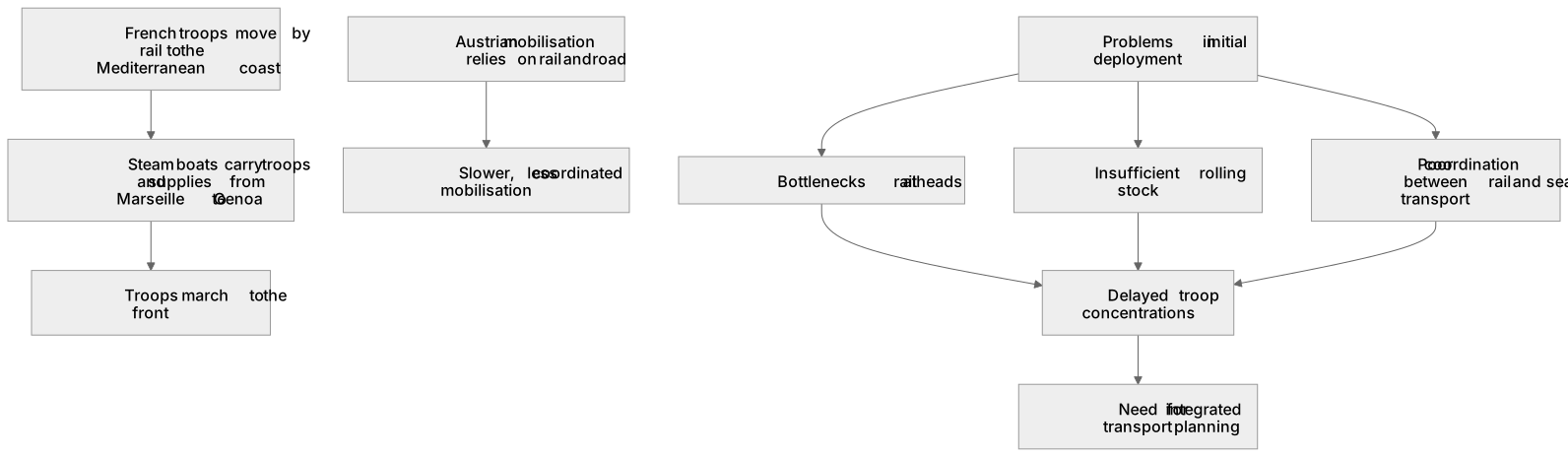
Label the diagram
Some boxes have lost their names. Pick the right name for each number.
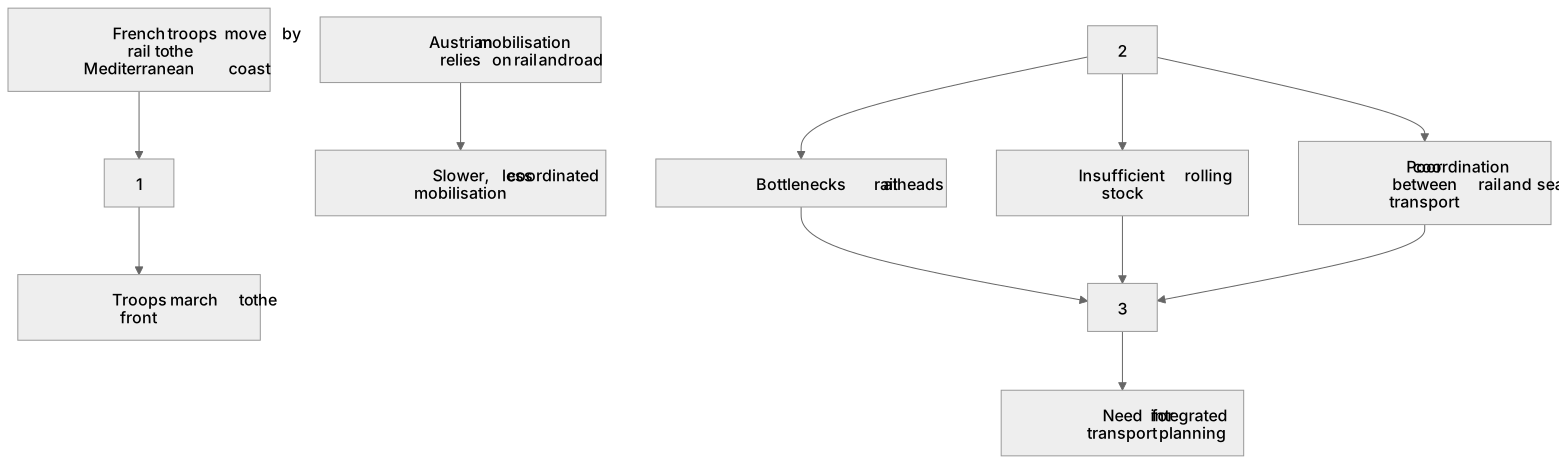
1Box 1
2Box 2
3Box 3
There is more to this lesson
The full lesson goes on to check your understanding and help you earn the marks. Create a free account to carry on, with your progress saved.
A week of Premium from your first lesson · Then the free plan continues · No card, no charge
Test your understanding of Paper 3, Option 37.1: The changing nature of warfare, 1859–1991: perception and reality - 1 Increased firepower and steam power, 1859–70: The use of railways and steam boats to move and supply armies: the mobilisation of French and Austrian armies in 1859 and problems encountered in the initial deployment.
Active recall beats re-reading. Take an instant quiz now to test what you’ve learned and lock it into long-term memory.
A week of Premium from your first lesson · Then the free plan continues · No card, no charge