Pearson Edexcel · A-Level · History
Course version: 9HI0 · Version from Sept 2015
The changing nature of warfare, 1859–1991: perception and reality - 1…
Full specification wording
Paper 3, Option 37.1: The changing nature of warfare, 1859–1991: perception and reality - 1 Increased firepower and steam power, 1859–70: Increased firepower: Colt's revolver, breechloading rifles, Krupp's artillery; the breechloader vs. muzzle-loader debate.
The mid-19th century saw significant advances in firepower.
Checked against the Pearson Edexcel 9HI0 specification (opens in a new tab) on .
- Point 2 of 3
- 2 key terms
Study notes
From the checked teaching notes for this specification point.
The idea
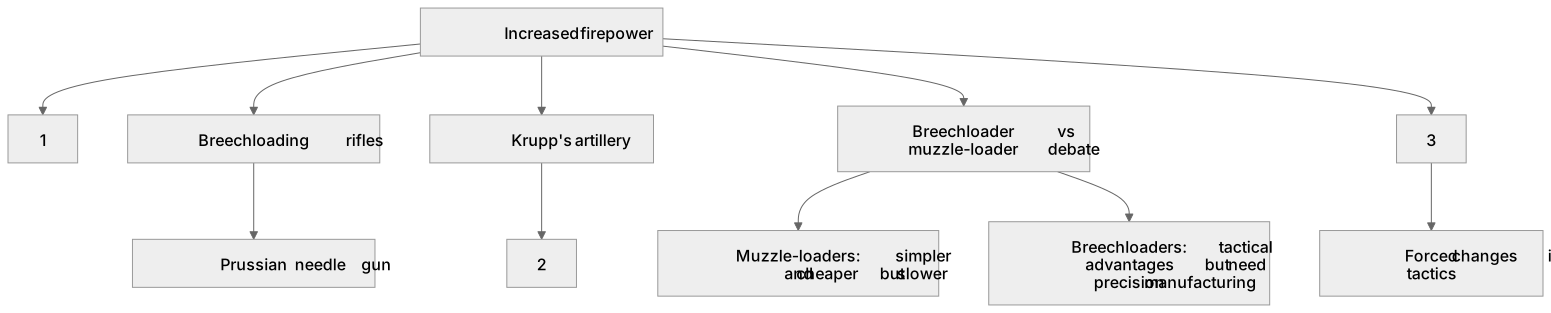
The mid-19th century saw significant advances in firepower. Colt's revolver allowed multiple shots without reloading, improving close-range firepower. Breechloading rifles, such as the Prussian needle gun, could be loaded faster and fired from prone positions, increasing rate of fire and reducing exposure. Krupp's artillery used breechloading steel barrels, offering greater range, accuracy, and rate of fire compared to muzzle-loading bronze cannon. The debate between breechloaders and muzzle-loaders centred on reliability, cost, and complexity: muzzle-loaders were simpler and cheaper but slower, while breechloaders offered tactical advantages but required precision manufacturing. These developments contributed to the lethality of battlefields and forced changes in tactics.
What earns the marks
- Explains how Colt's revolver increased firepower by allowing multiple shots before reloading.
- Describes the advantages of breechloading rifles, such as faster reloading and ability to fire from cover.
- Explains Krupp's artillery innovation: breechloading steel guns with improved range and accuracy.
- Compares breechloaders and muzzle-loaders in terms of rate of fire, reliability, cost, and tactical use.
- Assesses the impact of increased firepower on tactics and casualty rates in the 1859–70 period.
Common mistakes and how to put them right
Believing breechloaders were universally adopted immediately.
Put it right: Muzzle-loaders remained common due to cost and reliability concerns.
Confusing the mechanism of Colt's revolver with that of a rifle.
Put it right: The revolver uses a rotating cylinder, while rifles use a single barrel.
Assuming Krupp's artillery was muzzle-loading.
Put it right: Krupp's guns were breechloading and made of steel.
Exam tips
- Use technical terms correctly, e.g. 'breechloading' and 'muzzle-loading', to show precise understanding.
- Link each weapon to its tactical effect, such as increased rate of fire leading to more dispersed formations.
- Refer to specific examples, like the Prussian needle gun or Krupp's steel cannon, to support arguments.
Try the lesson
The start of the Paper 3, Option 37.1: The changing nature of warfare, 1859–1991: perception and reality - 1 Increased firepower and steam power, 1859–70: Increased firepower: Colt's revolver, breechloading rifles, Krupp's artillery; the breechloader vs. muzzle-loader debate. lesson, made from checked teaching notes for this specification point.
Have a go first
Which mid-nineteenth-century weapon development provided cavalry and officers with a reliable multi-shot capability in close-quarters combat?
Listen
The mid-19th century saw significant advances in firepower. Colt's revolver allowed multiple shots without reloading, improving close-range firepower. Breechloading rifles, such as the Prussian needle gun, could be loaded faster and fired from prone positions, increasing rate of fire and reducing exposure. Krupp's artillery used breechloading steel barrels, offering greater range, accuracy, and rate of fire compared to muzzle-loading bronze cannon. The debate between breechloaders and muzzle-loaders centred on reliability, cost, and complexity: muzzle-loaders were simpler and cheaper but slower, while breechloaders offered tactical advantages but required precision manufacturing. These developments contributed to the lethality of battlefields and forced changes in tactics. A strong answer earns marks for these points. Explains how Colt's revolver increased firepower by allowing multiple shots before reloading. Describes the advantages of breechloading rifles, such as faster reloading and ability to fire from cover. Explains Krupp's artillery innovation: breechloading steel guns with improved range and accuracy. Compares breechloaders and muzzle-loaders in terms of rate of fire, reliability, cost, and tactical use. A common slip: Believing breechloaders were universally adopted immediately. Instead, muzzle-loaders remained common due to cost and reliability concerns. Exam tip: Use technical terms correctly, e.g. 'breechloading' and 'muzzle-loading', to show precise understanding.
See it

Key words
Say what each word means before you turn the card.
Firepower and tactics
Try answering aloud or in your head before turning the card.
Cost versus capability
Try answering aloud or in your head before turning the card.
See every definition
- Firepower and tactics
- Advances such as Colt's revolver, breechloading rifles and Krupp's artillery increased lethality on the battlefield and forced changes in tactics.
- Cost versus capability
- The debate between breechloaders and muzzle-loaders centred on reliability, cost and complexity, as muzzle-loaders were simpler and cheaper but slower.
Label the diagram
Some boxes have lost their names. Pick the right name for each number.
1Box 1
2Box 2
3Box 3
There is more to this lesson
The full lesson goes on to check your understanding and help you earn the marks. Create a free account to carry on, with your progress saved.
A week of Premium from your first lesson · Then the free plan continues · No card, no charge
Test your understanding of Paper 3, Option 37.1: The changing nature of warfare, 1859–1991: perception and reality - 1 Increased firepower and steam power, 1859–70: Increased firepower: Colt's revolver, breechloading rifles, Krupp's artillery; the breechloader vs. muzzle-loader debate.
Active recall beats re-reading. Take an instant quiz now to test what you’ve learned and lock it into long-term memory.
A week of Premium from your first lesson · Then the free plan continues · No card, no charge