Pearson Edexcel · A-Level · History
Course version: 9HI0 · Version from Sept 2015
The changing nature of warfare, 1859–1991: perception and reality - 1…
Full specification wording
Paper 3, Option 37.1: The changing nature of warfare, 1859–1991: perception and reality - 1 Increased firepower and steam power, 1859–70: Von Moltke and the Prussian general staff and their influence on military planning; the Prussian use of the new technologies in the wars of 1866 and 1870, and Grant’s use of them in US Civil War, 1863–65.
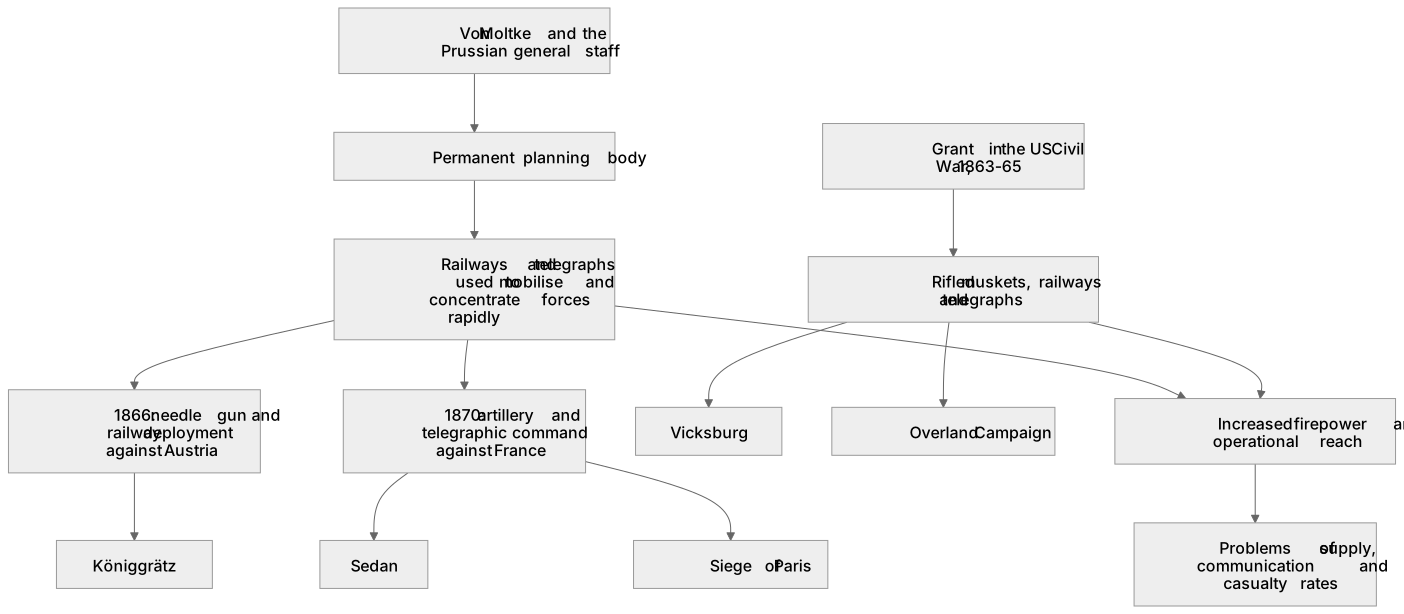
Helmuth von Moltke the Elder transformed the Prussian general staff into a permanent planning body that used railways and telegraphs to mobilise and concentrate forces rapidly.
Checked against the Pearson Edexcel 9HI0 specification (opens in a new tab) on .
- Point 3 of 3
- 4 key terms
Study notes
From the checked teaching notes for this specification point.
The idea
Helmuth von Moltke the Elder transformed the Prussian general staff into a permanent planning body that used railways and telegraphs to mobilise and concentrate forces rapidly. In 1866, Prussia’s breech-loading needle gun and railway deployment helped defeat Austria at Königgrätz. In 1870, superior artillery and telegraphic command contributed to victory over France at Sedan. In the US Civil War, Ulysses S. Grant combined rifled muskets, railways and telegraphs in campaigns such as Vicksburg and the Overland Campaign. These developments increased firepower and operational reach, but also exposed problems of supply, communication and casualty rates.
What earns the marks
- Explains how von Moltke and the Prussian general staff created a professional planning system that integrated railways, telegraphs and detailed mobilisation schedules.
- Analyses the Prussian use of breech-loading rifles (needle gun) and railway concentration in the 1866 war against Austria, including the battle of Königgrätz.
- Assesses Prussian artillery and telegraphic coordination in the 1870 war against France, including the battle of Sedan and the siege of Paris.
- Evaluates Grant’s use of rifled muskets, railways and telegraphs in the US Civil War from 1863 to 1865, for example at Vicksburg and in the Overland Campaign.
- Compares the extent to which new technologies changed military planning and outcomes across the three cases.
Common mistakes and how to put them right
Treating von Moltke as a field commander rather than recognising his role as chief of the Prussian general staff.
Put it right: Focus on his organisational and planning reforms.
Assuming that the needle gun was the sole reason for Prussian victory in 1866.
Put it right: Also consider railway mobilisation, artillery and Austrian tactical errors.
Overstating Grant’s reliance on technology while ignoring his use of attrition and manoeuvre.
Put it right: Show how technology supported but did not replace operational judgement.
Exam tips
- Use specific battles and dates to support analysis, such as Königgrätz (1866), Sedan (1870), Vicksburg (1863) and the Overland Campaign (1864).
- Compare the Prussian and Union experiences directly rather than describing them separately.
- Link each technological example to a change in planning, command or logistics.
Try the lesson
The start of the Paper 3, Option 37.1: The changing nature of warfare, 1859–1991: perception and reality - 1 Increased firepower and steam power, 1859–70: Von Moltke and the Prussian general staff and their influence on military planning; the Prussian use of the new technologies in the wars of 1866 and 1870, and Grant’s use of them in US Civil War, 1863–65. lesson, made from checked teaching notes for this specification point.
Have a go first
Which new technology did the Prussian army exploit in the wars of 1866 and 1870 to move troops quickly between fronts?
Listen
Helmuth von Moltke the Elder transformed the Prussian general staff into a permanent planning body that used railways and telegraphs to mobilise and concentrate forces rapidly. In 1866, Prussia’s breech-loading needle gun and railway deployment helped defeat Austria at Königgrätz. In 1870, superior artillery and telegraphic command contributed to victory over France at Sedan. In the US Civil War, Ulysses S. Grant combined rifled muskets, railways and telegraphs in campaigns such as Vicksburg and the Overland Campaign. These developments increased firepower and operational reach, but also exposed problems of supply, communication and casualty rates. A strong answer earns marks for these points. Explains how von Moltke and the Prussian general staff created a professional planning system that integrated railways, telegraphs and detailed mobilisation schedules. Analyses the Prussian use of breech-loading rifles (needle gun) and railway concentration in the 1866 war against Austria, including the battle of Königgrätz. Assesses Prussian artillery and telegraphic coordination in the 1870 war against France, including the battle of Sedan and the siege of Paris. Evaluates Grant’s use of rifled muskets, railways and telegraphs in the US Civil War from 1863 to 1865, for example at Vicksburg and in the Overland Campaign. A common slip: Treating von Moltke as a field commander rather than recognising his role as chief of the Prussian general staff. Instead, focus on his organisational and planning reforms. Exam tip: Use specific battles and dates to support analysis, such as Königgrätz (1866), Sedan (1870), Vicksburg (1863) and the Overland Campaign (1864).
See it
Key words
Say what each word means before you turn the card.
Professionalisation of military planning
Try answering aloud or in your head before turning the card.
Railways and telegraphs in mobilisation and command
Try answering aloud or in your head before turning the card.
Breech-loading rifles and artillery
Try answering aloud or in your head before turning the card.
Technology and operational outcomes
Try answering aloud or in your head before turning the card.
See every definition
- Professionalisation of military planning
- Von Moltke transformed the Prussian general staff into a permanent planning body that used railways and telegraphs to mobilise and concentrate forces rapidly.
- Railways and telegraphs in mobilisation and command
- Used by the Prussian general staff to mobilise and concentrate forces rapidly, and by Grant alongside rifled muskets in his campaigns.
- Breech-loading rifles and artillery
- Prussia's breech-loading needle gun helped defeat Austria at Königgrätz in 1866, and superior artillery contributed to victory over France at Sedan in 1870.
- Technology and operational outcomes
- These developments increased firepower and operational reach, but also exposed problems of supply, communication and casualty rates.
Label the diagram
Some boxes have lost their names. Pick the right name for each number.
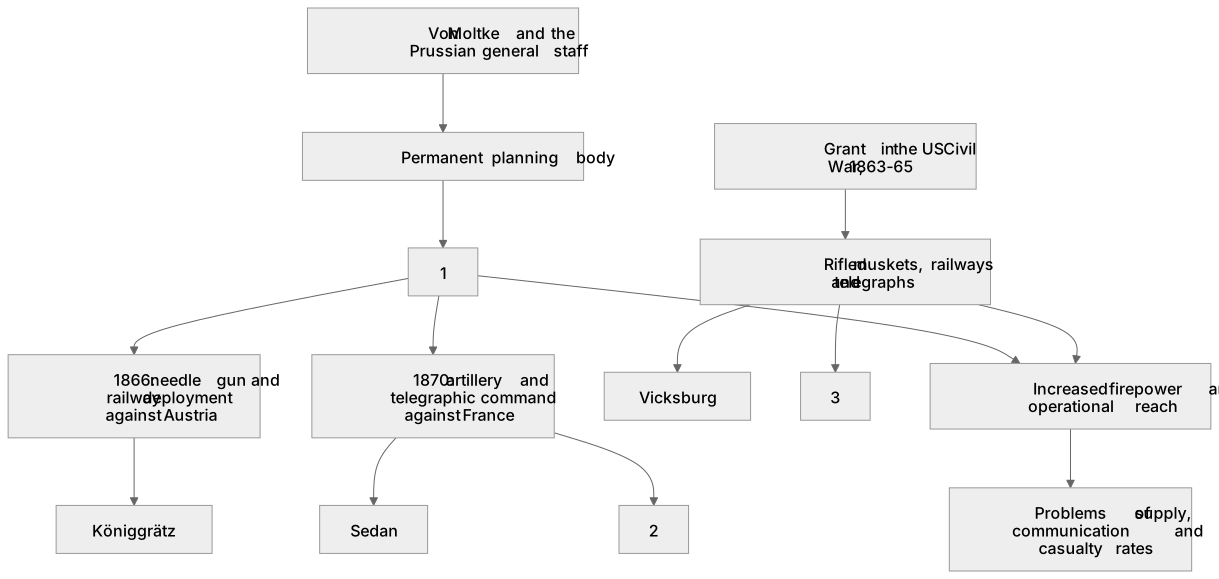
1Box 1
2Box 2
3Box 3
There is more to this lesson
The full lesson goes on to check your understanding and help you earn the marks. Create a free account to carry on, with your progress saved.
A week of Premium from your first lesson · Then the free plan continues · No card, no charge
Test your understanding of Paper 3, Option 37.1: The changing nature of warfare, 1859–1991: perception and reality - 1 Increased firepower and steam power, 1859–70: Von Moltke and the Prussian general staff and their influence on military planning; the Prussian use of the new technologies in the wars of 1866 and 1870, and Grant’s use of them in US Civil War, 1863–65.
Active recall beats re-reading. Take an instant quiz now to test what you’ve learned and lock it into long-term memory.
A week of Premium from your first lesson · Then the free plan continues · No card, no charge