Pearson Edexcel · A-Level · History
Course version: 9HI0 · Version from Sept 2015
The changing nature of warfare, 1859–1991: perception and reality - 2…
Full specification wording
Paper 3, Option 37.1: The changing nature of warfare, 1859–1991: perception and reality - 2 Technology of defence: machine guns, smokeless powder and artillery, c1900–16: The impact of the development of smokeless propellants and machine guns before 1914 on military thought and planning.
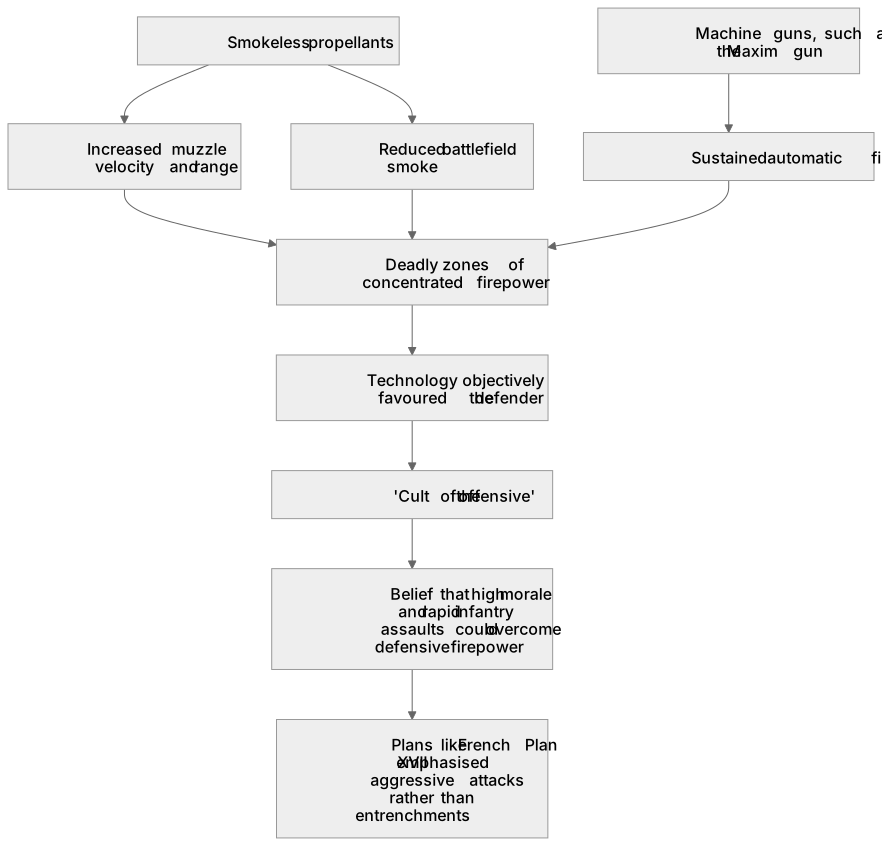
Smokeless propellants increased muzzle velocity and range while reducing battlefield smoke.
Checked against the Pearson Edexcel 9HI0 specification (opens in a new tab) on .
- Point 1 of 3
- 3 key terms
Study notes
From the checked teaching notes for this specification point.
The idea
Smokeless propellants increased muzzle velocity and range while reducing battlefield smoke. Machine guns, such as the Maxim gun, delivered sustained automatic fire. Before 1914, these technologies objectively favoured the defender by creating deadly zones of concentrated firepower. However, military planners largely failed to adapt, instead embracing the 'cult of the offensive'. They believed that high morale and rapid infantry assaults could overcome defensive firepower. Consequently, plans like the French Plan XVII emphasised aggressive attacks rather than entrenchments.
What earns the marks
- Explains how smokeless propellants improved range, accuracy and concealment, altering the battlefield environment.
- Describes the development and capabilities of early machine guns, such as the Maxim gun, and their high rate of fire.
- Analyses how military thought largely ignored the defensive advantages of these weapons, instead favouring the 'cult of the offensive'.
- Assesses the impact on planning, noting that pre-1914 plans like Plan XVII emphasised rapid infantry assaults over entrenchment.
- Evaluates the extent to which planners failed to correctly anticipate the devastating nature of defensive firepower in future war.
Common mistakes and how to put them right
Claiming that pre-1914 planners adopted defensive strategies.
Put it right: Recognise that most planners embraced the 'cult of the offensive' despite the new technology.
Confusing smokeless propellants with earlier black powder.
Put it right: Note that smokeless powder reduced smoke and increased muzzle velocity.
Assuming machine guns were universally understood.
Put it right: Show that their defensive potential was often underestimated by planners focused on morale and attack.
Exam tips
- Use specific examples, such as the Maxim gun, to illustrate technological change and its defensive potential.
- Contrast the objective defensive advantages of the new technology with the offensive focus of pre-1914 military planning.
Try the lesson
The start of the Paper 3, Option 37.1: The changing nature of warfare, 1859–1991: perception and reality - 2 Technology of defence: machine guns, smokeless powder and artillery, c1900–16: The impact of the development of smokeless propellants and machine guns before 1914 on military thought and planning. lesson, made from checked teaching notes for this specification point.
Have a go first
What military advantage did smokeless propellant give to troops firing from a concealed position before 1914?
Listen
Smokeless propellants increased muzzle velocity and range while reducing battlefield smoke. Machine guns, such as the Maxim gun, delivered sustained automatic fire. Before 1914, these technologies objectively favoured the defender by creating deadly zones of concentrated firepower. However, military planners largely failed to adapt, instead embracing the 'cult of the offensive'. They believed that high morale and rapid infantry assaults could overcome defensive firepower. Consequently, plans like the French Plan XVII emphasised aggressive attacks rather than entrenchments. A strong answer earns marks for these points. Explains how smokeless propellants improved range, accuracy and concealment, altering the battlefield environment. Describes the development and capabilities of early machine guns, such as the Maxim gun, and their high rate of fire. Analyses how military thought largely ignored the defensive advantages of these weapons, instead favouring the 'cult of the offensive'. Assesses the impact on planning, noting that pre-1914 plans like Plan XVII emphasised rapid infantry assaults over entrenchment. A common slip: Claiming that pre-1914 planners adopted defensive strategies. Instead, recognise that most planners embraced the 'cult of the offensive' despite the new technology. Exam tip: Use specific examples, such as the Maxim gun, to illustrate technological change and its defensive potential.
See it
Key words
Say what each word means before you turn the card.
Smokeless propellants and machine guns
Try answering aloud or in your head before turning the card.
The cult of the offensive
Try answering aloud or in your head before turning the card.
Perception versus reality in pre-1914 planning
Try answering aloud or in your head before turning the card.
See every definition
- Smokeless propellants and machine guns
- Technologies that increased muzzle velocity and range while reducing battlefield smoke, and delivered sustained automatic fire.
- The cult of the offensive
- A belief that high morale and rapid infantry assaults could overcome defensive firepower, embraced by military planners before 1914.
- Perception versus reality in pre-1914 planning
- Planners underestimated defensive firepower, favouring aggressive attacks such as Plan XVII over entrenchments, despite technologies that objectively favoured the defender.
Label the diagram
Some boxes have lost their names. Pick the right name for each number.
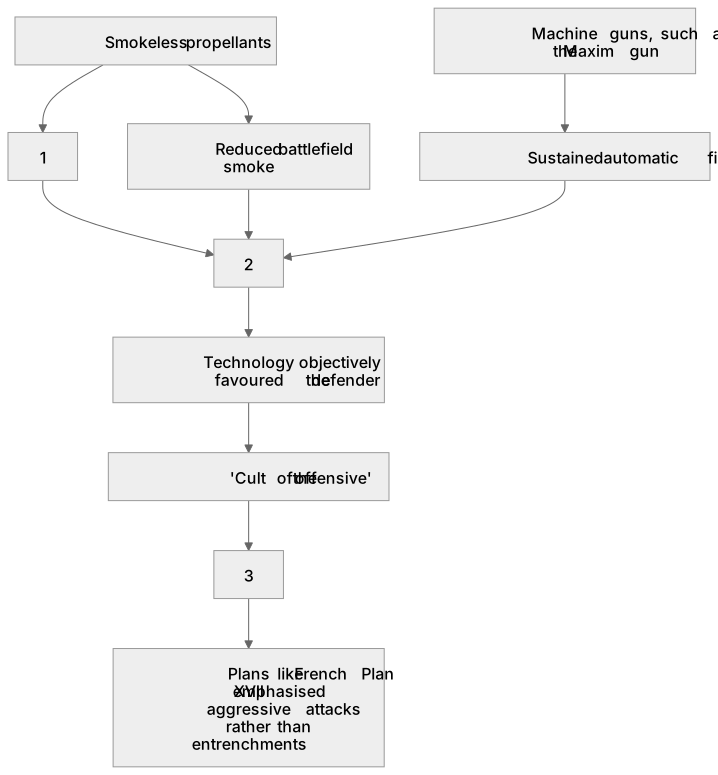
1Box 1
2Box 2
3Box 3
There is more to this lesson
The full lesson goes on to check your understanding and help you earn the marks. Create a free account to carry on, with your progress saved.
A week of Premium from your first lesson · Then the free plan continues · No card, no charge
Test your understanding of Paper 3, Option 37.1: The changing nature of warfare, 1859–1991: perception and reality - 2 Technology of defence: machine guns, smokeless powder and artillery, c1900–16: The impact of the development of smokeless propellants and machine guns before 1914 on military thought and planning.
Active recall beats re-reading. Take an instant quiz now to test what you’ve learned and lock it into long-term memory.
A week of Premium from your first lesson · Then the free plan continues · No card, no charge