Pearson Edexcel · A-Level · History
Course version: 9HI0 · Version from Sept 2015
The changing nature of warfare, 1859–1991: perception and reality - 2…
Full specification wording
Paper 3, Option 37.1: The changing nature of warfare, 1859–1991: perception and reality - 2 Technology of defence: machine guns, smokeless powder and artillery, c1900–16: The impact of French 75mm and German heavies before 1914 on the French Plan XVII and the Schlieffen Plan.
Artillery before 1914 shaped both plans.
Checked against the Pearson Edexcel 9HI0 specification (opens in a new tab) on .
- Point 2 of 3
- 4 key terms
Study notes
From the checked teaching notes for this specification point.
The idea
Artillery before 1914 shaped both plans. The French 75mm field gun was a quick-firing design with a recoil-absorption mechanism, a high rate of fire and accurate shrapnel, ideal for mobile, offensive support. French doctrine therefore stressed the offensive spirit, and Plan XVII committed armies to rapid attacks in Alsace-Lorraine. German heavies, such as 150mm howitzers and the 420mm Big Bertha, were slower but fired heavy high-explosive shells able to smash fortresses. The Schlieffen Plan relied on speed through Belgium, with heavy guns to reduce Belgian and French forts. Each side's artillery thus reflected and reinforced its plan: French light guns suited dash, German heavy guns suited siege and breakthrough.
What earns the marks
- Explains the French 75mm as a quick-firing field gun with a recoil-absorption mechanism, high rate of fire and shrapnel, suited to mobile offensive support.
- Links French artillery doctrine to the offensive spirit and Plan XVII's rapid attacks into Alsace-Lorraine.
- Describes German heavies such as 150mm howitzers and 420mm mortars as slower but capable of destroying fortresses with high-explosive shells.
- Connects German heavy artillery to the Schlieffen Plan's need to reduce Belgian and French forts quickly during the advance.
- Compares the two artillery types: French light and mobile versus German heavy and siege-oriented.
Common mistakes and how to put them right
Treating the French 75mm as a heavy siege gun.
Put it right by describing it as a light, quick-firing field gun.
Assuming German heavies were fast and mobile.
Put it right by noting their weight and slow movement, requiring rail or road transport.
Ignoring the link between artillery and plan timetables.
Put it right by explaining how gun characteristics affected speed of attack or siege.
Exam tips
- Use specific technical terms such as quick-firing, recoil-absorption mechanism, shrapnel and high-explosive to show precise knowledge.
- Always connect each artillery type to the plan it supported, rather than describing technology in isolation.
Try the lesson
The start of the Paper 3, Option 37.1: The changing nature of warfare, 1859–1991: perception and reality - 2 Technology of defence: machine guns, smokeless powder and artillery, c1900–16: The impact of French 75mm and German heavies before 1914 on the French Plan XVII and the Schlieffen Plan. lesson, made from checked teaching notes for this specification point.
Have a go first
Which artillery piece did the French army adopt before 1914 as its principal field gun, prized for a rapid rate of fire?
Listen
Artillery before 1914 shaped both plans. The French 75mm field gun was a quick-firing design with a recoil-absorption mechanism, a high rate of fire and accurate shrapnel, ideal for mobile, offensive support. French doctrine therefore stressed the offensive spirit, and Plan XVII committed armies to rapid attacks in Alsace-Lorraine. German heavies, such as 150mm howitzers and the 420mm Big Bertha, were slower but fired heavy high-explosive shells able to smash fortresses. The Schlieffen Plan relied on speed through Belgium, with heavy guns to reduce Belgian and French forts. Each side's artillery thus reflected and reinforced its plan: French light guns suited dash, German heavy guns suited siege and breakthrough. A strong answer earns marks for these points. Explains the French 75mm as a quick-firing field gun with a recoil-absorption mechanism, high rate of fire and shrapnel, suited to mobile offensive support. Links French artillery doctrine to the offensive spirit and Plan XVII's rapid attacks into Alsace-Lorraine. Describes German heavies such as 150mm howitzers and 420mm mortars as slower but capable of destroying fortresses with high-explosive shells. Connects German heavy artillery to the Schlieffen Plan's need to reduce Belgian and French forts quickly during the advance. A common slip: Treating the French 75mm as a heavy siege gun. Instead, describing it as a light, quick-firing field gun. Exam tip: Use specific technical terms such as quick-firing, recoil-absorption mechanism, shrapnel and high-explosive to show precise knowledge.
See it
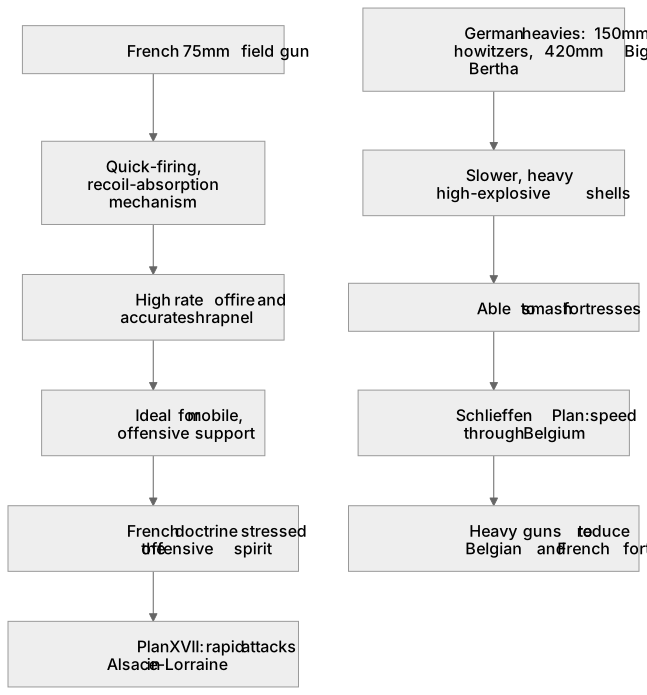
Key words
Say what each word means before you turn the card.
Technology and doctrine
Try answering aloud or in your head before turning the card.
Offensive spirit and Plan XVII
Try answering aloud or in your head before turning the card.
Schlieffen Plan and speed
Try answering aloud or in your head before turning the card.
Siege artillery and fortress reduction
Try answering aloud or in your head before turning the card.
See every definition
- Technology and doctrine
- Artillery before 1914 shaped both plans, each side's guns reflecting and reinforcing its plan.
- Offensive spirit and Plan XVII
- French doctrine stressed the offensive spirit, and Plan XVII committed armies to rapid attacks in Alsace-Lorraine.
- Schlieffen Plan and speed
- Relied on speed through Belgium, with heavy guns to reduce Belgian and French forts.
- Siege artillery and fortress reduction
- German heavies were slower but fired heavy high-explosive shells able to smash fortresses.
Label the diagram
Some boxes have lost their names. Pick the right name for each number.
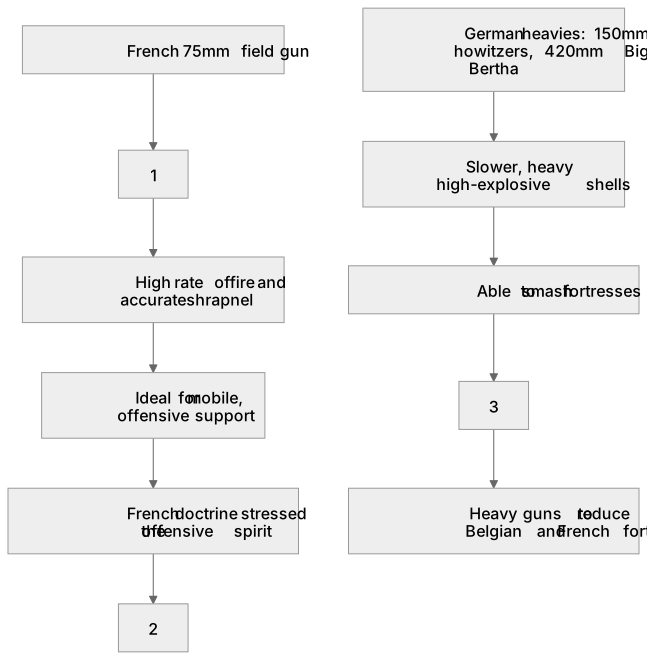
1Box 1
2Box 2
3Box 3
There is more to this lesson
The full lesson goes on to check your understanding and help you earn the marks. Create a free account to carry on, with your progress saved.
A week of Premium from your first lesson · Then the free plan continues · No card, no charge
Test your understanding of Paper 3, Option 37.1: The changing nature of warfare, 1859–1991: perception and reality - 2 Technology of defence: machine guns, smokeless powder and artillery, c1900–16: The impact of French 75mm and German heavies before 1914 on the French Plan XVII and the Schlieffen Plan.
Active recall beats re-reading. Take an instant quiz now to test what you’ve learned and lock it into long-term memory.
A week of Premium from your first lesson · Then the free plan continues · No card, no charge