Pearson Edexcel · A-Level · History
Course version: 9HI0 · Version from Sept 2015
Germany, 1871–1990: united, divided and reunited - 2 The birth of…
Full specification wording
Paper 3, Option 37.2: Germany, 1871–1990: united, divided and reunited - 2 The birth of democratic Germany, 1917–19: Strains of war, tensions and military dictatorship 1917; the roles of Hindenburg and Ludendorff; Erzberger's Peace Resolution, emergence of the Independent Socialist Party.
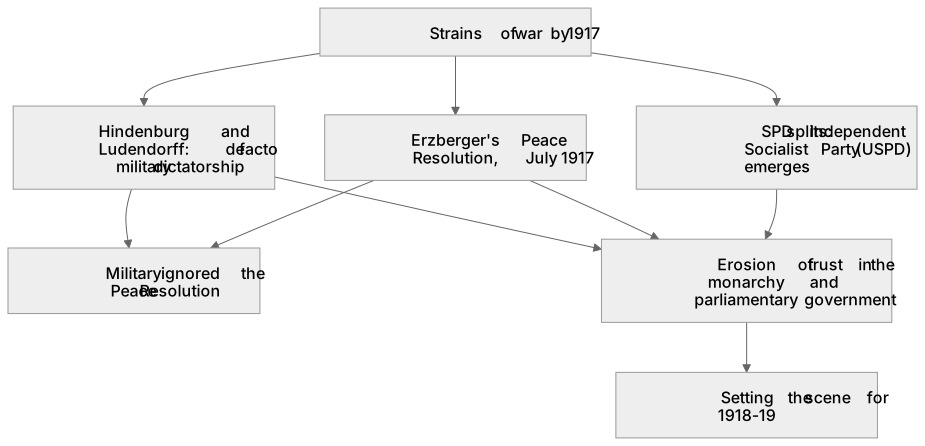
By 1917, total war had strained Germany's economy and society: the Turnip Winter brought hunger, inflation and strikes, while the Auxiliary Service Law conscripted labour.
Checked against the Pearson Edexcel 9HI0 specification (opens in a new tab) on .
- Point 1 of 3
- 4 key terms
Study notes
From the checked teaching notes for this specification point.
The idea
By 1917, total war had strained Germany's economy and society: the Turnip Winter brought hunger, inflation and strikes, while the Auxiliary Service Law conscripted labour. The Kaiser's authority waned as Hindenburg and Ludendorff ran a de facto military dictatorship, dictating policy and forcing Bethmann Hollweg's resignation. In July 1917, Erzberger's Peace Resolution urged a negotiated end without annexations, but the military ignored it. The SPD split when anti-war members formed the Independent Socialist Party (USPD), demanding immediate peace and democratisation. These developments eroded trust in the monarchy and parliamentary government, setting the scene for 1918–19.
What earns the marks
- Explains how the strains of war by 1917, including food shortages, inflation and labour unrest, undermined civilian morale and the Kaiser's prestige.
- Analyses the roles of Hindenburg and Ludendorff in establishing a military dictatorship, including their influence over the Kaiser, the Chancellor and war aims.
- Assesses the significance of Erzberger's Peace Resolution of July 1917 as a parliamentary challenge to military control and annexationist aims.
- Explains the emergence of the Independent Socialist Party (USPD) as a split from the SPD over war credits and peace policy, and its call for immediate peace and democratisation.
- Evaluates the extent to which these developments by 1917 made the collapse of the imperial regime and the birth of democracy more likely.
Common mistakes and how to put them right
Treating the military dictatorship as total and unchallenged.
Put it right: Recognise that the Kaiser, Chancellor and Reichstag still existed, and that the military's power was informal and contested.
Confusing the USPD with the Spartacists or later KPD.
Put it right: The USPD was a broad anti-war socialist party formed in 1917, while the Spartacists were a smaller revolutionary group within it.
Assuming the Peace Resolution ended the war or was accepted by the military.
Put it right: It was a Reichstag vote that the military leadership ignored, and the war continued.
Describing the Turnip Winter as merely a bad harvest.
Put it right: It was a severe food crisis caused by blockade, poor harvests and mismanagement, leading to mass hunger and deaths.
Exam tips
- Use precise dates and names: July 1917 for the Peace Resolution, 1917 for the USPD founding, and distinguish Hindenburg and Ludendorff's roles.
- Link each development to the broader question of how democratic Germany emerged, showing causation and significance rather than listing events.
- When discussing the military dictatorship, weigh its impact against other factors such as economic strain and socialist division to reach a supported judgement.
Try the lesson
The start of the Paper 3, Option 37.2: Germany, 1871–1990: united, divided and reunited - 2 The birth of democratic Germany, 1917–19: Strains of war, tensions and military dictatorship 1917; the roles of Hindenburg and Ludendorff; Erzberger's Peace Resolution, emergence of the Independent Socialist Party. lesson, made from checked teaching notes for this specification point.
Have a go first
Which political party was formed in April 1917 by Social Democrats who opposed the SPD leadership's continued support for the war?
Listen
By 1917, total war had strained Germany's economy and society: the Turnip Winter brought hunger, inflation and strikes, while the Auxiliary Service Law conscripted labour. The Kaiser's authority waned as Hindenburg and Ludendorff ran a de facto military dictatorship, dictating policy and forcing Bethmann Hollweg's resignation. In July 1917, Erzberger's Peace Resolution urged a negotiated end without annexations, but the military ignored it. The SPD split when anti-war members formed the Independent Socialist Party (USPD), demanding immediate peace and democratisation. These developments eroded trust in the monarchy and parliamentary government, setting the scene for 1918–19. A strong answer earns marks for these points. Explains how the strains of war by 1917, including food shortages, inflation and labour unrest, undermined civilian morale and the Kaiser's prestige. Analyses the roles of Hindenburg and Ludendorff in establishing a military dictatorship, including their influence over the Kaiser, the Chancellor and war aims. Assesses the significance of Erzberger's Peace Resolution of July 1917 as a parliamentary challenge to military control and annexationist aims. Explains the emergence of the Independent Socialist Party (USPD) as a split from the SPD over war credits and peace policy, and its call for immediate peace and democratisation. A common slip: Treating the military dictatorship as total and unchallenged. Instead, recognise that the Kaiser, Chancellor and Reichstag still existed, and that the military's power was informal and contested. Exam tip: Use precise dates and names: July 1917 for the Peace Resolution, 1917 for the USPD founding, and distinguish Hindenburg and Ludendorff's roles.
See it
Key words
Say what each word means before you turn the card.
Turnip Winter
Try answering aloud or in your head before turning the card.
Auxiliary Service Law
Try answering aloud or in your head before turning the card.
Peace Resolution
Try answering aloud or in your head before turning the card.
Independent Socialist Party
Try answering aloud or in your head before turning the card.
See every definition
- Turnip Winter
- A severe food crisis caused by blockade, poor harvests and mismanagement, leading to mass hunger and deaths.
- Auxiliary Service Law
- A law that conscripted labour as total war strained Germany's economy and society.
- Peace Resolution
- Erzberger's July 1917 Reichstag vote urging a negotiated end without annexations, which the military leadership ignored.
- Independent Socialist Party
- A broad anti-war socialist party formed in 1917 when the SPD split, demanding immediate peace and democratisation.
Label the diagram
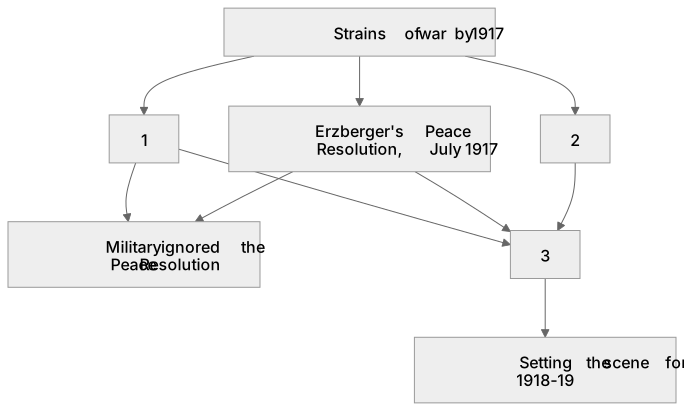
Some boxes have lost their names. Pick the right name for each number.
1Box 1
2Box 2
3Box 3
There is more to this lesson
The full lesson goes on to check your understanding and help you earn the marks. Create a free account to carry on, with your progress saved.
A week of Premium from your first lesson · Then the free plan continues · No card, no charge
Test your understanding of Paper 3, Option 37.2: Germany, 1871–1990: united, divided and reunited - 2 The birth of democratic Germany, 1917–19: Strains of war, tensions and military dictatorship 1917; the roles of Hindenburg and Ludendorff; Erzberger's Peace Resolution, emergence of the Independent Socialist Party.
Active recall beats re-reading. Take an instant quiz now to test what you’ve learned and lock it into long-term memory.
A week of Premium from your first lesson · Then the free plan continues · No card, no charge