Pearson Edexcel · A-Level · History
Course version: 9HI0 · Version from Sept 2015
Germany, 1871–1990: united, divided and reunited - 2 The birth of…
Full specification wording
Paper 3, Option 37.2: Germany, 1871–1990: united, divided and reunited - 2 The birth of democratic Germany, 1917–19: Constitutional reforms from above 1918; the role of Prince Max of Baden; disintegration, defeat and revolution, 1918– 19; the roles of Ebert, Scheidemann and Rosa Luxemburg.
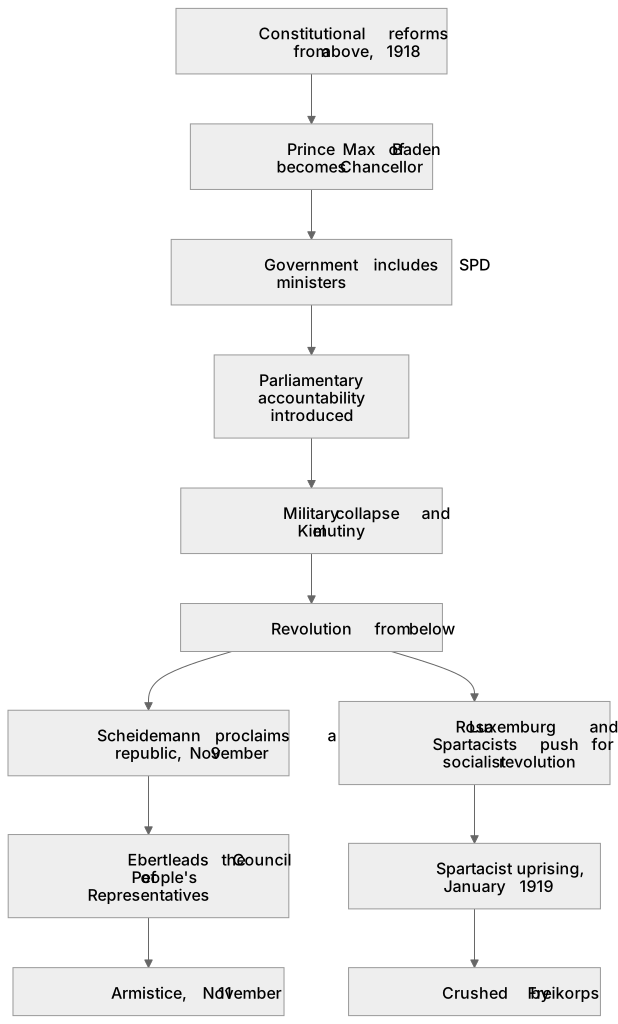
In 1918, facing defeat, the German elite attempted constitutional reforms from above: Prince Max of Baden became Chancellor, formed a government including SPD ministers, and introduced…
Checked against the Pearson Edexcel 9HI0 specification (opens in a new tab) on .
- Point 2 of 3
- 4 key terms
Study notes
From the checked teaching notes for this specification point.
The idea
In 1918, facing defeat, the German elite attempted constitutional reforms from above: Prince Max of Baden became Chancellor, formed a government including SPD ministers, and introduced parliamentary accountability. But military collapse and the Kiel mutiny sparked revolution. On 9 November, Scheidemann proclaimed a republic, and Ebert led the Council of People's Representatives. The armistice followed on 11 November. Meanwhile, Rosa Luxemburg and the Spartacists pushed for a socialist revolution, leading to the Spartacist uprising in January 1919, which was crushed by Freikorps. These events shaped the birth of the Weimar Republic amid defeat, revolution and division.
What earns the marks
- Explains the constitutional reforms from above in 1918, including Prince Max of Baden's chancellorship and the introduction of parliamentary government.
- Analyses the role of Prince Max of Baden in attempting to preserve the monarchy through reform and in negotiating the armistice.
- Explains the disintegration, defeat and revolution of 1918–19, including the Kiel mutiny, the proclamation of the republic and the armistice.
- Assesses the roles of Ebert and Scheidemann in leading the new republic and seeking a moderate parliamentary democracy.
- Evaluates the role of Rosa Luxemburg and the Spartacists in pushing for a socialist revolution and the significance of the Spartacist uprising.
Common mistakes and how to put them right
Confusing the constitutional reforms from above with a revolution from below.
Put it right: The reforms were initiated by the elite to save the monarchy, while the revolution came from popular unrest and mutiny.
Assuming Ebert and Scheidemann wanted a socialist revolution.
Put it right: They were moderate socialists who sought parliamentary democracy and opposed radical revolution.
Treating Rosa Luxemburg as a supporter of the Weimar Republic.
Put it right: She was a revolutionary socialist who criticised the SPD leadership and sought a soviet-style republic.
Stating that the Spartacist uprising succeeded.
Put it right: It was crushed by Freikorps and military forces in January 1919, and Luxemburg and Liebknecht were killed.
Exam tips
- Distinguish clearly between reforms from above and revolution from below, using specific evidence such as the October reforms and the Kiel mutiny.
- Compare the aims and methods of Ebert, Scheidemann and Luxemburg to show the range of socialist responses.
- Link the events of 1918–19 to the wider question of how democratic Germany was born, considering continuity and change.
Try the lesson
The start of the Paper 3, Option 37.2: Germany, 1871–1990: united, divided and reunited - 2 The birth of democratic Germany, 1917–19: Constitutional reforms from above 1918; the role of Prince Max of Baden; disintegration, defeat and revolution, 1918– 19; the roles of Ebert, Scheidemann and Rosa Luxemburg. lesson, made from checked teaching notes for this specification point.
Have a go first
Who was appointed Chancellor of Germany in October 1918 to lead the constitutional reforms from above?
Listen
In 1918, facing defeat, the German elite attempted constitutional reforms from above: Prince Max of Baden became Chancellor, formed a government including SPD ministers, and introduced parliamentary accountability. But military collapse and the Kiel mutiny sparked revolution. On 9 November, Scheidemann proclaimed a republic, and Ebert led the Council of People's Representatives. The armistice followed on 11 November. Meanwhile, Rosa Luxemburg and the Spartacists pushed for a socialist revolution, leading to the Spartacist uprising in January 1919, which was crushed by Freikorps. These events shaped the birth of the Weimar Republic amid defeat, revolution and division. A strong answer earns marks for these points. Explains the constitutional reforms from above in 1918, including Prince Max of Baden's chancellorship and the introduction of parliamentary government. Analyses the role of Prince Max of Baden in attempting to preserve the monarchy through reform and in negotiating the armistice. Explains the disintegration, defeat and revolution of 1918–19, including the Kiel mutiny, the proclamation of the republic and the armistice. Assesses the roles of Ebert and Scheidemann in leading the new republic and seeking a moderate parliamentary democracy. A common slip: Confusing the constitutional reforms from above with a revolution from below. Instead, the reforms were initiated by the elite to save the monarchy, while the revolution came from popular unrest and mutiny. Exam tip: Distinguish clearly between reforms from above and revolution from below, using specific evidence such as the October reforms and the Kiel mutiny.
See it
Key words
Say what each word means before you turn the card.
Reform from above versus revolution from below
Try answering aloud or in your head before turning the card.
Defeat and the collapse of the imperial regime
Try answering aloud or in your head before turning the card.
Competing visions of democracy and socialism
Try answering aloud or in your head before turning the card.
The role of individuals in shaping the new republic
Try answering aloud or in your head before turning the card.
See every definition
- Reform from above versus revolution from below
- The elite initiated constitutional reforms to save the monarchy, while the revolution came from popular unrest and mutiny.
- Defeat and the collapse of the imperial regime
- Facing defeat, military collapse and the Kiel mutiny sparked revolution, and on 9 November Scheidemann proclaimed a republic.
- Competing visions of democracy and socialism
- Ebert and Scheidemann were moderate socialists who sought parliamentary democracy, while Rosa Luxemburg and the Spartacists pushed for a socialist revolution.
- The role of individuals in shaping the new republic
- Prince Max of Baden became Chancellor, Ebert led the Council of People's Representatives, and Rosa Luxemburg pushed for socialist revolution.
Label the diagram
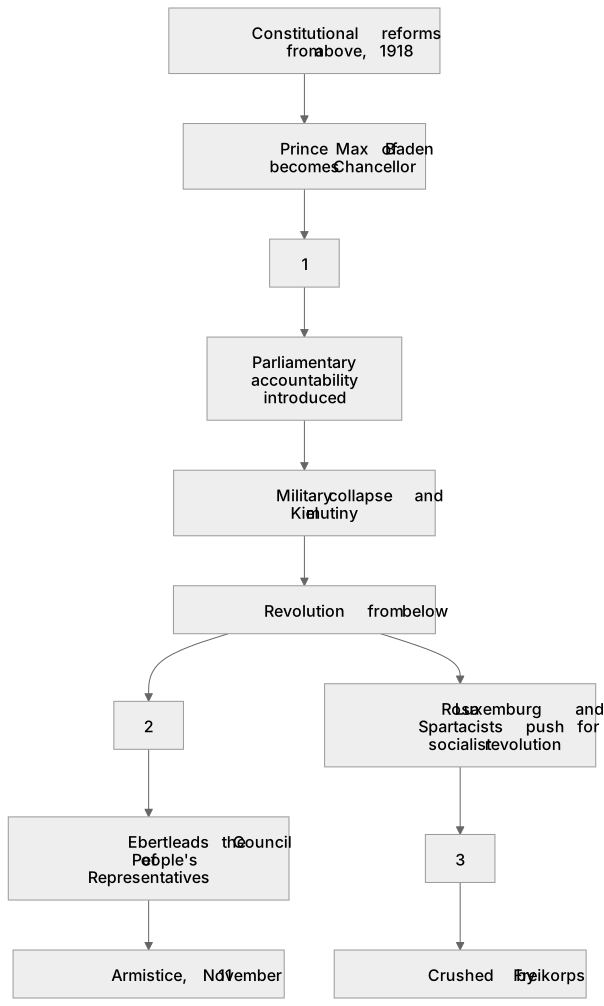
Some boxes have lost their names. Pick the right name for each number.
1Box 1
2Box 2
3Box 3
There is more to this lesson
The full lesson goes on to check your understanding and help you earn the marks. Create a free account to carry on, with your progress saved.
A week of Premium from your first lesson · Then the free plan continues · No card, no charge
Test your understanding of Paper 3, Option 37.2: Germany, 1871–1990: united, divided and reunited - 2 The birth of democratic Germany, 1917–19: Constitutional reforms from above 1918; the role of Prince Max of Baden; disintegration, defeat and revolution, 1918– 19; the roles of Ebert, Scheidemann and Rosa Luxemburg.
Active recall beats re-reading. Take an instant quiz now to test what you’ve learned and lock it into long-term memory.
A week of Premium from your first lesson · Then the free plan continues · No card, no charge