Pearson Edexcel · A-Level · History
Course version: 9HI0 · Version from Sept 2015
Germany, 1871–1990: united, divided and reunited - 2 The birth of…
Full specification wording
Paper 3, Option 37.2: Germany, 1871–1990: united, divided and reunited - 2 The birth of democratic Germany, 1917–19: The attempt to achieve unity through democracy: the Weimar Republic; the importance of the Weimar Constitution including its salient features and their strengths and potential weaknesses for achieving freedom and stability.
After 1918 the new Weimar Republic tried to unite Germany through democracy rather than monarchy.
Checked against the Pearson Edexcel 9HI0 specification (opens in a new tab) on .
- Point 3 of 3
- 4 key terms
Study notes
From the checked teaching notes for this specification point.
The idea
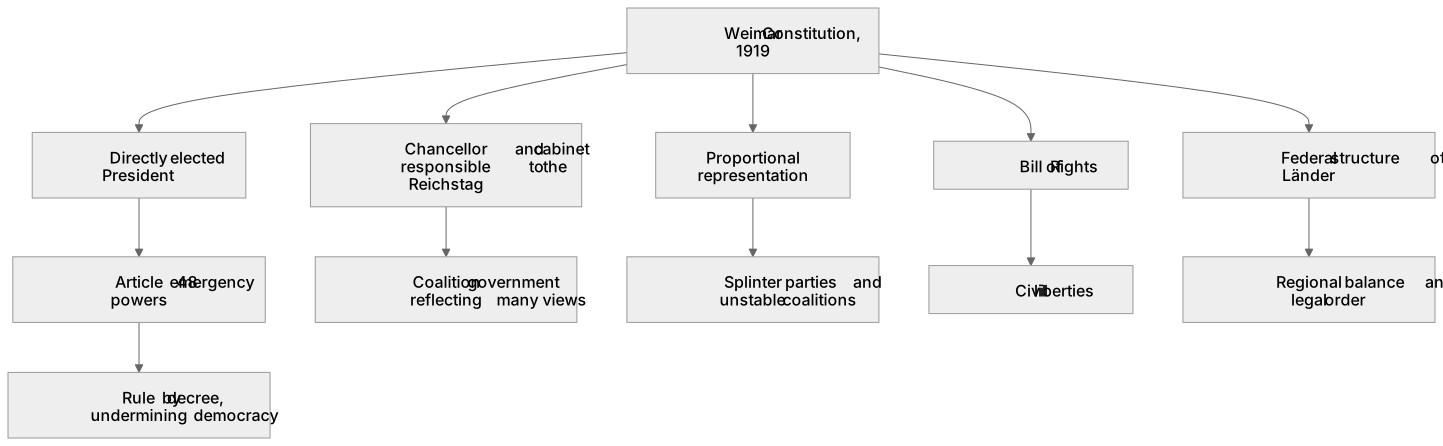
After 1918 the new Weimar Republic tried to unite Germany through democracy rather than monarchy. Its Constitution, drafted 1919, had salient features: a directly elected President with emergency Article 48 powers; a Chancellor and cabinet responsible to the Reichstag; proportional representation; a Bill of Rights; and a federal structure of Länder. Strengths for freedom and stability included universal suffrage, civil liberties, and coalition government reflecting many views. Potential weaknesses included unstable coalitions, splinter parties, and Article 48 allowing presidential rule by decree. Example: in 1923 hyperinflation and revolts tested these features; in 1930–33 Article 48 was used extensively, undermining democracy.
What earns the marks
- Explains that the Weimar Republic was the democratic state created in 1919 after the Kaiser's abdication, aiming to unify Germany on popular sovereignty rather than monarchy.
- Identifies salient features: directly elected President, Chancellor responsible to the Reichstag, proportional representation, Bill of Rights, and federal Länder.
- Assesses strengths for freedom: universal suffrage, civil liberties, and representative government gave citizens rights and a voice.
- Assesses strengths for stability: a written constitution and federal structure provided legal order and regional balance.
- Assesses weaknesses for stability: proportional representation produced fragmented Reichstag and unstable coalitions.
- Assesses weaknesses for freedom: Article 48 emergency powers allowed rule by decree, suspending normal parliamentary process.
Common mistakes and how to put them right
Treating the Constitution as either wholly strong or wholly weak.
Put it right: Weigh strengths and weaknesses for both freedom and stability.
Confusing the Weimar Constitution with the later Basic Law of 1949.
Put it right: Date Weimar features to 1919 and keep them distinct.
Assuming Article 48 was always destructive.
Put it right: Note it was used in emergencies such as 1923 but became destabilising when used routinely after 1930.
Exam tips
- Link each constitutional feature directly to freedom or stability, using precise terms such as proportional representation and Article 48.
- Use short case examples, such as the 1923 crises or the 1930–33 presidential cabinets, to test whether features helped or harmed.
- Reach a judgement on whether the Constitution's design or the political context mattered more for the Republic's survival.
Try the lesson
The start of the Paper 3, Option 37.2: Germany, 1871–1990: united, divided and reunited - 2 The birth of democratic Germany, 1917–19: The attempt to achieve unity through democracy: the Weimar Republic; the importance of the Weimar Constitution including its salient features and their strengths and potential weaknesses for achieving freedom and stability. lesson, made from checked teaching notes for this specification point.
Have a go first
Under the Weimar Constitution, which method was used to elect the President of the Republic?
Listen
After 1918 the new Weimar Republic tried to unite Germany through democracy rather than monarchy. Its Constitution, drafted 1919, had salient features: a directly elected President with emergency Article 48 powers; a Chancellor and cabinet responsible to the Reichstag; proportional representation; a Bill of Rights; and a federal structure of Länder. Strengths for freedom and stability included universal suffrage, civil liberties, and coalition government reflecting many views. Potential weaknesses included unstable coalitions, splinter parties, and Article 48 allowing presidential rule by decree. Example: in 1923 hyperinflation and revolts tested these features; in 1930–33 Article 48 was used extensively, undermining democracy. A strong answer earns marks for these points. Explains that the Weimar Republic was the democratic state created in 1919 after the Kaiser's abdication, aiming to unify Germany on popular sovereignty rather than monarchy. Identifies salient features: directly elected President, Chancellor responsible to the Reichstag, proportional representation, Bill of Rights, and federal Länder. Assesses strengths for freedom: universal suffrage, civil liberties, and representative government gave citizens rights and a voice. Assesses strengths for stability: a written constitution and federal structure provided legal order and regional balance. A common slip: Treating the Constitution as either wholly strong or wholly weak. Instead, weigh strengths and weaknesses for both freedom and stability. Exam tip: Link each constitutional feature directly to freedom or stability, using precise terms such as proportional representation and Article 48.
See it
Key words
Say what each word means before you turn the card.
Democracy and legitimacy
Try answering aloud or in your head before turning the card.
Constitutional design and stability
Try answering aloud or in your head before turning the card.
Freedom and civil rights
Try answering aloud or in your head before turning the card.
Federalism and emergency powers
Try answering aloud or in your head before turning the card.
See every definition
- Democracy and legitimacy
- The attempt to achieve unity through democracy, with the Weimar Republic aiming to unify Germany on popular sovereignty rather than monarchy.
- Constitutional design and stability
- The 1919 Constitution's salient features, whose strengths for stability included a written constitution and federal structure providing legal order and regional balance.
- Freedom and civil rights
- Strengths for freedom included universal suffrage, civil liberties and representative government giving citizens rights and a voice, while Article 48 allowed rule by decree.
- Federalism and emergency powers
- A federal structure of Länder provided regional balance, while Article 48 emergency powers allowed presidential rule by decree, suspending normal parliamentary process.
Label the diagram
Some boxes have lost their names. Pick the right name for each number.
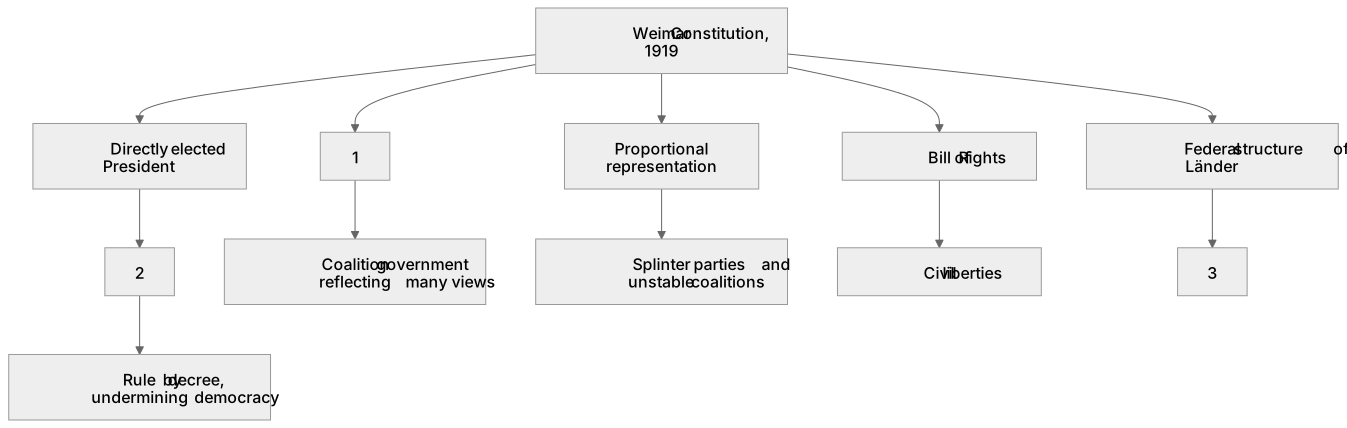
1Box 1
2Box 2
3Box 3
There is more to this lesson
The full lesson goes on to check your understanding and help you earn the marks. Create a free account to carry on, with your progress saved.
A week of Premium from your first lesson · Then the free plan continues · No card, no charge
Test your understanding of Paper 3, Option 37.2: Germany, 1871–1990: united, divided and reunited - 2 The birth of democratic Germany, 1917–19: The attempt to achieve unity through democracy: the Weimar Republic; the importance of the Weimar Constitution including its salient features and their strengths and potential weaknesses for achieving freedom and stability.
Active recall beats re-reading. Take an instant quiz now to test what you’ve learned and lock it into long-term memory.
A week of Premium from your first lesson · Then the free plan continues · No card, no charge