Pearson Edexcel · A-Level · History
Course version: 9HI0 · Version from Sept 2015
Germany, 1871–1990: united, divided and reunited - 5 Reunification:…
Full specification wording
Paper 3, Option 37.2: Germany, 1871–1990: united, divided and reunited - 5 Reunification: recreating a united Germany, 1989–90: Reasons for the flood of refugees from the GDR in 1989.
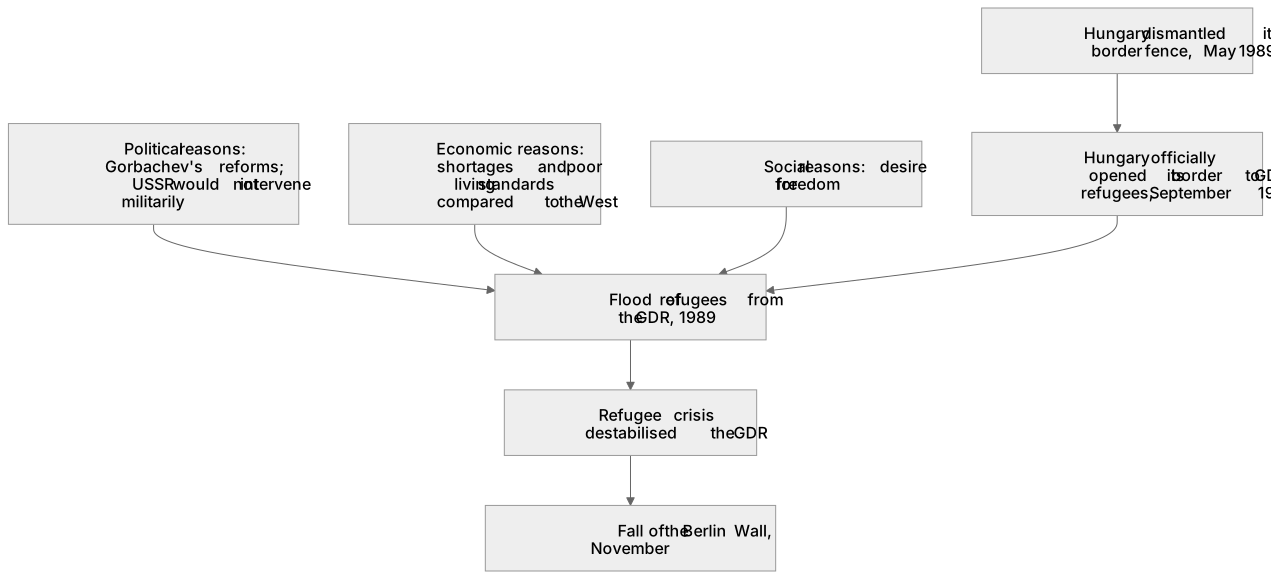
The flood of refugees from the GDR in 1989 was driven by political, economic, and social reasons.
Checked against the Pearson Edexcel 9HI0 specification (opens in a new tab) on .
- Point 1 of 3
- 3 key terms
Study notes
From the checked teaching notes for this specification point.
The idea
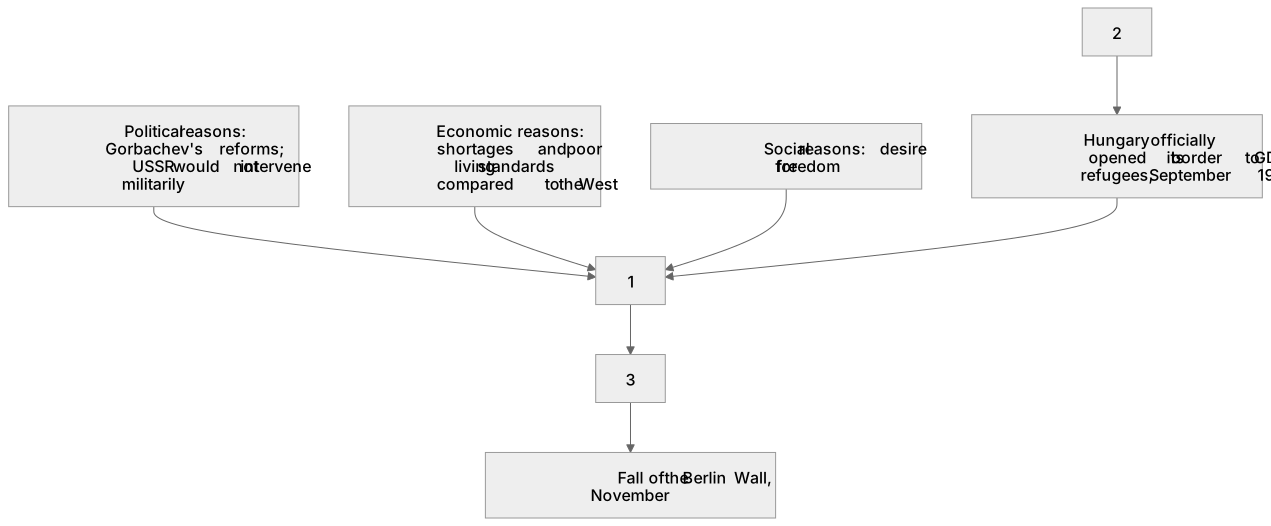
The flood of refugees from the GDR in 1989 was driven by political, economic, and social reasons. Politically, Gorbachev's reforms signalled that the USSR would not intervene militarily, emboldening opposition. Economically, the GDR suffered from shortages and poor living standards compared to the West. Socially, the desire for freedom created momentum. Crucially, Hungary dismantled its border fence in May 1989 and officially opened its border to GDR refugees in September 1989. Thousands of East Germans fled via Hungary and Czechoslovakia. The refugee crisis destabilised the GDR, leading to the fall of the Berlin Wall in November. The reasons are interlinked: political liberalisation, economic disparity, and the demonstration effect.
What earns the marks
- Explains the role of Gorbachev's reforms and the Soviet refusal to use force, which removed the fear of repression.
- Analyses the economic push factors, such as shortages, poor housing, and the contrast with West German prosperity.
- Discusses the social and political pull factors, including the desire for freedom and the opening of the Hungarian border to GDR refugees in September 1989.
- Uses specific examples, such as the mass exodus through Hungary and the Prague embassy crisis, to illustrate the flood of refugees.
- Evaluates the consequences, such as the destabilisation of the GDR and the pressure for reform leading to the fall of the Wall.
Common mistakes and how to put them right
Attributing the refugee flood solely to economic reasons.
Put it right: Adopt a multi-causal approach.
Inaccurately dating the opening of the Hungarian border for East German refugees to May 1989.
Put it right: May was the start of fence dismantling, but the effective opening for GDR refugees was September 1989.
Ignoring the role of Gorbachev.
Put it right: Include the Soviet factor explicitly.
Exam tips
- Structure your answer around political, economic, and social reasons, with clear topic sentences.
- Use specific events and dates, such as the opening of the Hungarian border (September 1989) and the Prague embassy crisis, to support your analysis.
Try the lesson
The start of the Paper 3, Option 37.2: Germany, 1871–1990: united, divided and reunited - 5 Reunification: recreating a united Germany, 1989–90: Reasons for the flood of refugees from the GDR in 1989. lesson, made from checked teaching notes for this specification point.
Have a go first
What was a primary external catalyst for the sudden flood of refugees leaving the German Democratic Republic (GDR) in the summer of 1989?
Listen
The flood of refugees from the GDR in 1989 was driven by political, economic, and social reasons. Politically, Gorbachev's reforms signalled that the USSR would not intervene militarily, emboldening opposition. Economically, the GDR suffered from shortages and poor living standards compared to the West. Socially, the desire for freedom created momentum. Crucially, Hungary dismantled its border fence in May 1989 and officially opened its border to GDR refugees in September 1989. Thousands of East Germans fled via Hungary and Czechoslovakia. The refugee crisis destabilised the GDR, leading to the fall of the Berlin Wall in November. The reasons are interlinked: political liberalisation, economic disparity, and the demonstration effect. A strong answer earns marks for these points. Explains the role of Gorbachev's reforms and the Soviet refusal to use force, which removed the fear of repression. Analyses the economic push factors, such as shortages, poor housing, and the contrast with West German prosperity. Discusses the social and political pull factors, including the desire for freedom and the opening of the Hungarian border to GDR refugees in September 1989. Uses specific examples, such as the mass exodus through Hungary and the Prague embassy crisis, to illustrate the flood of refugees. A common slip: Attributing the refugee flood solely to economic reasons: political and social factors were equally important. Instead, adopt a multi-causal approach. Exam tip: Structure your answer around political, economic, and social reasons, with clear topic sentences.
See it
Key words
Say what each word means before you turn the card.
Push and pull factors in migration
Try answering aloud or in your head before turning the card.
The impact of Soviet reforms on Eastern Europe
Try answering aloud or in your head before turning the card.
Economic disparity between East and West
Try answering aloud or in your head before turning the card.
See every definition
- Push and pull factors in migration
- Economic push factors such as shortages and poor housing, and social and political pull factors including the desire for freedom, together drove the flood of refugees.
- The impact of Soviet reforms on Eastern Europe
- Gorbachev's reforms signalled that the USSR would not intervene militarily, emboldening opposition and removing the fear of repression.
- Economic disparity between East and West
- The GDR suffered from shortages and poor living standards compared to the West, which acted as an economic push factor.
Label the diagram
Some boxes have lost their names. Pick the right name for each number.
1Box 1
2Box 2
3Box 3
There is more to this lesson
The full lesson goes on to check your understanding and help you earn the marks. Create a free account to carry on, with your progress saved.
A week of Premium from your first lesson · Then the free plan continues · No card, no charge
Test your understanding of Paper 3, Option 37.2: Germany, 1871–1990: united, divided and reunited - 5 Reunification: recreating a united Germany, 1989–90: Reasons for the flood of refugees from the GDR in 1989.
Active recall beats re-reading. Take an instant quiz now to test what you’ve learned and lock it into long-term memory.
A week of Premium from your first lesson · Then the free plan continues · No card, no charge