Pearson Edexcel · A-Level · History
Course version: 9HI0 · Version from Sept 2015
Germany, 1871–1990: united, divided and reunited - 5 Reunification:…
Full specification wording
Paper 3, Option 37.2: Germany, 1871–1990: united, divided and reunited - 5 Reunification: recreating a united Germany, 1989–90: The revolution in the GDR 1989, and its impact on the FRG; the significance of Kohl's Ten Point Plan.
The 1989 revolution in the GDR began with mass protests and the regime's loss of control.
Checked against the Pearson Edexcel 9HI0 specification (opens in a new tab) on .
- Point 2 of 3
- 4 key terms
Study notes
From the checked teaching notes for this specification point.
The idea
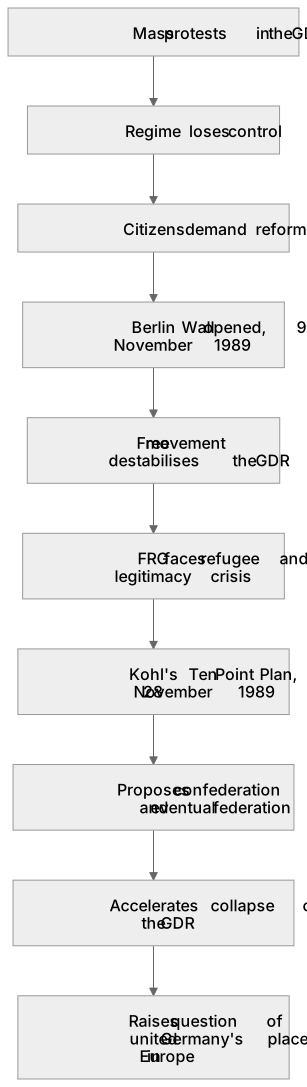
The 1989 revolution in the GDR began with mass protests and the regime's loss of control. Citizens demanded reform, and the opening of the Berlin Wall on 9 November allowed free movement. This destabilised the GDR and confronted the FRG with a refugee and legitimacy crisis. Chancellor Kohl responded on 28 November with a Ten Point Plan for overcoming the division of Germany and Europe. It proposed confederation and eventual federation, but not immediate unification. The plan shaped FRG policy, reassured allies and accelerated the collapse of the GDR. It also raised the question of a united Germany's place in Europe, making the plan significant for the reunification process.
What earns the marks
- Explains how the revolution in the GDR developed in 1989, including the role of mass protests, the reform movement, and the opening of the Berlin Wall on 9 November.
- Analyses the impact of the GDR revolution on the FRG, such as the refugee crisis, pressure on the FRG government, and the opportunity to pursue reunification.
- Explains the content and aims of Kohl's Ten Point Plan of 28 November 1989, including confederation and the goal of a federal united Germany.
- Assesses the significance of the Ten Point Plan for the reunification process, including its effect on the GDR, the FRG, and the Four Powers.
- Uses specific evidence, such as the Monday demonstrations in Leipzig, the New Forum, the fall of the Wall, and the Ten Point Plan, to support arguments.
Common mistakes and how to put them right
Treating the revolution in the GDR as a single event rather than a process.
Put it right: Show how protests, the regime's loss of authority, and the Wall's opening interacted over 1989.
Assuming Kohl's Ten Point Plan immediately called for a single German state.
Put it right: Explain that it proposed confederation and a longer-term federation, which was more cautious than immediate unification.
Ignoring the impact of the GDR revolution on the FRG.
Put it right: Discuss how the refugee movement and the GDR's instability forced the FRG to respond politically and economically.
Exam tips
- Plan your answer around the three parts of the statement: the revolution, its impact on the FRG, and the significance of the Ten Point Plan.
- Use precise dates and terms, such as 9 November 1989 and 28 November 1989, to show secure knowledge.
- When assessing significance, weigh short-term and long-term effects, and consider different perspectives, including those of the FRG, the GDR, and the Four Powers.
Try the lesson
The start of the Paper 3, Option 37.2: Germany, 1871–1990: united, divided and reunited - 5 Reunification: recreating a united Germany, 1989–90: The revolution in the GDR 1989, and its impact on the FRG; the significance of Kohl's Ten Point Plan. lesson, made from checked teaching notes for this specification point.
Have a go first
In which month of 1989 did the East German authorities open the Berlin Wall and its crossing points?
Listen
The 1989 revolution in the GDR began with mass protests and the regime's loss of control. Citizens demanded reform, and the opening of the Berlin Wall on 9 November allowed free movement. This destabilised the GDR and confronted the FRG with a refugee and legitimacy crisis. Chancellor Kohl responded on 28 November with a Ten Point Plan for overcoming the division of Germany and Europe. It proposed confederation and eventual federation, but not immediate unification. The plan shaped FRG policy, reassured allies and accelerated the collapse of the GDR. It also raised the question of a united Germany's place in Europe, making the plan significant for the reunification process. A strong answer earns marks for these points. Explains how the revolution in the GDR developed in 1989, including the role of mass protests, the reform movement, and the opening of the Berlin Wall on 9 November. Analyses the impact of the GDR revolution on the FRG, such as the refugee crisis, pressure on the FRG government, and the opportunity to pursue reunification. Explains the content and aims of Kohl's Ten Point Plan of 28 November 1989, including confederation and the goal of a federal united Germany. Assesses the significance of the Ten Point Plan for the reunification process, including its effect on the GDR, the FRG, and the Four Powers. A common slip: treating the revolution in the GDR as a single event rather than a process. Instead, show how protests, the regime's loss of authority, and the Wall's opening interacted over 1989. Exam tip: Plan your answer around the three parts of the statement: the revolution, its impact on the FRG, and the significance of the Ten Point Plan.
See it
Key words
Say what each word means before you turn the card.
Revolution and protest in the GDR
Try answering aloud or in your head before turning the card.
Impact of the GDR crisis on the FRG
Try answering aloud or in your head before turning the card.
Kohl's Ten Point Plan and its aims
Try answering aloud or in your head before turning the card.
Significance for the reunification process
Try answering aloud or in your head before turning the card.
See every definition
- Revolution and protest in the GDR
- A process beginning with mass protests and the regime's loss of control, in which citizens demanded reform and the Berlin Wall opened on 9 November.
- Impact of the GDR crisis on the FRG
- The destabilising of the GDR confronted the FRG with a refugee and legitimacy crisis, forcing it to respond politically and economically.
- Kohl's Ten Point Plan and its aims
- A response of 28 November for overcoming the division of Germany and Europe, proposing confederation and eventual federation, but not immediate unification.
- Significance for the reunification process
- The plan shaped FRG policy, reassured allies, accelerated the collapse of the GDR and raised the question of a united Germany's place in Europe.
Label the diagram
Some boxes have lost their names. Pick the right name for each number.
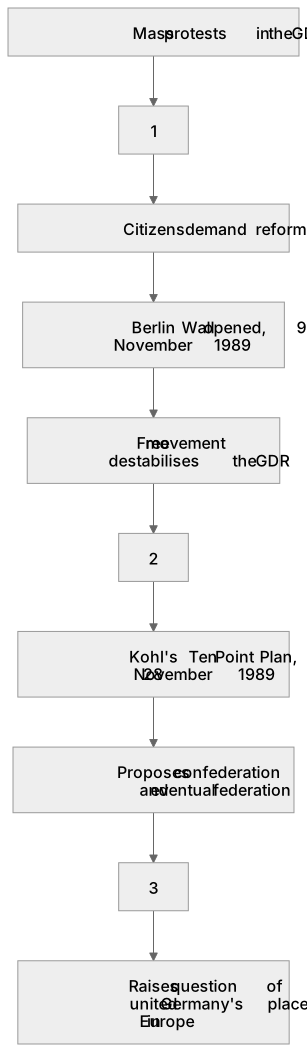
1Box 1
2Box 2
3Box 3
There is more to this lesson
The full lesson goes on to check your understanding and help you earn the marks. Create a free account to carry on, with your progress saved.
A week of Premium from your first lesson · Then the free plan continues · No card, no charge
Test your understanding of Paper 3, Option 37.2: Germany, 1871–1990: united, divided and reunited - 5 Reunification: recreating a united Germany, 1989–90: The revolution in the GDR 1989, and its impact on the FRG; the significance of Kohl's Ten Point Plan.
Active recall beats re-reading. Take an instant quiz now to test what you’ve learned and lock it into long-term memory.
A week of Premium from your first lesson · Then the free plan continues · No card, no charge