Pearson Edexcel · A-Level · History
Course version: 9HI0 · Version from Sept 2015
The making of modern Russia, 1855–1991 - 1 The changing status and…
Full specification wording
Paper 3, Option 38.1: The making of modern Russia, 1855–1991 - 1 The changing status and condition of the peasantry: The impact of changes in government policy, 1855–1991 (key developments: the abolition of serfdom 1861, Stolypin's reforms 1906–11, the Land Decree 1917, NEP 1921, collectivisation 1928–32, the increase in state farms (sovkhoz) at the expense of kholkhoz after 1945).
This topic examines how state policy reshaped the peasantry from 1855 to 1991.
Checked against the Pearson Edexcel 9HI0 specification (opens in a new tab) on .
- Point 1 of 2
- 4 key terms
Study notes
From the checked teaching notes for this specification point.
The idea
This topic examines how state policy reshaped the peasantry from 1855 to 1991. The 1861 abolition of serfdom freed peasants but tied them to land and redemption payments. Stolypin's reforms (1906–11) encouraged private farming and land consolidation to create a prosperous class. The 1917 Land Decree legitimised peasant seizures and abolished landlord property. The 1921 NEP replaced requisitioning with a tax in kind, allowing limited markets. Collectivisation (1928–32) forced peasants into kolkhozy and eliminated kulaks. After 1945, state farms (sovkhozy) expanded at the expense of collective farms (kolkhozy), increasing state control. Assess impact by comparing intended aims with outcomes for peasants' status, condition and productivity.
What earns the marks
- Explains the 1861 abolition of serfdom: peasants gained legal freedom but remained tied to the commune and burdened by redemption payments, limiting real improvement.
- Analyses Stolypin's reforms 1906–11: aimed to create a class of independent farmers; some prospered, but many peasants remained in repartitional communes and reform was incomplete.
- Assesses the 1917 Land Decree: legitimised peasant land seizures, redistributed land, but did not resolve rural poverty or increase productivity significantly.
- Evaluates NEP 1921: replaced grain requisitioning with a tax in kind, allowing peasants to sell surpluses; recovery followed, but tensions remained over pricing and procurement.
- Examines collectivisation 1928–32: forced consolidation into kolkhozy, dekulakisation, and state procurement; caused resistance, famine, and long-term inefficiency.
- Explains post-1945 increase in sovkhozy at the expense of kolkhozy: state farms expanded, often on marginal land, increasing state control but not necessarily improving output.
Common mistakes and how to put them right
Treating the 1861 abolition as an immediate improvement for all peasants.
Put it right: Recognise that redemption payments and communal constraints limited benefits for many.
Assuming Stolypin's reforms transformed the entire peasantry.
Put it right: Note that only a minority became independent farmers, and reform was cut short by his assassination and later war.
Confusing kolkhozy and sovkhozy.
Put it right: Kolkhozy were collective farms nominally owned by peasants, while sovkhozy were state farms where workers were employees.
Overstating the success of NEP for peasants.
Put it right: Acknowledge recovery but also the 'scissors crisis' and procurement difficulties that strained peasant-state relations.
Exam tips
- Plan essays by grouping policies chronologically or thematically (e.g., freedom vs control, economic vs political aims) to show change over time.
- Use precise dates and terms (e.g., 1861, 1906–11, 1917, 1921, 1928–32, sovkhoz, kolkhoz) to demonstrate secure knowledge.
- When assessing impact, weigh intended aims against actual outcomes for peasants' status, living standards and productivity, and reach a substantiated judgement.
Try the lesson
The start of the Paper 3, Option 38.1: The making of modern Russia, 1855–1991 - 1 The changing status and condition of the peasantry: The impact of changes in government policy, 1855–1991 (key developments: the abolition of serfdom 1861, Stolypin's reforms 1906–11, the Land Decree 1917, NEP 1921, collectivisation 1928–32, the increase in state farms (sovkhoz) at the expense of kholkhoz after 1945). lesson, made from checked teaching notes for this specification point.
Have a go first
Which government policy of 1861 ended the legal ownership of peasants by private landowners in the Russian Empire?
Listen
This topic examines how state policy reshaped the peasantry from 1855 to 1991. The 1861 abolition of serfdom freed peasants but tied them to land and redemption payments. Stolypin's reforms (1906–11) encouraged private farming and land consolidation to create a prosperous class. The 1917 Land Decree legitimised peasant seizures and abolished landlord property. The 1921 NEP replaced requisitioning with a tax in kind, allowing limited markets. Collectivisation (1928–32) forced peasants into kolkhozy and eliminated kulaks. After 1945, state farms (sovkhozy) expanded at the expense of collective farms (kolkhozy), increasing state control. Assess impact by comparing intended aims with outcomes for peasants' status, condition and productivity. A strong answer earns marks for these points. Explains the 1861 abolition of serfdom: peasants gained legal freedom but remained tied to the commune and burdened by redemption payments, limiting real improvement. Analyses Stolypin's reforms 1906–11: aimed to create a class of independent farmers; some prospered, but many peasants remained in repartitional communes and reform was incomplete. Assesses the 1917 Land Decree: legitimised peasant land seizures, redistributed land, but did not resolve rural poverty or increase productivity significantly. Evaluates NEP 1921: replaced grain requisitioning with a tax in kind, allowing peasants to sell surpluses; recovery followed, but tensions remained over pricing and procurement. A common slip: Treating the 1861 abolition as an immediate improvement for all peasants. Instead, recognise that redemption payments and communal constraints limited benefits for many. Exam tip: Plan essays by grouping policies chronologically or thematically (e.g., freedom vs control, economic vs political aims) to show change over time.
See it
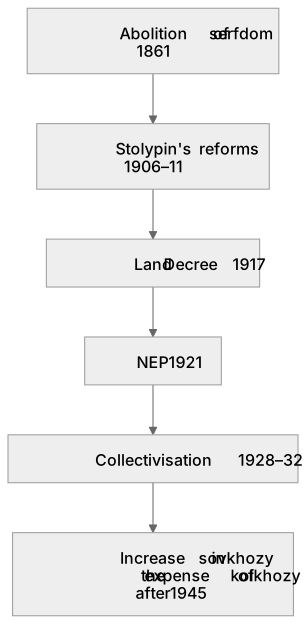
Put it in order
Put these steps in the order they happen.
- 1. Land Decree 1917
- 2. Stolypin's reforms 1906–11
- 3. Abolition of serfdom 1861
- 4. Increase in sovkhozy at the expense of kolkhozy after 1945
- 5. Collectivisation 1928–32
- 6. NEP 1921
Key words
Say what each word means before you turn the card.
State control versus peasant autonomy
Try answering aloud or in your head before turning the card.
Economic productivity and agricultural modernisation
Try answering aloud or in your head before turning the card.
Social hierarchy and class transformation
Try answering aloud or in your head before turning the card.
Ideology and policy implementation
Try answering aloud or in your head before turning the card.
See every definition
- State control versus peasant autonomy
- The tension between government direction of the peasantry and peasants' own independent action, seen across policies from the 1861 abolition to the post-1945 expansion of state farms.
- Economic productivity and agricultural modernisation
- The aim of raising output and modernising farming, pursued through measures such as Stolypin's reforms and collectivisation, though outcomes for productivity varied.
- Social hierarchy and class transformation
- Changes in the rural social structure, including attempts to create a class of independent farmers and the elimination of kulaks during collectivisation.
- Ideology and policy implementation
- The relationship between the aims behind government measures and how they were actually carried out, assessed by comparing intended aims with outcomes for peasants.
Label the diagram
Some boxes have lost their names. Pick the right name for each number.
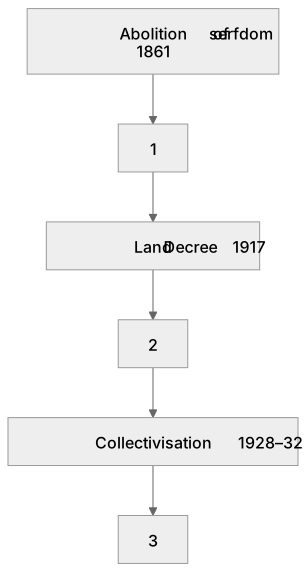
1Box 1
2Box 2
3Box 3
There is more to this lesson
The full lesson goes on to check your understanding and help you earn the marks. Create a free account to carry on, with your progress saved.
A week of Premium from your first lesson · Then the free plan continues · No card, no charge
Test your understanding of Paper 3, Option 38.1: The making of modern Russia, 1855–1991 - 1 The changing status and condition of the peasantry: The impact of changes in government policy, 1855–1991 (key developments: the abolition of serfdom 1861, Stolypin's reforms 1906–11, the Land Decree 1917, NEP 1921, collectivisation 1928–32, the increase in state farms (sovkhoz) at the expense of kholkhoz after 1945).
Active recall beats re-reading. Take an instant quiz now to test what you’ve learned and lock it into long-term memory.
A week of Premium from your first lesson · Then the free plan continues · No card, no charge