Pearson Edexcel · A-Level · History
Course version: 9HI0 · Version from Sept 2015
The making of modern Russia, 1855–1991 - 2 Agriculture and productivity:…
Full specification wording
Paper 3, Option 38.1: The making of modern Russia, 1855–1991 - 2 Agriculture and productivity: meeting the country's needs?: Feeding the population, 1861–1991: the extent to which agriculture met the changing demands to feed the populace of countryside and town (key development: the import of western grain, 1972–79).
Agriculture had to feed a growing and urbanising population from 1861 to 1991.
Checked against the Pearson Edexcel 9HI0 specification (opens in a new tab) on .
- Point 2 of 2
- 4 key terms
Study notes
From the checked teaching notes for this specification point.
The idea
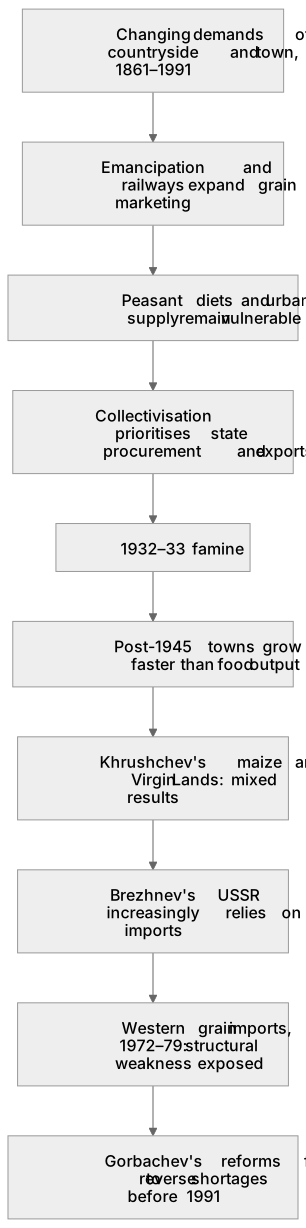
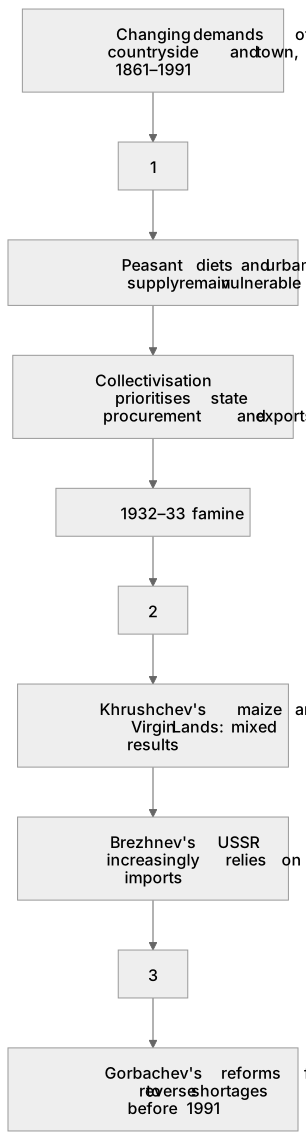
Agriculture had to feed a growing and urbanising population from 1861 to 1991. Emancipation and railways expanded grain marketing, but peasant diets and urban supply remained vulnerable. Collectivisation prioritised state procurement and exports, contributing to the 1932–33 famine. Post-1945, towns grew faster than food output; Khrushchev's maize and Virgin Lands aimed to close the gap, with mixed results. Brezhnev's USSR increasingly relied on imports, and the western grain imports of 1972–79 exposed structural weakness. Gorbachev's reforms failed to reverse shortages before 1991. Success should be judged by availability, affordability and nutrition in countryside and town.
What earns the marks
- Explains the changing demands of countryside and town: population growth, urbanisation and rising expectations of food supply across 1861–1991.
- Assesses the extent to which agriculture met those demands in different periods, using evidence such as grain harvests, procurement and shortages.
- Analyses the significance of western grain imports, 1972–79, as evidence of failure to feed the population from domestic production.
- Evaluates the human consequences of shortfalls, including famine, rationing and reliance on imports, for both rural and urban populations.
- Sustains a judgement on the extent of success, distinguishing between feeding the countryside and feeding the towns.
Common mistakes and how to put them right
Assuming that increased grain production always meant better diets.
Put it right: Consider procurement, distribution and access, especially for peasants.
Treating the 1972–79 imports as a minor episode.
Put it right: Explain that they marked a structural dependence on western grain.
Ignoring the countryside when discussing food supply.
Put it right: Compare rural self-provisioning and poverty with urban rationing and shortages.
Confusing the 1932–33 famine with later shortages.
Put it right: Distinguish the causes and scale of each crisis.
Exam tips
- Define 'feeding the population' in terms of availability, affordability and nutritional adequacy before judging success.
- Use the 1972–79 grain imports as a turning point to structure an argument about long-term failure.
- Compare rural and urban experiences explicitly, using examples such as peasant subsistence versus town rationing.
- Support judgements with named periods and policies, such as collectivisation, the Virgin Lands and Brezhnev's import reliance.
Try the lesson
The start of the Paper 3, Option 38.1: The making of modern Russia, 1855–1991 - 2 Agriculture and productivity: meeting the country's needs?: Feeding the population, 1861–1991: the extent to which agriculture met the changing demands to feed the populace of countryside and town (key development: the import of western grain, 1972–79). lesson, made from checked teaching notes for this specification point.
Have a go first
What major shift in Soviet agricultural trade occurred between 1972 and 1979 to address the failure of domestic farming to meet the population's needs?
Listen
Agriculture had to feed a growing and urbanising population from 1861 to 1991. Emancipation and railways expanded grain marketing, but peasant diets and urban supply remained vulnerable. Collectivisation prioritised state procurement and exports, contributing to the 1932–33 famine. Post-1945, towns grew faster than food output; Khrushchev's maize and Virgin Lands aimed to close the gap, with mixed results. Brezhnev's USSR increasingly relied on imports, and the western grain imports of 1972–79 exposed structural weakness. Gorbachev's reforms failed to reverse shortages before 1991. Success should be judged by availability, affordability and nutrition in countryside and town. A strong answer earns marks for these points. Explains the changing demands of countryside and town: population growth, urbanisation and rising expectations of food supply across 1861–1991. Assesses the extent to which agriculture met those demands in different periods, using evidence such as grain harvests, procurement and shortages. Analyses the significance of western grain imports, 1972–79, as evidence of failure to feed the population from domestic production. Evaluates the human consequences of shortfalls, including famine, rationing and reliance on imports, for both rural and urban populations. A common slip: Assuming that increased grain production always meant better diets. Instead, consider procurement, distribution and access, especially for peasants. Exam tip: Define 'feeding the population' in terms of availability, affordability and nutritional adequacy before judging success.
See it
Key words
Say what each word means before you turn the card.
Changing food demands of countryside and town
Try answering aloud or in your head before turning the card.
Extent of agricultural success in feeding the population
Try answering aloud or in your head before turning the card.
Western grain imports, 1972–79
Try answering aloud or in your head before turning the card.
Famine, shortage and rationing
Try answering aloud or in your head before turning the card.
See every definition
- Changing food demands of countryside and town
- Population growth, urbanisation and rising expectations of food supply across 1861–1991 shaped what the countryside and town required.
- Extent of agricultural success in feeding the population
- Judged by availability, affordability and nutrition in countryside and town, and by whether agriculture met changing demands in different periods.
- Western grain imports, 1972–79
- A key development that exposed structural weakness and marked a structural dependence on western grain as evidence of failure to feed the population from domestic production.
- Famine, shortage and rationing
- Human consequences of shortfalls, including the 1932–33 famine, which should be distinguished from later shortages in causes and scale.
Label the diagram
Some boxes have lost their names. Pick the right name for each number.
1Box 1
2Box 2
3Box 3
There is more to this lesson
The full lesson goes on to check your understanding and help you earn the marks. Create a free account to carry on, with your progress saved.
A week of Premium from your first lesson · Then the free plan continues · No card, no charge
Test your understanding of Paper 3, Option 38.1: The making of modern Russia, 1855–1991 - 2 Agriculture and productivity: meeting the country's needs?: Feeding the population, 1861–1991: the extent to which agriculture met the changing demands to feed the populace of countryside and town (key development: the import of western grain, 1972–79).
Active recall beats re-reading. Take an instant quiz now to test what you’ve learned and lock it into long-term memory.
A week of Premium from your first lesson · Then the free plan continues · No card, no charge