Pearson Edexcel · A-Level · History
Course version: 9HI0 · Version from Sept 2015
The making of modern Russia, 1855–1991 - 2 Agriculture and productivity:…
Full specification wording
Paper 3, Option 38.1: The making of modern Russia, 1855–1991 - 2 Agriculture and productivity: meeting the country's needs?: Reform, innovation and productivity, 1861–1991: the backwardness of peasant agriculture in the nineteenth century (key developments: the impact of railways on the larger estates of the gentry and nobility pre-1914, the drive to modernise under Stalin, Khrushchev's drive to boost productivity – maize mania and the Virgin Lands, attempts to boost productivity under Brezhnev and Gorbachev).
Peasant farming stayed backward after 1861: strip farming, communal repartition, low yields and debt limited innovation.
Checked against the Pearson Edexcel 9HI0 specification (opens in a new tab) on .
- Point 1 of 2
- 3 key terms
Study notes
From the checked teaching notes for this specification point.
The idea
Peasant farming stayed backward after 1861: strip farming, communal repartition, low yields and debt limited innovation. Railways from the 1860s let gentry and nobility estates sell grain commercially, but many still relied on traditional methods and noble debt grew. Stalin's collectivisation (1929–33) imposed kolkhozy and sovkhozy, mechanised via Machine Tractor Stations, yet grain extraction and livestock losses caused famine. Khrushchev promoted maize widely, even in unsuitable climates, and opened the Virgin Lands in Kazakhstan and Siberia; early gains faded as soil eroded. Brezhnev increased fertiliser and irrigation spending but output stagnated and imports rose. Gorbachev sought leasehold contracting and private plots within collective structures, but reform was incomplete before 1991.
What earns the marks
- Explains how serf emancipation in 1861 left peasant agriculture backward: redemption payments, communal land repartition and strip farming discouraged investment and new techniques.
- Assesses the impact of railways on larger gentry and nobility estates before 1914: export routes raised grain sales, but many estates remained indebted and technically conservative.
- Analyses Stalin's drive to modernise: collectivisation, kolkhozy and sovkhozy, Machine Tractor Stations and procurement quotas, with consequences for productivity and rural living standards.
- Evaluates Khrushchev's productivity drive: maize mania and the Virgin Lands scheme, including early successes and later soil exhaustion and climatic failure.
- Compares attempts under Brezhnev and Gorbachev: Brezhnev's investment in fertiliser and irrigation with persistent inefficiency; Gorbachev's leasehold contracting and private plots within collective agriculture.
- Sustains a judgement on continuity and change in reform, innovation and productivity across 1861–1991, using evidence from more than one period.
Common mistakes and how to put them right
Treating the 1861 emancipation as an immediate modernisation of peasant farming.
Put it right: Explain that redemption payments and communal repartition often reinforced backwardness.
Assuming railways automatically transformed all agriculture.
Put it right: Distinguish the commercial gains of larger gentry and nobility estates from the limited change on peasant smallholdings.
Presenting Khrushchev's maize campaign as uniformly successful.
Put it right: Note that maize failed in unsuitable climates and that Virgin Lands gains were eroded by soil exhaustion.
Describing Brezhnev's and Gorbachev's policies as identical.
Put it right: Contrast Brezhnev's input-led investment with Gorbachev's structural experiments such as leasehold contracting.
Exam tips
- Plan by factor: peasant structure, state policy, technology and environment, then judge which best explains persistent low productivity.
- Use precise dates and named schemes, such as 1861 emancipation, 1929–33 collectivisation, 1954 Virgin Lands and 1972–79 grain imports, to anchor analysis.
- When comparing leaders, state the criterion for success, such as grain output, livestock numbers or rural living standards, before reaching a judgement.
- Integrate the key developments into an argument about reform and innovation rather than listing them chronologically.
Try the lesson
The start of the Paper 3, Option 38.1: The making of modern Russia, 1855–1991 - 2 Agriculture and productivity: meeting the country's needs?: Reform, innovation and productivity, 1861–1991: the backwardness of peasant agriculture in the nineteenth century (key developments: the impact of railways on the larger estates of the gentry and nobility pre-1914, the drive to modernise under Stalin, Khrushchev's drive to boost productivity – maize mania and the Virgin Lands, attempts to boost productivity under Brezhnev and Gorbachev). lesson, made from checked teaching notes for this specification point.
Have a go first
Which crop did Nikita Khrushchev intensively promote in the 1950s and 1960s in an attempt to solve Soviet livestock feed shortages, leading to a widely mocked agricultural campaign?
Listen
Peasant farming stayed backward after 1861: strip farming, communal repartition, low yields and debt limited innovation. Railways from the 1860s let gentry and nobility estates sell grain commercially, but many still relied on traditional methods and noble debt grew. Stalin's collectivisation (1929–33) imposed kolkhozy and sovkhozy, mechanised via Machine Tractor Stations, yet grain extraction and livestock losses caused famine. Khrushchev promoted maize widely, even in unsuitable climates, and opened the Virgin Lands in Kazakhstan and Siberia; early gains faded as soil eroded. Brezhnev increased fertiliser and irrigation spending but output stagnated and imports rose. Gorbachev sought leasehold contracting and private plots within collective structures, but reform was incomplete before 1991. A strong answer earns marks for these points. Explains how serf emancipation in 1861 left peasant agriculture backward: redemption payments, communal land repartition and strip farming discouraged investment and new techniques. Assesses the impact of railways on larger gentry and nobility estates before 1914: export routes raised grain sales, but many estates remained indebted and technically conservative. Analyses Stalin's drive to modernise: collectivisation, kolkhozy and sovkhozy, Machine Tractor Stations and procurement quotas, with consequences for productivity and rural living standards. Evaluates Khrushchev's productivity drive: maize mania and the Virgin Lands scheme, including early successes and later soil exhaustion and climatic failure. A common slip: Treating the 1861 emancipation as an immediate modernisation of peasant farming. Instead, explain that redemption payments and communal repartition often reinforced backwardness. Exam tip: Plan by factor: peasant structure, state policy, technology and environment, then judge which best explains persistent low productivity.
See it
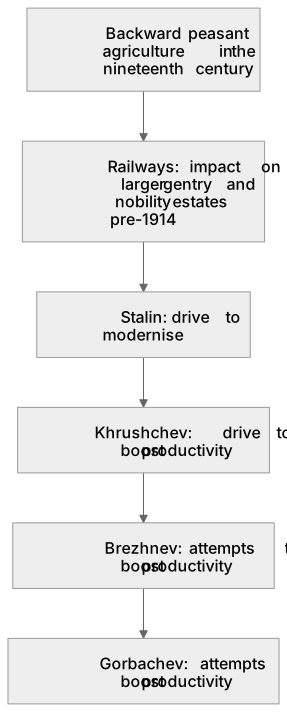
Put it in order
Put these steps in the order they happen.
- 1. Stalin: drive to modernise
- 2. Railways: impact on larger gentry and nobility estates pre-1914
- 3. Backward peasant agriculture in the nineteenth century
- 4. Gorbachev: attempts to boost productivity
- 5. Brezhnev: attempts to boost productivity
- 6. Khrushchev: drive to boost productivity
Put the events in order
Put these events in the order they happened, earliest first.
- 1. Grain imports rose under Brezhnev
- 2. Serf emancipation left peasant agriculture backward
- 3. Khrushchev opened the Virgin Lands scheme
- 4. Stalin's collectivisation imposed kolkhozy and sovkhozy
Key words
Say what each word means before you turn the card.
Backwardness of peasant agriculture
Try answering aloud or in your head before turning the card.
Stalin's modernisation through collectivisation
Try answering aloud or in your head before turning the card.
Khrushchev's maize mania and Virgin Lands
Try answering aloud or in your head before turning the card.
See every definition
- Backwardness of peasant agriculture
- Peasant farming stayed backward after 1861, with strip farming, communal repartition, low yields and debt limiting innovation.
- Stalin's modernisation through collectivisation
- Collectivisation imposed kolkhozy and sovkhozy, mechanised via Machine Tractor Stations, yet grain extraction and livestock losses caused famine.
- Khrushchev's maize mania and Virgin Lands
- Maize was promoted widely, even in unsuitable climates, and the Virgin Lands were opened, but early gains faded as soil eroded.
Label the diagram
Some boxes have lost their names. Pick the right name for each number.
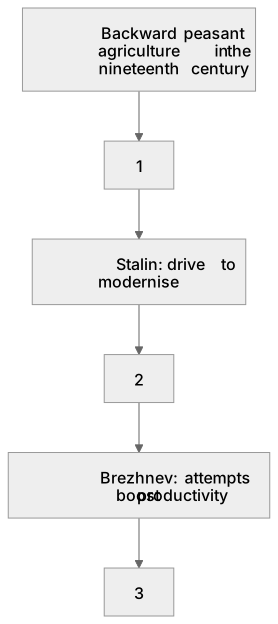
1Box 1
2Box 2
3Box 3
There is more to this lesson
The full lesson goes on to check your understanding and help you earn the marks. Create a free account to carry on, with your progress saved.
A week of Premium from your first lesson · Then the free plan continues · No card, no charge
Test your understanding of Paper 3, Option 38.1: The making of modern Russia, 1855–1991 - 2 Agriculture and productivity: meeting the country's needs?: Reform, innovation and productivity, 1861–1991: the backwardness of peasant agriculture in the nineteenth century (key developments: the impact of railways on the larger estates of the gentry and nobility pre-1914, the drive to modernise under Stalin, Khrushchev's drive to boost productivity – maize mania and the Virgin Lands, attempts to boost productivity under Brezhnev and Gorbachev).
Active recall beats re-reading. Take an instant quiz now to test what you’ve learned and lock it into long-term memory.
A week of Premium from your first lesson · Then the free plan continues · No card, no charge