Pearson Edexcel · A-Level · History
Course version: 9HI0 · Version from Sept 2015
The making of modern Russia, 1855–1991 - 2 Revolution and reform, 1904–06:…
Full specification wording
Paper 3, Option 38.1: The making of modern Russia, 1855–1991 - 2 Revolution and reform, 1904–06: Repression of opposition in town and countryside, including the closure of the St Petersburg and Moscow Soviets.
After the October Manifesto, the government moved to crush remaining opposition.
Checked against the Pearson Edexcel 9HI0 specification (opens in a new tab) on .
- Point 3 of 3
- 2 key terms
Study notes
From the checked teaching notes for this specification point.
The idea
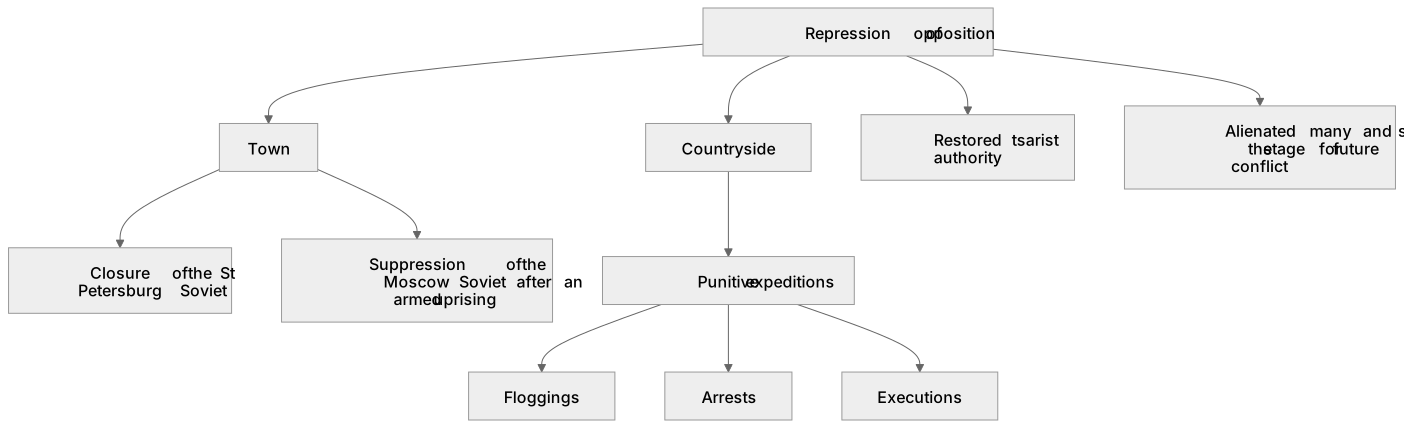
After the October Manifesto, the government moved to crush remaining opposition. In December 1905, the St Petersburg Soviet was arrested and the Moscow Soviet was suppressed after an armed uprising. Repression was not confined to the cities: in the countryside, punitive expeditions put down peasant disturbances, with floggings, arrests and executions. This dual repression in town and countryside restored tsarist authority, but at the cost of alienating many and setting the stage for future conflict.
What earns the marks
- Describes the closure of the St Petersburg Soviet in December 1905 and the arrest of its leaders.
- Explains the suppression of the Moscow Soviet after the December uprising, including the use of troops.
- Analyses repression in the countryside: punitive expeditions, courts-martial, and landowner reprisals.
- Assesses the impact of repression on the revolutionary movement and on tsarist authority.
- Links repression to the broader pattern of government response in 1905–06, including the Fundamental Laws.
Common mistakes and how to put them right
Thinking the Soviets were permanent bodies in 1905.
Put it right: They were temporary councils that were suppressed by the government.
Assuming repression was only urban.
Put it right: Rural areas also saw severe repression through punitive expeditions.
Confusing the St Petersburg Soviet with the Union of Unions.
Put it right: The Soviet was a workers' council, while the Union of Unions was a liberal-professional organisation.
Exam tips
- Provide specific examples of repression, such as the arrest of the St Petersburg Soviet in December 1905.
- Explain the significance of repression for the tsarist regime: it restored order but deepened grievances.
- Use terms like 'punitive expeditions' and 'courts-martial' accurately to show understanding.
Try the lesson
The start of the Paper 3, Option 38.1: The making of modern Russia, 1855–1991 - 2 Revolution and reform, 1904–06: Repression of opposition in town and countryside, including the closure of the St Petersburg and Moscow Soviets. lesson, made from checked teaching notes for this specification point.
Have a go first
Which body did the government close in December 1905 as part of its repression of opposition in the towns?
Listen
After the October Manifesto, the government moved to crush remaining opposition. In December 1905, the St Petersburg Soviet was arrested and the Moscow Soviet was suppressed after an armed uprising. Repression was not confined to the cities: in the countryside, punitive expeditions put down peasant disturbances, with floggings, arrests and executions. This dual repression in town and countryside restored tsarist authority, but at the cost of alienating many and setting the stage for future conflict. A strong answer earns marks for these points. Describes the closure of the St Petersburg Soviet in December 1905 and the arrest of its leaders. Explains the suppression of the Moscow Soviet after the December uprising, including the use of troops. Analyses repression in the countryside: punitive expeditions, courts-martial, and landowner reprisals. Assesses the impact of repression on the revolutionary movement and on tsarist authority. A common slip: thinking the Soviets were permanent bodies in 1905. Instead, they were temporary councils that were suppressed by the government. Exam tip: Provide specific examples of repression, such as the arrest of the St Petersburg Soviet in December 1905.
See it
Key words
Say what each word means before you turn the card.
Repression and control
Try answering aloud or in your head before turning the card.
Urban and rural protest
Try answering aloud or in your head before turning the card.
See every definition
- Repression and control
- The government's crushing of remaining opposition after the October Manifesto, in both town and countryside, which restored tsarist authority but alienated many.
- Urban and rural protest
- Opposition in the cities, where the St Petersburg and Moscow Soviets were closed, and in the countryside, where peasant disturbances were put down.
Label the diagram
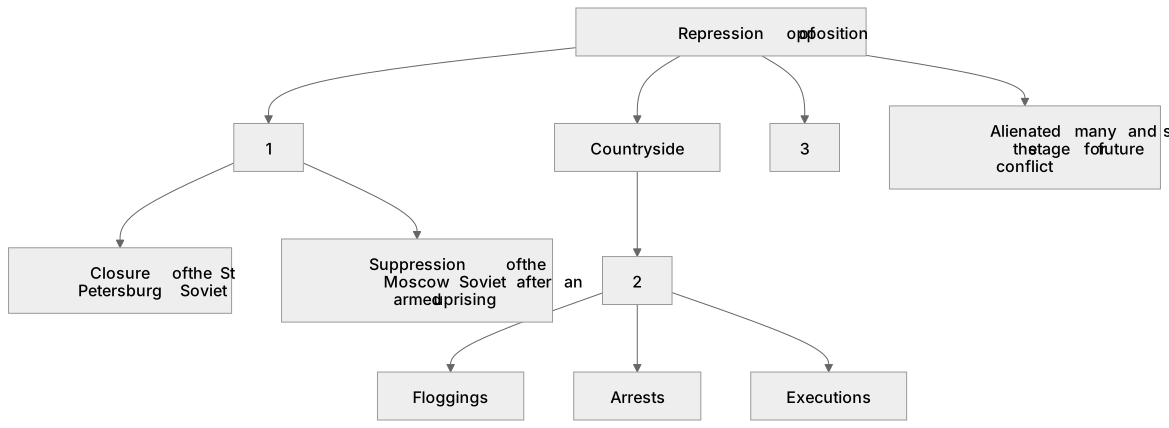
Some boxes have lost their names. Pick the right name for each number.
1Box 1
2Box 2
3Box 3
There is more to this lesson
The full lesson goes on to check your understanding and help you earn the marks. Create a free account to carry on, with your progress saved.
A week of Premium from your first lesson · Then the free plan continues · No card, no charge
Test your understanding of Paper 3, Option 38.1: The making of modern Russia, 1855–1991 - 2 Revolution and reform, 1904–06: Repression of opposition in town and countryside, including the closure of the St Petersburg and Moscow Soviets.
Active recall beats re-reading. Take an instant quiz now to test what you’ve learned and lock it into long-term memory.
A week of Premium from your first lesson · Then the free plan continues · No card, no charge