Pearson Edexcel · A-Level · History
Course version: 9HI0 · Version from Sept 2015
The making of modern Russia, 1855–1991 - 2 Revolution and reform, 1904–06:…
Full specification wording
Paper 3, Option 38.1: The making of modern Russia, 1855–1991 - 2 Revolution and reform, 1904–06: The significance of Bloody Sunday 1905: strikes and mutinies; formation and impact of the Union of Unions. The significance of the October Manifesto: extent of concessions.
Bloody Sunday (9 January 1905) saw troops fire on peaceful petitioners led by Father Gapon, killing hundreds.
Checked against the Pearson Edexcel 9HI0 specification (opens in a new tab) on .
- Point 2 of 3
- 4 key terms
Study notes
From the checked teaching notes for this specification point.
The idea
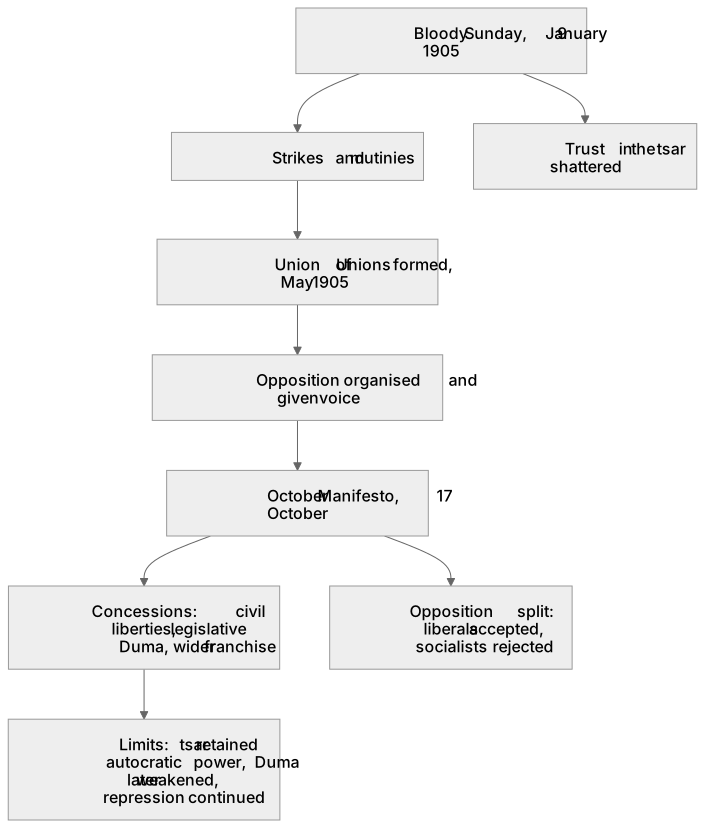
Bloody Sunday (9 January 1905) saw troops fire on peaceful petitioners led by Father Gapon, killing hundreds. This shattered trust in the tsar and triggered strikes and mutinies. The Union of Unions, formed in May 1905, united professional groups and pressed for political reform, giving opposition organisation and voice. The October Manifesto (17 October) promised civil liberties, a Duma with legislative powers, and a broader franchise. It split opposition: liberals accepted, socialists rejected. The concessions were significant but limited: the tsar retained autocratic power, the Duma was later weakened, and repression continued.
What earns the marks
- Explains how Bloody Sunday turned peaceful protest into widespread strikes and mutinies, e.g. the Potemkin mutiny in June 1905.
- Analyses the formation of the Union of Unions in May 1905 and its impact in coordinating professional and political opposition.
- Assesses the significance of the October Manifesto in terms of concessions: civil liberties, legislative Duma, wider franchise.
- Evaluates the extent of concessions by noting limitations: tsar retained veto, Fundamental Laws 1906, and continued repression.
- Links the events to the broader revolutionary context of 1905, including the role of the Soviet and later suppression.
Common mistakes and how to put them right
Treating Bloody Sunday as the sole cause of the 1905 Revolution.
Put it right: It was a catalyst, but underlying grievances and the war with Japan also mattered.
Assuming the October Manifesto granted full democracy.
Put it right: It promised a Duma but the tsar retained autocratic power and later curtailed the Duma's authority.
Confusing the Union of Unions with the St Petersburg Soviet.
Put it right: The Union of Unions was a liberal-professional body, while the Soviet was a workers' council.
Exam tips
- Use precise dates and names to show secure knowledge, e.g. 'Bloody Sunday, 9 January 1905'.
- For 'extent of concessions', weigh what was promised against what was actually delivered and implemented.
- Integrate analysis of significance throughout your answer rather than describing events in isolation.
Try the lesson
The start of the Paper 3, Option 38.1: The making of modern Russia, 1855–1991 - 2 Revolution and reform, 1904–06: The significance of Bloody Sunday 1905: strikes and mutinies; formation and impact of the Union of Unions. The significance of the October Manifesto: extent of concessions. lesson, made from checked teaching notes for this specification point.
Have a go first
What was the immediate political impact of the Bloody Sunday massacre in January 1905?
Listen
Bloody Sunday (9 January 1905) saw troops fire on peaceful petitioners led by Father Gapon, killing hundreds. This shattered trust in the tsar and triggered strikes and mutinies. The Union of Unions, formed in May 1905, united professional groups and pressed for political reform, giving opposition organisation and voice. The October Manifesto (17 October) promised civil liberties, a Duma with legislative powers, and a broader franchise. It split opposition: liberals accepted, socialists rejected. The concessions were significant but limited: the tsar retained autocratic power, the Duma was later weakened, and repression continued. A strong answer earns marks for these points. Explains how Bloody Sunday turned peaceful protest into widespread strikes and mutinies, e.g. the Potemkin mutiny in June 1905. Analyses the formation of the Union of Unions in May 1905 and its impact in coordinating professional and political opposition. Assesses the significance of the October Manifesto in terms of concessions: civil liberties, legislative Duma, wider franchise. Evaluates the extent of concessions by noting limitations: tsar retained veto, Fundamental Laws 1906, and continued repression. A common slip: treating Bloody Sunday as the sole cause of the 1905 Revolution. Instead, it was a catalyst, but underlying grievances and the war with Japan also mattered. Exam tip: Use precise dates and names to show secure knowledge, e.g. 'Bloody Sunday, 9 January 1905'.
See it
Key words
Say what each word means before you turn the card.
Bloody Sunday
Try answering aloud or in your head before turning the card.
Union of Unions
Try answering aloud or in your head before turning the card.
October Manifesto
Try answering aloud or in your head before turning the card.
extent of change
Try answering aloud or in your head before turning the card.
See every definition
- Bloody Sunday
- On 9 January 1905 troops fired on peaceful petitioners led by Father Gapon, killing hundreds, which shattered trust in the tsar and triggered strikes and mutinies.
- Union of Unions
- Formed in May 1905, it united professional groups and pressed for political reform, giving opposition organisation and voice.
- October Manifesto
- Issued on 17 October, it promised civil liberties, a Duma with legislative powers and a broader franchise, splitting opposition as liberals accepted and socialists rejected.
- extent of change
- The concessions were significant but limited, as the tsar retained autocratic power, the Duma was later weakened and repression continued.
Label the diagram
Some boxes have lost their names. Pick the right name for each number.
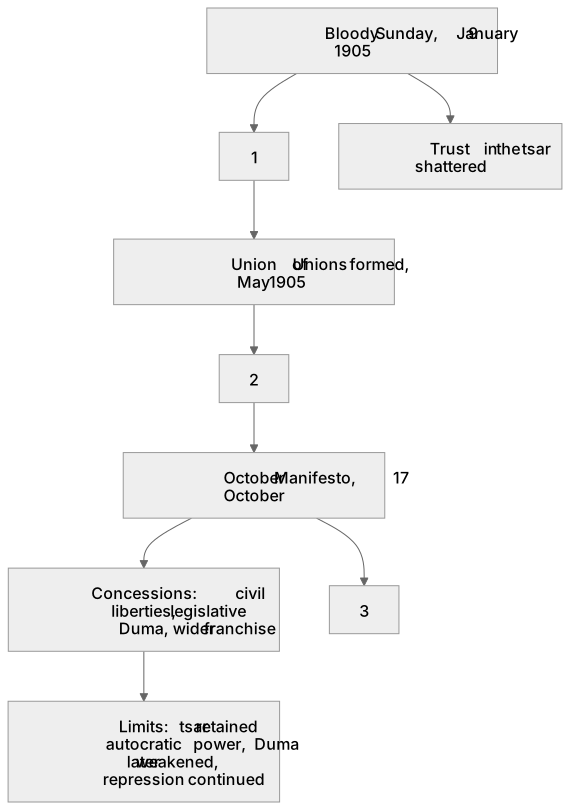
1Box 1
2Box 2
3Box 3
There is more to this lesson
The full lesson goes on to check your understanding and help you earn the marks. Create a free account to carry on, with your progress saved.
A week of Premium from your first lesson · Then the free plan continues · No card, no charge
Test your understanding of Paper 3, Option 38.1: The making of modern Russia, 1855–1991 - 2 Revolution and reform, 1904–06: The significance of Bloody Sunday 1905: strikes and mutinies; formation and impact of the Union of Unions. The significance of the October Manifesto: extent of concessions.
Active recall beats re-reading. Take an instant quiz now to test what you’ve learned and lock it into long-term memory.
A week of Premium from your first lesson · Then the free plan continues · No card, no charge