Pearson Edexcel · A-Level · History
Course version: 9HI0 · Version from Sept 2015
The making of modern China, 1860–1997 - 1 Opening up China to foreigners,…
Full specification wording
Paper 3, Option 38.2: The making of modern China, 1860–1997 - 1 Opening up China to foreigners, 1860–70: The terms and significance of the Treaty of Tianjin 1860.
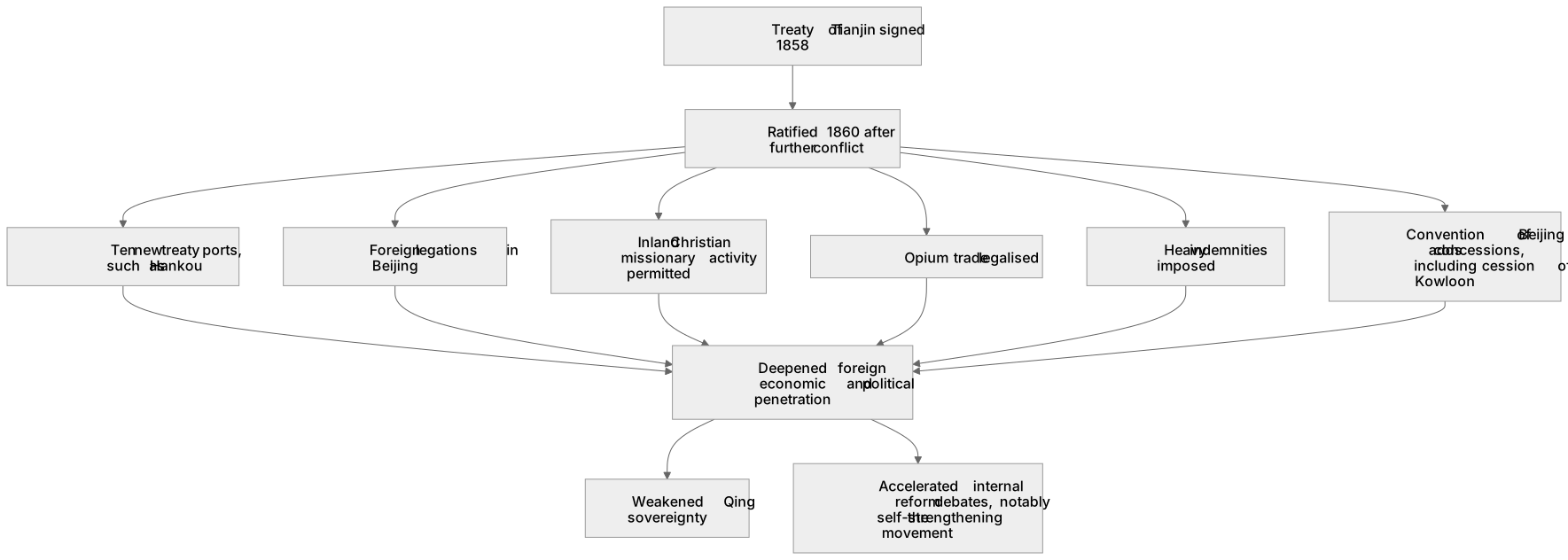
The Treaty of Tianjin was signed in 1858 but only ratified in 1860 after further conflict, which is why it is often referred to as the Treaty of Tianjin 1860.
Checked against the Pearson Edexcel 9HI0 specification (opens in a new tab) on .
- Point 1 of 3
- 4 key terms
Study notes
From the checked teaching notes for this specification point.
The idea
The Treaty of Tianjin was signed in 1858 but only ratified in 1860 after further conflict, which is why it is often referred to as the Treaty of Tianjin 1860. Its terms included opening ten new treaty ports (such as Hankou), allowing foreign legations in Beijing, permitting inland Christian missionary activity, legalising the opium trade, and imposing heavy indemnities. Its significance lies in deepening foreign economic and political penetration, severely weakening Qing sovereignty, and accelerating internal reform debates, notably the self-strengthening movement. The 1860 ratification was accompanied by the Convention of Beijing, which added further concessions like the cession of Kowloon. Study the specific terms and judge how far they opened China to foreigners.
What earns the marks
- Identifies the key terms of the Treaty of Tianjin, including additional treaty ports, legations in Beijing, missionary rights, opium legalisation, and indemnities.
- Explains the diplomatic consequences, such as the presence of foreign representatives in Beijing, which challenged the traditional tribute system.
- Explains the economic significance of expanded trade access and the legalisation of opium for foreign merchants and Qing revenues.
- Assesses how the treaty weakened Qing sovereignty and contributed to the opening up of China to foreigners in the 1860–70 period.
- Links the treaty's significance to later reform responses, including the self-strengthening movement and debates about China's place in the world.
Common mistakes and how to put them right
Confusing the terms of the Treaty of Tianjin with the 1860 Convention of Beijing.
Put it right by noting that while Tianjin (1858/1860) opened ports and legations, the Convention of Beijing ceded Kowloon.
Listing terms without explaining their significance.
Put it right by linking each term to foreign penetration or Qing weakness.
Assuming the treaty alone opened China.
Put it right by placing it alongside earlier treaties and internal Qing responses.
Exam tips
- Acknowledge that the Treaty of Tianjin was signed in 1858 but ratified in 1860; this demonstrates precise chronological understanding.
- Separate terms from significance in your plan so both parts of the statement are covered.
- Conclude by weighing how far the treaty, rather than other factors, opened China to foreigners in 1860–70.
Try the lesson
The start of the Paper 3, Option 38.2: The making of modern China, 1860–1997 - 1 Opening up China to foreigners, 1860–70: The terms and significance of the Treaty of Tianjin 1860. lesson, made from checked teaching notes for this specification point.
Have a go first
Which of the following was a key commercial concession granted to foreign powers under the terms of the Treaty of Tianjin (ratified in 1860)?
Listen
The Treaty of Tianjin was signed in 1858 but only ratified in 1860 after further conflict, which is why it is often referred to as the Treaty of Tianjin 1860. Its terms included opening ten new treaty ports (such as Hankou), allowing foreign legations in Beijing, permitting inland Christian missionary activity, legalising the opium trade, and imposing heavy indemnities. Its significance lies in deepening foreign economic and political penetration, severely weakening Qing sovereignty, and accelerating internal reform debates, notably the self-strengthening movement. The 1860 ratification was accompanied by the Convention of Beijing, which added further concessions like the cession of Kowloon. Study the specific terms and judge how far they opened China to foreigners. A strong answer earns marks for these points. Identifies the key terms of the Treaty of Tianjin, including additional treaty ports, legations in Beijing, missionary rights, opium legalisation, and indemnities. Explains the diplomatic consequences, such as the presence of foreign representatives in Beijing, which challenged the traditional tribute system. Explains the economic significance of expanded trade access and the legalisation of opium for foreign merchants and Qing revenues. Assesses how the treaty weakened Qing sovereignty and contributed to the opening up of China to foreigners in the 1860–70 period. A common slip: Confusing the terms of the Treaty of Tianjin with the 1860 Convention of Beijing. Instead, noting that while Tianjin (1858/1860) opened ports and legations, the Convention of Beijing ceded Kowloon. Exam tip: Acknowledge that the Treaty of Tianjin was signed in 1858 but ratified in 1860; this demonstrates precise chronological understanding.
See it
Key words
Say what each word means before you turn the card.
Unequal treaties and foreign penetration
Try answering aloud or in your head before turning the card.
Treaty ports and trade expansion
Try answering aloud or in your head before turning the card.
Qing sovereignty and diplomatic change
Try answering aloud or in your head before turning the card.
Missionary activity and opium legalisation
Try answering aloud or in your head before turning the card.
See every definition
- Unequal treaties and foreign penetration
- The treaty deepened foreign economic and political penetration and severely weakened Qing sovereignty.
- Treaty ports and trade expansion
- Its terms included opening ten new treaty ports, such as Hankou, which expanded trade access.
- Qing sovereignty and diplomatic change
- Foreign legations in Beijing challenged the traditional tribute system and weakened Qing sovereignty.
- Missionary activity and opium legalisation
- The terms permitted inland Christian missionary activity and legalised the opium trade.
Label the diagram
Some boxes have lost their names. Pick the right name for each number.
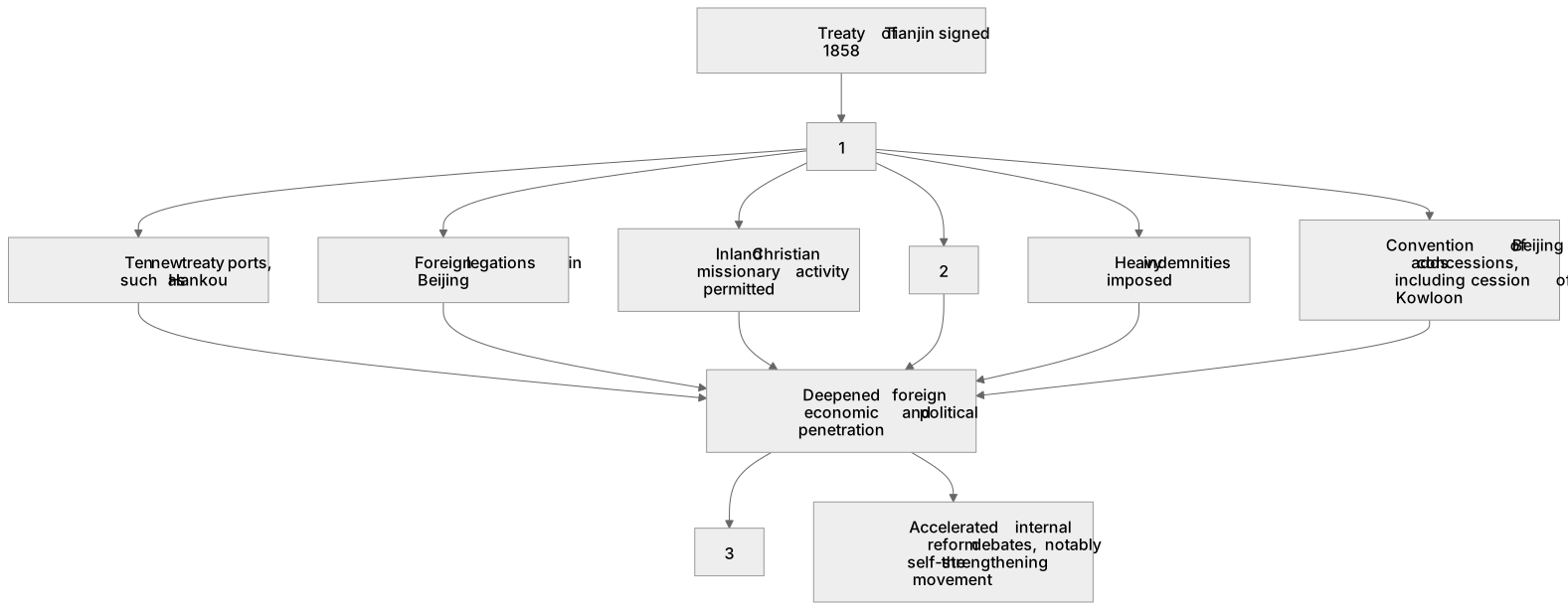
1Box 1
2Box 2
3Box 3
There is more to this lesson
The full lesson goes on to check your understanding and help you earn the marks. Create a free account to carry on, with your progress saved.
A week of Premium from your first lesson · Then the free plan continues · No card, no charge
Test your understanding of Paper 3, Option 38.2: The making of modern China, 1860–1997 - 1 Opening up China to foreigners, 1860–70: The terms and significance of the Treaty of Tianjin 1860.
Active recall beats re-reading. Take an instant quiz now to test what you’ve learned and lock it into long-term memory.
A week of Premium from your first lesson · Then the free plan continues · No card, no charge