Pearson Edexcel · A-Level · History
Course version: 9HI0 · Version from Sept 2015
The making of modern China, 1860–1997 - 1 Opening up China to foreigners,…
Full specification wording
Paper 3, Option 38.2: The making of modern China, 1860–1997 - 1 Opening up China to foreigners, 1860–70: Treaty ports and the significance of growing foreign trade; the British in Shanghai and penetration of the Yangtze valley.
After 1860, treaty ports such as Shanghai became hubs where foreign trade expanded under unequal treaties.
Checked against the Pearson Edexcel 9HI0 specification (opens in a new tab) on .
- Point 2 of 3
- 4 key terms
Study notes
From the checked teaching notes for this specification point.
The idea
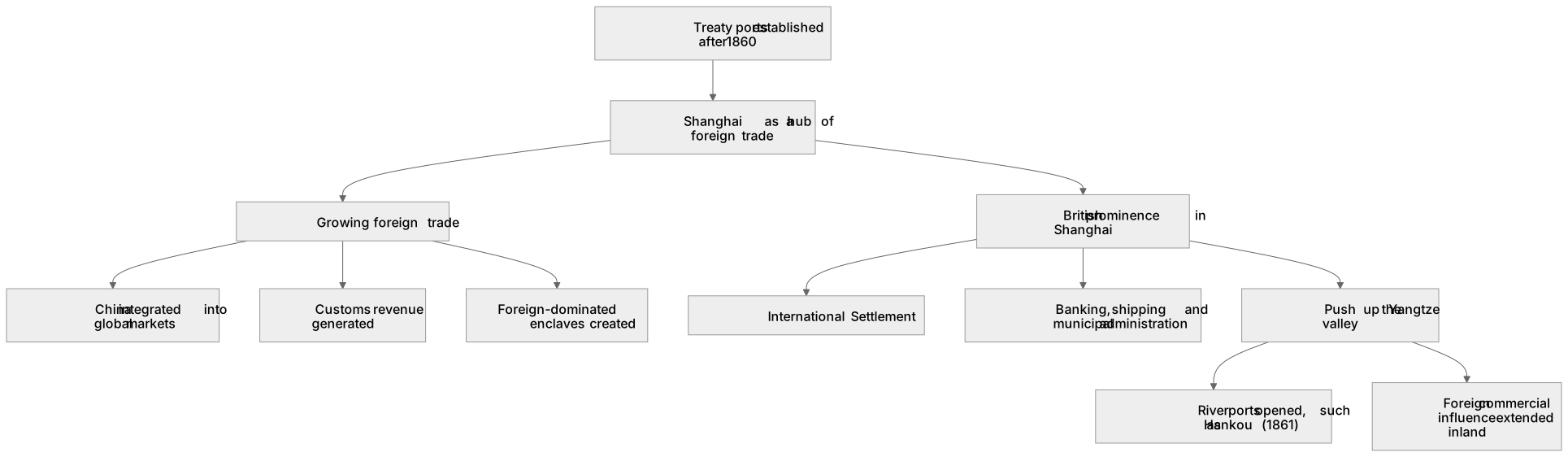
After 1860, treaty ports such as Shanghai became hubs where foreign trade expanded under unequal treaties. Growing foreign trade was significant because it integrated China into global markets, generated customs revenue, and created foreign-dominated enclaves. The British were especially prominent in Shanghai, dominating the International Settlement, banking, shipping, and municipal administration. From Shanghai, British merchants and diplomats pushed up the Yangtze valley, opening river ports like Hankou (1861) to foreign trade. This penetration extended informal empire and challenged Qing authority. For example, British firms like Jardine Matheson pioneered steamship navigation on the Yangtze during the 1860s, linking Shanghai to inland markets. Assess the significance of these developments.
What earns the marks
- Explains how treaty ports were established and why they became centres of foreign trade after 1860.
- Analyses the economic significance of growing foreign trade, including customs revenue, import-export growth, and the comprador system.
- Assesses the British role in Shanghai, including the International Settlement, municipal council, and commercial dominance.
- Evaluates the penetration of the Yangtze valley, including the opening of river ports like Hankou and the extension of foreign commercial influence inland.
- Considers the impact on Chinese sovereignty and the Qing state, including loss of tariff autonomy and legal jurisdiction.
Common mistakes and how to put them right
Treating all treaty ports as identical.
Put it right: Distinguish between the coastal ports and later river ports, noting variations in foreign control.
Assuming foreign trade only benefited foreigners.
Put it right: Recognise Chinese merchants and compradors also profited, though benefits were unevenly distributed.
Using post-1870 examples for Yangtze penetration.
Put it right: Focus on 1860s developments, such as early steamship routes by Jardine Matheson, rather than later companies.
Exam tips
- Plan your answer around the key clauses: treaty ports, foreign trade, British Shanghai, and Yangtze penetration.
- Use precise examples from the 1860–70 period, such as the opening of Hankou in 1861, to demonstrate Yangtze penetration.
- Link economic changes to political consequences, such as the growth of informal empire and Chinese resentment.
Try the lesson
The start of the Paper 3, Option 38.2: The making of modern China, 1860–1997 - 1 Opening up China to foreigners, 1860–70: Treaty ports and the significance of growing foreign trade; the British in Shanghai and penetration of the Yangtze valley. lesson, made from checked teaching notes for this specification point.
Have a go first
Which of the following best describes the primary geographical focus of British economic penetration in China following the opening of the treaty ports in the 1860s?
Listen
After 1860, treaty ports such as Shanghai became hubs where foreign trade expanded under unequal treaties. Growing foreign trade was significant because it integrated China into global markets, generated customs revenue, and created foreign-dominated enclaves. The British were especially prominent in Shanghai, dominating the International Settlement, banking, shipping, and municipal administration. From Shanghai, British merchants and diplomats pushed up the Yangtze valley, opening river ports like Hankou (1861) to foreign trade. This penetration extended informal empire and challenged Qing authority. For example, British firms like Jardine Matheson pioneered steamship navigation on the Yangtze during the 1860s, linking Shanghai to inland markets. Assess the significance of these developments. A strong answer earns marks for these points. Explains how treaty ports were established and why they became centres of foreign trade after 1860. Analyses the economic significance of growing foreign trade, including customs revenue, import-export growth, and the comprador system. Assesses the British role in Shanghai, including the International Settlement, municipal council, and commercial dominance. Evaluates the penetration of the Yangtze valley, including the opening of river ports like Hankou and the extension of foreign commercial influence inland. A common slip: Treating all treaty ports as identical. Instead, distinguish between the coastal ports and later river ports, noting variations in foreign control. Exam tip: Plan your answer around the key clauses: treaty ports, foreign trade, British Shanghai, and Yangtze penetration.
See it
Watch it explained
Assess the significance of treaty ports and growing foreign trade for China in the years 1860–70.
Read the described scene instead
Welcome to this interactive study breakdown for A-Level Pearson Edexcel History, Paper 3, Option 38.2. In this lesson we examine how, after 1860, treaty ports such as Shanghai became hubs of expanding foreign trade under unequal treaties. We will assess growing foreign trade, the British role in Shanghai, and the penetration of the Yangtze valley, while linking these developments to imperialism, economic change, sovereignty, and foreign enclaves. Let's map the core themes. Treaty ports were not just coastal stopping points; after 1860 they connected China to global markets. Growing trade mattered because it generated customs revenue and helped create foreign-dominated enclaves. Unequal treaties undermined Chinese sovereignty through lost tariff autonomy and legal jurisdiction. British commercial dominance in Shanghai then extended up the Yangtze valley, broadening informal empire and challenging Qing authority. Keep these connections in mind as you plan an answer around treaty ports, trade, British Shanghai, and Yangtze penetration. Our source notes focus on the significance of growing foreign trade. After 1860, treaty ports such as Shanghai became hubs where foreign trade expanded under unequal treaties. This growth was significant because it integrated China into global markets, generated customs revenue, and created foreign-dominated enclaves. Economically, you should refer to customs revenue, import-export growth, and the comprador system. Remember the correction: foreign trade did not only benefit foreigners. Chinese merchants and compradors could also profit, although benefits were unevenly distributed. That nuance matters when you assess significance. Now follow the process of penetration. The British were especially prominent in Shanghai, dominating the International Settlement, banking, shipping, and municipal administration. From Shanghai, British merchants and diplomats pushed up the Yangtze valley. This opened river ports such as Hankou to foreign trade in 1861. British firms like Jardine Matheson pioneered steamship navigation on the Yangtze during the 1860s, linking Shanghai to inland markets. This sequence matters because it extended informal empire and challenged Qing authority. Note also that treaty ports were not identical: distinguish earlier coastal ports from later river ports and their varying degrees of foreign control. Let's work through an assessment question. Plan around the key clauses: treaty ports, foreign trade, British Shanghai, and Yangtze penetration. Use precise examples from 1860 to 1870, such as the opening of Hankou in 1861, and avoid using post-1870 examples for Yangtze penetration. Explain that treaty ports such as Shanghai expanded foreign trade under unequal treaties, integrating China into global markets and generating customs revenue. Then assess British dominance in Shanghai's International Settlement, banking, shipping, and municipal administration. Finally, link the opening of river ports and Jardine Matheson's 1860s steamship navigation to informal empire, challenged Qing authority, and Chinese resentment. A strong answer weighs economic and political significance, while noting uneven benefits. Watch out for these examiner traps. First, do not treat all treaty ports as identical. Distinguish the coastal ports from later river ports, and note variations in foreign control. Second, do not assume foreign trade only benefited foreigners. Chinese merchants and compradors also profited, although benefits were unevenly distributed. Third, do not use post-1870 examples for Yangtze penetration. Focus on 1860s developments, such as early steamship routes by Jardine Matheson. In your conclusions, link economic change to political consequences, especially the growth of informal empire and Chinese resentment, and keep referring back to sovereignty and unequal treaties. To recap: after 1860, treaty ports such as Shanghai became hubs where foreign trade expanded under unequal treaties. Growing foreign trade integrated China into global markets, generated customs revenue, and created foreign-dominated enclaves. British prominence in Shanghai was built on the International Settlement, banking, shipping, and municipal administration. From Shanghai, influence penetrated the Yangtze valley, with Hankou opening to foreign trade in 1861 and Jardine Matheson pioneering steamship navigation during the 1860s. The overall significance lies in informal empire, economic change, challenged Qing authority, and the loss of tariff autonomy and legal jurisdiction. Use these precise links in your exam answer.
Key words
Say what each word means before you turn the card.
Imperialism and informal empire
Try answering aloud or in your head before turning the card.
Trade and economic change
Try answering aloud or in your head before turning the card.
Sovereignty and unequal treaties
Try answering aloud or in your head before turning the card.
Urbanisation and foreign enclaves
Try answering aloud or in your head before turning the card.
See every definition
- Imperialism and informal empire
- The extension of foreign commercial influence inland, as when British merchants and diplomats pushed up the Yangtze valley, which challenged Qing authority.
- Trade and economic change
- Growing foreign trade integrated China into global markets, generated customs revenue and created foreign-dominated enclaves.
- Sovereignty and unequal treaties
- Foreign trade expanded under unequal treaties, and the impact on Chinese sovereignty included loss of tariff autonomy and legal jurisdiction.
- Urbanisation and foreign enclaves
- Treaty ports such as Shanghai became hubs where foreign-dominated enclaves were created, with the British dominating the International Settlement.
Label the diagram
Some boxes have lost their names. Pick the right name for each number.
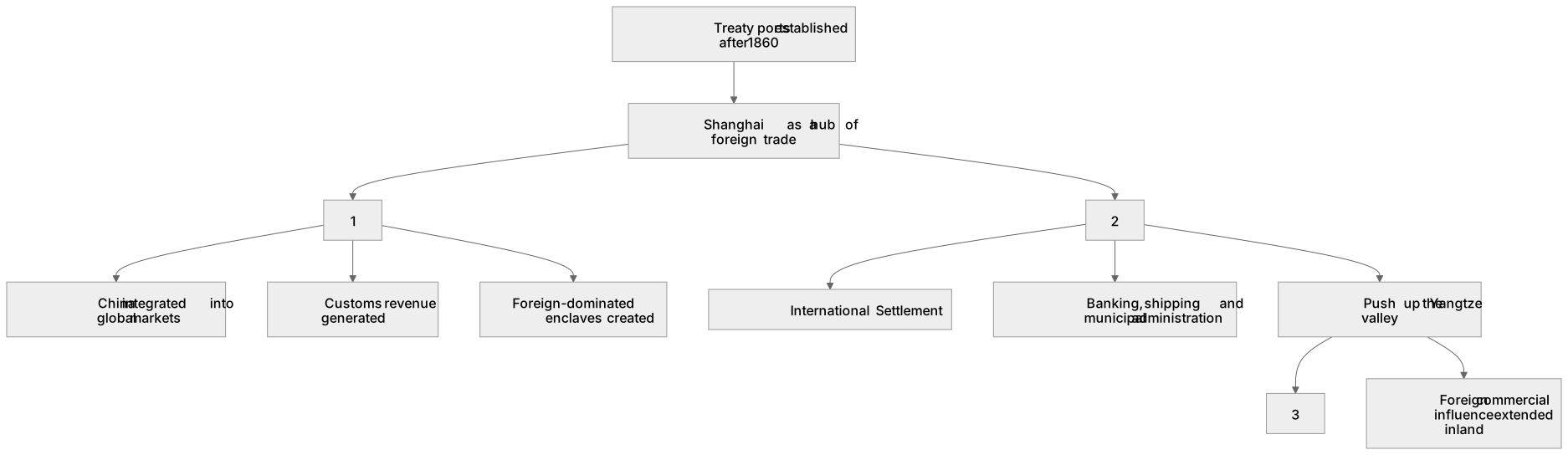
1Box 1
2Box 2
3Box 3
There is more to this lesson
The full lesson goes on to check your understanding and help you earn the marks. Create a free account to carry on, with your progress saved.
A week of Premium from your first lesson · Then the free plan continues · No card, no charge
Test your understanding of Paper 3, Option 38.2: The making of modern China, 1860–1997 - 1 Opening up China to foreigners, 1860–70: Treaty ports and the significance of growing foreign trade; the British in Shanghai and penetration of the Yangtze valley.
Active recall beats re-reading. Take an instant quiz now to test what you’ve learned and lock it into long-term memory.
A week of Premium from your first lesson · Then the free plan continues · No card, no charge