Pearson Edexcel · A-Level · History
Course version: 9HI0 · Version from Sept 2015
The making of modern China, 1860–1997 - 2 Ideologies and individuals…
Full specification wording
Paper 3, Option 38.2: The making of modern China, 1860–1997 - 2 Ideologies and individuals behind economic growth: Ideas and ideologies as factors promoting change, 1860– 1997 (key developments: the Self-Strengthening Movement of the 1860s and 70s, the cult of science and rejection of traditional values in the May Fourth Movement 1915–24, Marxism and the Soviet inspired cult of heavy industry in the early 1950s, modifying soviet Marxism and ‘walking on two legs’ 1958, the embrace of capitalism in the 1980s and 90s).
This theme examines how ideas and ideologies drove economic change from 1860 to 1997.
Checked against the Pearson Edexcel 9HI0 specification (opens in a new tab) on .
- Point 1 of 2
- 4 key terms
Study notes
From the checked teaching notes for this specification point.
The idea
This theme examines how ideas and ideologies drove economic change from 1860 to 1997. The Self-Strengthening Movement of the 1860s and 70s sought reform through adopting Western technology while preserving Chinese values. The May Fourth Movement (1915–24) promoted a cult of science and rejected traditional values, encouraging modernisation. In the early 1950s, Marxism and a Soviet-inspired cult of heavy industry shaped planned development. By 1958, Mao modified Soviet Marxism through 'walking on two legs', balancing industry and agriculture. Finally, the 1980s and 90s saw an embrace of capitalism and market mechanisms. Assess how far each ideology actually promoted change.
What earns the marks
- Explains the Self-Strengthening Movement of the 1860s and 70s as selective adoption of Western technology within Confucian frameworks.
- Analyses the May Fourth Movement (1915–24) as promoting science and rejecting traditional values to foster modernisation.
- Examines early 1950s Marxism and Soviet-inspired heavy industry as ideological drivers of planned economic growth.
- Assesses the 1958 modification of Soviet Marxism through 'walking on two legs' as a distinct Chinese approach.
- Evaluates the embrace of capitalism in the 1980s and 90s as an ideological shift promoting market-led change.
Common mistakes and how to put them right
Treating the Self-Strengthening Movement as full Westernisation.
Put it right by stressing its aim to preserve Chinese core values.
Assuming May Fourth ideas immediately transformed the economy.
Put it right by noting their gradual and indirect influence.
Confusing 'walking on two legs' with pure Soviet Marxism.
Put it right by explaining it as a modified, balanced approach.
Exam tips
- Link each ideology to specific economic outcomes or policies to show causal impact.
- Use dates precisely, especially 1915–24, 1953–57 and 1958, to structure your argument.
- Compare ideologies directly, for example Self-Strengthening conservatism against 1980s market embrace.
Try the lesson
The start of the Paper 3, Option 38.2: The making of modern China, 1860–1997 - 2 Ideologies and individuals behind economic growth: Ideas and ideologies as factors promoting change, 1860– 1997 (key developments: the Self-Strengthening Movement of the 1860s and 70s, the cult of science and rejection of traditional values in the May Fourth Movement 1915–24, Marxism and the Soviet inspired cult of heavy industry in the early 1950s, modifying soviet Marxism and ‘walking on two legs’ 1958, the embrace of capitalism in the 1980s and 90s). lesson, made from checked teaching notes for this specification point.
Have a go first
What was the central aim of the Self-Strengthening Movement of the 1860s and 70s?
Listen
This theme examines how ideas and ideologies drove economic change from 1860 to 1997. The Self-Strengthening Movement of the 1860s and 70s sought reform through adopting Western technology while preserving Chinese values. The May Fourth Movement (1915–24) promoted a cult of science and rejected traditional values, encouraging modernisation. In the early 1950s, Marxism and a Soviet-inspired cult of heavy industry shaped planned development. By 1958, Mao modified Soviet Marxism through 'walking on two legs', balancing industry and agriculture. Finally, the 1980s and 90s saw an embrace of capitalism and market mechanisms. Assess how far each ideology actually promoted change. A strong answer earns marks for these points. Explains the Self-Strengthening Movement of the 1860s and 70s as selective adoption of Western technology within Confucian frameworks. Analyses the May Fourth Movement (1915–24) as promoting science and rejecting traditional values to foster modernisation. Examines early 1950s Marxism and Soviet-inspired heavy industry as ideological drivers of planned economic growth. Assesses the 1958 modification of Soviet Marxism through 'walking on two legs' as a distinct Chinese approach. A common slip: Treating the Self-Strengthening Movement as full Westernisation. Instead, stressing its aim to preserve Chinese core values. Exam tip: Link each ideology to specific economic outcomes or policies to show causal impact.
See it
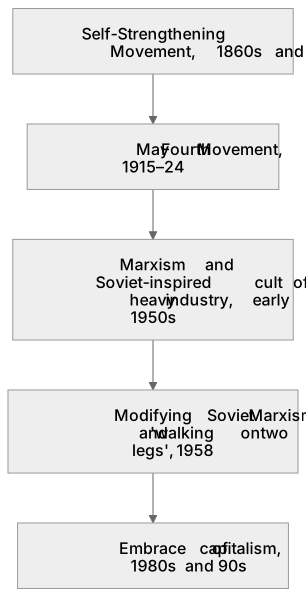
Put it in order
Put these steps in the order they happen.
- 1. May Fourth Movement, 1915–24
- 2. Marxism and Soviet-inspired cult of heavy industry, early 1950s
- 3. Self-Strengthening Movement, 1860s and 70s
- 4. Embrace of capitalism, 1980s and 90s
- 5. Modifying Soviet Marxism and 'walking on two legs', 1958
Put the events in order
Put these events in the order they happened, earliest first.
- 1. Self-Strengthening Movement adopts Western technology within Confucian frameworks
- 2. Mao modifies Soviet Marxism through 'walking on two legs'
- 3. May Fourth Movement promotes science and rejects traditional values
Key words
Say what each word means before you turn the card.
Reform and modernisation
Try answering aloud or in your head before turning the card.
State planning and Marxism
Try answering aloud or in your head before turning the card.
Market transition and capitalism
Try answering aloud or in your head before turning the card.
Ideology and economic change
Try answering aloud or in your head before turning the card.
See every definition
- Reform and modernisation
- Sought reform through adopting Western technology while preserving Chinese values, as in the Self-Strengthening Movement of the 1860s and 70s.
- State planning and Marxism
- In the early 1950s, Marxism and a Soviet-inspired cult of heavy industry shaped planned development.
- Market transition and capitalism
- The 1980s and 90s saw an embrace of capitalism and market mechanisms, an ideological shift promoting market-led change.
- Ideology and economic change
- Ideas and ideologies acted as factors promoting change from 1860 to 1997, and each ideology's promotion of change is assessed.
Label the diagram
Some boxes have lost their names. Pick the right name for each number.
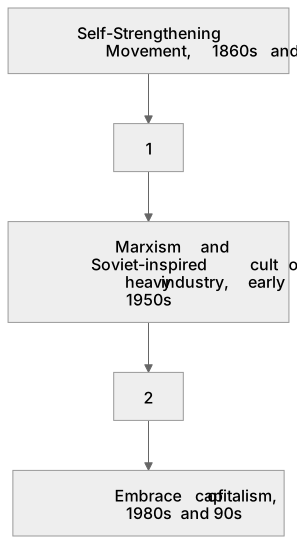
1Box 1
2Box 2
There is more to this lesson
The full lesson goes on to check your understanding and help you earn the marks. Create a free account to carry on, with your progress saved.
A week of Premium from your first lesson · Then the free plan continues · No card, no charge
Test your understanding of Paper 3, Option 38.2: The making of modern China, 1860–1997 - 2 Ideologies and individuals behind economic growth: Ideas and ideologies as factors promoting change, 1860– 1997 (key developments: the Self-Strengthening Movement of the 1860s and 70s, the cult of science and rejection of traditional values in the May Fourth Movement 1915–24, Marxism and the Soviet inspired cult of heavy industry in the early 1950s, modifying soviet Marxism and ‘walking on two legs’ 1958, the embrace of capitalism in the 1980s and 90s).
Active recall beats re-reading. Take an instant quiz now to test what you’ve learned and lock it into long-term memory.
A week of Premium from your first lesson · Then the free plan continues · No card, no charge