Pearson Edexcel · A-Level · History
Course version: 9HI0 · Version from Sept 2015
The making of modern China, 1860–1997 - 5 Reconciliation with old enemies…
Full specification wording
Paper 3, Option 38.2: The making of modern China, 1860–1997 - 5 Reconciliation with old enemies and the return of Hong Kong, 1978–97: The importance of the peaceful return of Hong Kong in July 1997: negotiations and terms.
Hong Kong’s peaceful return to China on 1 July 1997 ended British colonial rule and demonstrated China’s diplomatic and economic rise.
Checked against the Pearson Edexcel 9HI0 specification (opens in a new tab) on .
- Point 3 of 3
- 4 key terms
Study notes
From the checked teaching notes for this specification point.
The idea
Hong Kong’s peaceful return to China on 1 July 1997 ended British colonial rule and demonstrated China’s diplomatic and economic rise. Negotiations began after Margaret Thatcher’s 1982 visit to Beijing, where Deng Xiaoping insisted on Chinese sovereignty. Talks produced the 1984 Sino-British Joint Declaration, agreeing that Hong Kong would become a Special Administrative Region. Its terms included the ‘one country, two systems’ framework, a fifty-year guarantee of Hong Kong’s capitalist economy and lifestyle, and a high degree of autonomy except in foreign affairs and defence. The handover was significant because it reversed a national humiliation, avoided conflict, and tested China’s ability to reunify territory while preserving stability and prosperity.
What earns the marks
- Explains that negotiations began after Margaret Thatcher’s 1982 visit and Deng Xiaoping’s insistence on the recovery of sovereignty over Hong Kong.
- Describes the 1984 Sino-British Joint Declaration as the key agreement that set the date and framework for the handover.
- Explains the ‘one country, two systems’ principle, allowing Hong Kong to retain its capitalist system and way of life for fifty years after 1997.
- Identifies the terms of the return, including Hong Kong becoming a Special Administrative Region with a high degree of autonomy except in foreign affairs and defence.
- Assesses the importance of the peaceful handover on 1 July 1997 as a reversal of colonial humiliation and a boost to Chinese national prestige.
- Evaluates how the return demonstrated China’s diplomatic skill and growing international influence while raising questions about Hong Kong’s future autonomy.
Common mistakes and how to put them right
Stating that Hong Kong was returned in 1984.
Put it right: The Sino-British Joint Declaration was signed in 1984, but the handover occurred on 1 July 1997.
Confusing ‘one country, two systems’ with immediate integration into mainland socialism.
Put it right: The policy preserved Hong Kong’s capitalist system and autonomy for fifty years.
Claiming the handover was violent or forced.
Put it right: It was a negotiated, peaceful transfer of sovereignty.
Exam tips
- Distinguish clearly between the 1984 negotiations and the 1997 handover when explaining causes and consequences.
- Use the terms of the Joint Declaration to explain why the return was considered peaceful and orderly.
- Connect the return of Hong Kong to broader themes such as nationalism, decolonisation and China’s international standing.
Try the lesson
The start of the Paper 3, Option 38.2: The making of modern China, 1860–1997 - 5 Reconciliation with old enemies and the return of Hong Kong, 1978–97: The importance of the peaceful return of Hong Kong in July 1997: negotiations and terms. lesson, made from checked teaching notes for this specification point.
Have a go first
Which of the following was a key term agreed in the 1984 Sino-British Joint Declaration regarding the return of Hong Kong?
Listen
Hong Kong’s peaceful return to China on 1 July 1997 ended British colonial rule and demonstrated China’s diplomatic and economic rise. Negotiations began after Margaret Thatcher’s 1982 visit to Beijing, where Deng Xiaoping insisted on Chinese sovereignty. Talks produced the 1984 Sino-British Joint Declaration, agreeing that Hong Kong would become a Special Administrative Region. Its terms included the ‘one country, two systems’ framework, a fifty-year guarantee of Hong Kong’s capitalist economy and lifestyle, and a high degree of autonomy except in foreign affairs and defence. The handover was significant because it reversed a national humiliation, avoided conflict, and tested China’s ability to reunify territory while preserving stability and prosperity. A strong answer earns marks for these points. Explains that negotiations began after Margaret Thatcher’s 1982 visit and Deng Xiaoping’s insistence on the recovery of sovereignty over Hong Kong. Describes the 1984 Sino-British Joint Declaration as the key agreement that set the date and framework for the handover. Explains the ‘one country, two systems’ principle, allowing Hong Kong to retain its capitalist system and way of life for fifty years after 1997. Identifies the terms of the return, including Hong Kong becoming a Special Administrative Region with a high degree of autonomy except in foreign affairs and defence. A common slip: Stating that Hong Kong was returned in 1984. Instead, the Sino-British Joint Declaration was signed in 1984, but the handover occurred on 1 July 1997. Exam tip: Distinguish clearly between the 1984 negotiations and the 1997 handover when explaining causes and consequences.
See it
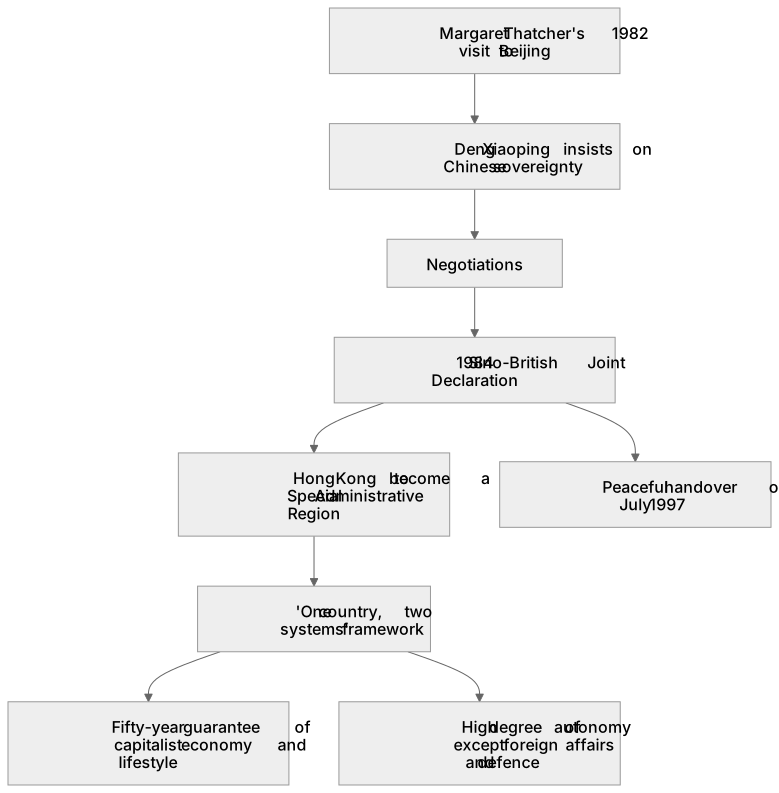
Put the events in order
Put these events in the order they happened, earliest first.
- 1. Margaret Thatcher visits Beijing for negotiations
- 2. Hong Kong peacefully returned to China
- 3. Sino-British Joint Declaration signed
Key words
Say what each word means before you turn the card.
Decolonisation and national reunification
Try answering aloud or in your head before turning the card.
Diplomatic negotiation and peaceful transfer of sovereignty
Try answering aloud or in your head before turning the card.
‘One country, two systems’ as a governing framework
Try answering aloud or in your head before turning the card.
National prestige and the reversal of humiliation
Try answering aloud or in your head before turning the card.
See every definition
- Decolonisation and national reunification
- Hong Kong’s peaceful return to China on 1 July 1997 ended British colonial rule and reunified territory.
- Diplomatic negotiation and peaceful transfer of sovereignty
- Negotiations began after Margaret Thatcher’s 1982 visit to Beijing, and the handover was a negotiated, peaceful transfer of sovereignty.
- ‘One country, two systems’ as a governing framework
- A framework guaranteeing Hong Kong’s capitalist economy and lifestyle for fifty years and a high degree of autonomy except in foreign affairs and defence.
- National prestige and the reversal of humiliation
- The handover reversed a national humiliation and boosted Chinese national prestige.
Label the diagram
Some boxes have lost their names. Pick the right name for each number.
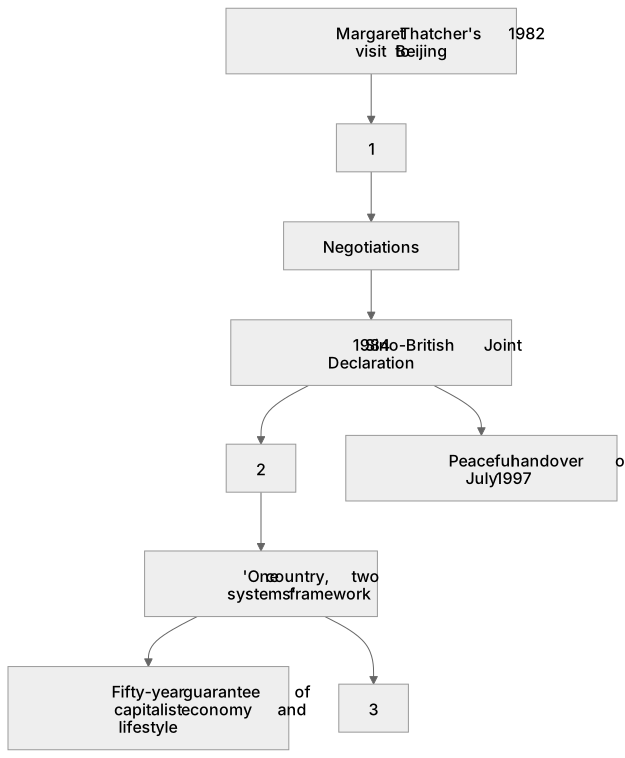
1Box 1
2Box 2
3Box 3
There is more to this lesson
The full lesson goes on to check your understanding and help you earn the marks. Create a free account to carry on, with your progress saved.
A week of Premium from your first lesson · Then the free plan continues · No card, no charge
Test your understanding of Paper 3, Option 38.2: The making of modern China, 1860–1997 - 5 Reconciliation with old enemies and the return of Hong Kong, 1978–97: The importance of the peaceful return of Hong Kong in July 1997: negotiations and terms.
Active recall beats re-reading. Take an instant quiz now to test what you’ve learned and lock it into long-term memory.
A week of Premium from your first lesson · Then the free plan continues · No card, no charge