Pearson Edexcel · A-Level · History
Course version: 9HI0 · Version from Sept 2015
Civil rights and race relations in the USA, 1850–2009 - 2 The triumph of…
Full specification wording
Paper 3, Option 39.1: Civil rights and race relations in the USA, 1850–2009 - 2 The triumph of ‘Jim Crow’, 1883–c1900: The impact of Plessy v. Ferguson 1896; Williams v. Mississippi 1898; Cumming v. Board of Education 1899.
These three Supreme Court cases shaped the legal framework of Jim Crow.
Checked against the Pearson Edexcel 9HI0 specification (opens in a new tab) on .
- Point 3 of 3
- 4 key terms
Study notes
From the checked teaching notes for this specification point.
The idea
These three Supreme Court cases shaped the legal framework of Jim Crow. Plessy v. Ferguson (1896) upheld a Louisiana railway segregation law, establishing the ‘separate but equal’ doctrine that allowed states to segregate facilities if they claimed to provide equal ones. Williams v. Mississippi (1898) upheld Mississippi’s voter registration provisions, including poll taxes and literacy tests, despite their discriminatory effect, effectively allowing disenfranchisement to continue. Cumming v. Board of Education (1899) refused to strike down a Georgia school board’s decision to close a black high school while maintaining a white one, showing that the Court would not enforce equal educational provision. Together they legitimised segregation and disenfranchisement, leaving black Americans to rely on protest, migration and later litigation.
What earns the marks
- Plessy v. Ferguson (1896) upheld racial segregation in railway carriages and established the ‘separate but equal’ doctrine, which became a legal foundation for Jim Crow.
- Williams v. Mississippi (1898) upheld Mississippi’s voter registration requirements, including poll taxes and literacy tests, despite evidence of discriminatory application.
- Cumming v. Board of Education (1899) allowed a Georgia school board to close a black high school while keeping a white school open, showing the Court would not enforce equal educational provision.
- The cases collectively legitimised state-level segregation and disenfranchisement, reducing federal protection for black civil rights.
- The ‘separate but equal’ doctrine was used to justify unequal facilities because courts rarely enforced genuine equality.
- The decisions encouraged further Jim Crow legislation and discouraged federal intervention until the mid-twentieth century.
Common mistakes and how to put them right
Believing Plessy v. Ferguson ended segregation.
Put it right by explaining that it upheld segregation and created the ‘separate but equal’ doctrine.
Assuming Williams v. Mississippi struck down voter discrimination.
Put it right by explaining that the Court upheld the state’s registration provisions despite their discriminatory effect.
Thinking Cumming v. Board of Education required equal schooling.
Put it right by explaining that the Court allowed a black high school to close while a white school remained open.
Treating the cases as unrelated.
Put it right by linking them as a pattern of judicial approval for segregation and disenfranchisement.
Exam tips
- State the year and outcome of each case precisely, and explain its significance rather than only naming it.
- Use the phrase ‘separate but equal’ accurately, noting that it was a doctrine that permitted segregation rather than a guarantee of equality.
- Connect each case to the wider theme of federal retreat from civil rights and the entrenchment of Jim Crow.
- Compare the cases where useful, for example showing how Plessy and Cumming limited equal provision while Williams limited political rights.
Try the lesson
The start of the Paper 3, Option 39.1: Civil rights and race relations in the USA, 1850–2009 - 2 The triumph of ‘Jim Crow’, 1883–c1900: The impact of Plessy v. Ferguson 1896; Williams v. Mississippi 1898; Cumming v. Board of Education 1899. lesson, made from checked teaching notes for this specification point.
Have a go first
In which year did the Supreme Court deliver its ruling in Plessy v. Ferguson?
Listen
These three Supreme Court cases shaped the legal framework of Jim Crow. Plessy v. Ferguson (1896) upheld a Louisiana railway segregation law, establishing the ‘separate but equal’ doctrine that allowed states to segregate facilities if they claimed to provide equal ones. Williams v. Mississippi (1898) upheld Mississippi’s voter registration provisions, including poll taxes and literacy tests, despite their discriminatory effect, effectively allowing disenfranchisement to continue. Cumming v. Board of Education (1899) refused to strike down a Georgia school board’s decision to close a black high school while maintaining a white one, showing that the Court would not enforce equal educational provision. Together they legitimised segregation and disenfranchisement, leaving black Americans to rely on protest, migration and later litigation. A strong answer earns marks for these points. Plessy v. Ferguson (1896) upheld racial segregation in railway carriages and established the ‘separate but equal’ doctrine, which became a legal foundation for Jim Crow. Williams v. Mississippi (1898) upheld Mississippi’s voter registration requirements, including poll taxes and literacy tests, despite evidence of discriminatory application. Cumming v. Board of Education (1899) allowed a Georgia school board to close a black high school while keeping a white school open, showing the Court would not enforce equal educational provision. The cases collectively legitimised state-level segregation and disenfranchisement, reducing federal protection for black civil rights. A common slip: Believing Plessy v. Ferguson ended segregation. Instead, explaining that it upheld segregation and created the ‘separate but equal’ doctrine. Exam tip: State the year and outcome of each case precisely, and explain its significance rather than only naming it.
See it
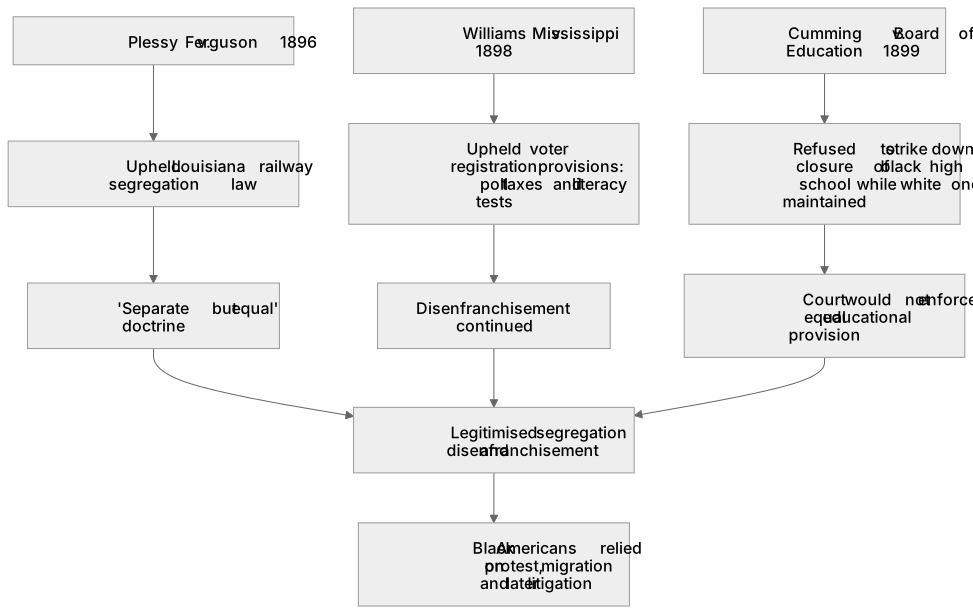
Put the events in order
Put these events in the order they happened, earliest first.
- 1. Plessy v. Ferguson upheld racial segregation in railway carriages
- 2. Cumming v. Board of Education allowed a black high school to close
- 3. Williams v. Mississippi upheld Mississippi’s voter registration requirements
Key words
Say what each word means before you turn the card.
Judicial endorsement of segregation and disenfranchisement
Try answering aloud or in your head before turning the card.
The ‘separate but equal’ doctrine and its consequences
Try answering aloud or in your head before turning the card.
Federal retreat from civil rights protection
Try answering aloud or in your head before turning the card.
The legal entrenchment of white supremacy in the South
Try answering aloud or in your head before turning the card.
See every definition
- Judicial endorsement of segregation and disenfranchisement
- The Supreme Court upheld a railway segregation law, voter registration provisions and a school board decision, legitimising segregation and disenfranchisement.
- The ‘separate but equal’ doctrine and its consequences
- A doctrine allowing states to segregate facilities if they claimed to provide equal ones, used to justify unequal facilities because courts rarely enforced genuine equality.
- Federal retreat from civil rights protection
- The cases collectively legitimised state-level segregation and disenfranchisement, reducing federal protection for black civil rights.
- The legal entrenchment of white supremacy in the South
- The decisions encouraged further Jim Crow legislation and discouraged federal intervention until the mid-twentieth century.
Label the diagram
Some boxes have lost their names. Pick the right name for each number.
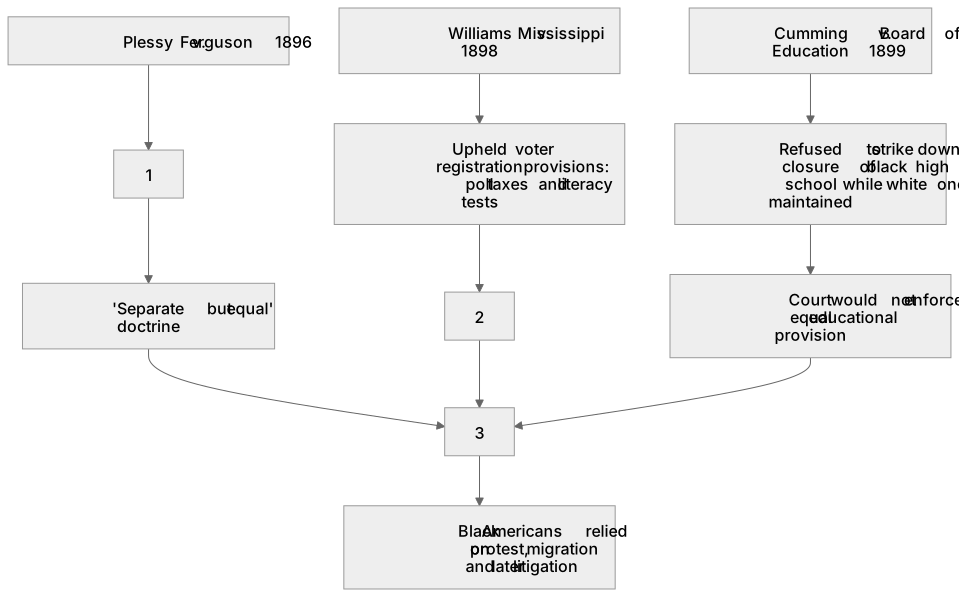
1Box 1
2Box 2
3Box 3
There is more to this lesson
The full lesson goes on to check your understanding and help you earn the marks. Create a free account to carry on, with your progress saved.
A week of Premium from your first lesson · Then the free plan continues · No card, no charge
Test your understanding of Paper 3, Option 39.1: Civil rights and race relations in the USA, 1850–2009 - 2 The triumph of ‘Jim Crow’, 1883–c1900: The impact of Plessy v. Ferguson 1896; Williams v. Mississippi 1898; Cumming v. Board of Education 1899.
Active recall beats re-reading. Take an instant quiz now to test what you’ve learned and lock it into long-term memory.
A week of Premium from your first lesson · Then the free plan continues · No card, no charge