Pearson Edexcel · A-Level · History
Course version: 9HI0 · Version from Sept 2015
Civil rights and race relations in the USA, 1850–2009 - 2 The triumph of…
Full specification wording
Paper 3, Option 39.1: Civil rights and race relations in the USA, 1850–2009 - 2 The triumph of ‘Jim Crow’, 1883–c1900: The spread of Jim Crow Laws: changes to rail travel in Florida 1887; extension of segregation to other social areas and other states. Excluding black voters: discrimination in Mississippi from 1890; Louisiana’s Grandfather clause 1898; impact on voter numbers in the south in the 1890s.
This topic examines how Jim Crow segregation spread through law and practice between 1887 and the late 1890s.
Checked against the Pearson Edexcel 9HI0 specification (opens in a new tab) on .
- Point 2 of 3
- 3 key terms
Study notes
From the checked teaching notes for this specification point.
The idea
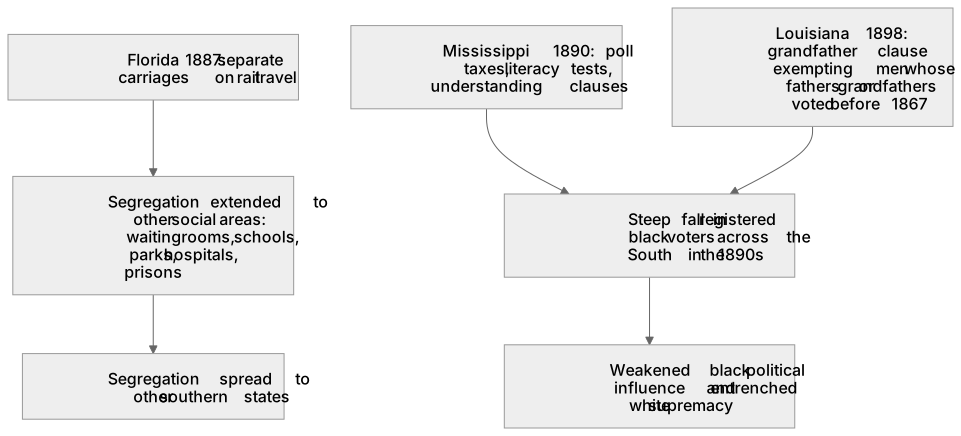
This topic examines how Jim Crow segregation spread through law and practice between 1887 and the late 1890s. Florida’s 1887 rail law required separate carriages for black and white passengers, establishing a legal template that other states copied and extended to waiting rooms, schools, parks, hospitals and prisons. Meanwhile, southern states used constitutional conventions and statutes to exclude black voters. Mississippi’s 1890 constitution imposed poll taxes, literacy tests and understanding clauses; Louisiana’s 1898 grandfather clause exempted men whose fathers or grandfathers had voted before 1867, effectively exempting many poor whites while excluding black men. The result was a steep fall in registered black voters across the South during the 1890s, weakening black political influence and entrenching white supremacy.
What earns the marks
- Florida’s 1887 law on rail travel is a concrete example of early legal segregation in transport, showing how separate-carriage rules were enacted before wider social segregation.
- Segregation extended beyond railways to other social areas such as schools, waiting rooms, parks, hospitals and prisons, and spread to other southern states through similar statutes and local ordinances.
- Mississippi’s 1890 constitutional provisions used poll taxes, literacy tests and understanding clauses to discriminate against black voters while often allowing poor whites to qualify.
- Louisiana’s 1898 grandfather clause exempted men whose fathers or grandfathers had voted before 1867, a date before black male suffrage was protected, so it excluded most black men while exempting many white men.
- The cumulative effect was a sharp decline in black voter registration and turnout across the South in the 1890s, reducing black political representation and influence.
Common mistakes and how to put them right
Treating Jim Crow as only informal custom.
Put it right by explaining that these were legally enacted statutes and constitutional provisions with binding force.
Assuming the grandfather clause applied equally to all voters.
Put it right by explaining that its pre-1867 cut-off deliberately exempted many white men while excluding most black men.
Confusing the dates or states, such as attributing the 1887 rail law to Mississippi or the 1890 constitution to Louisiana.
Put it right by keeping Florida 1887, Mississippi 1890 and Louisiana 1898 distinct.
Describing voter exclusion as a single law rather than a combination of devices.
Put it right by referring to poll taxes, literacy tests, understanding clauses and grandfather clauses together.
Exam tips
- Anchor answers with precise dates and state names, for example Florida 1887, Mississippi 1890 and Louisiana 1898, to show secure contextual knowledge.
- Explain the mechanism of each exclusion device, such as how a poll tax or literacy test could be applied selectively, rather than merely naming it.
- Link legal segregation and voter exclusion to their consequences, such as reduced black political representation and the entrenchment of white supremacy.
- Use the wording of the question to decide whether to compare states, trace change over time, or assess the impact on voter numbers.
Try the lesson
The start of the Paper 3, Option 39.1: Civil rights and race relations in the USA, 1850–2009 - 2 The triumph of ‘Jim Crow’, 1883–c1900: The spread of Jim Crow Laws: changes to rail travel in Florida 1887; extension of segregation to other social areas and other states. Excluding black voters: discrimination in Mississippi from 1890; Louisiana’s Grandfather clause 1898; impact on voter numbers in the south in the 1890s. lesson, made from checked teaching notes for this specification point.
Have a go first
In which year did Florida introduce a Jim Crow law requiring racially segregated railway carriages?
Listen
This topic examines how Jim Crow segregation spread through law and practice between 1887 and the late 1890s. Florida’s 1887 rail law required separate carriages for black and white passengers, establishing a legal template that other states copied and extended to waiting rooms, schools, parks, hospitals and prisons. Meanwhile, southern states used constitutional conventions and statutes to exclude black voters. Mississippi’s 1890 constitution imposed poll taxes, literacy tests and understanding clauses; Louisiana’s 1898 grandfather clause exempted men whose fathers or grandfathers had voted before 1867, effectively exempting many poor whites while excluding black men. The result was a steep fall in registered black voters across the South during the 1890s, weakening black political influence and entrenching white supremacy. A strong answer earns marks for these points. Florida’s 1887 law on rail travel is a concrete example of early legal segregation in transport, showing how separate-carriage rules were enacted before wider social segregation. Segregation extended beyond railways to other social areas such as schools, waiting rooms, parks, hospitals and prisons, and spread to other southern states through similar statutes and local ordinances. Mississippi’s 1890 constitutional provisions used poll taxes, literacy tests and understanding clauses to discriminate against black voters while often allowing poor whites to qualify. Louisiana’s 1898 grandfather clause exempted men whose fathers or grandfathers had voted before 1867, a date before black male suffrage was protected, so it excluded most black men while exempting many white men. A common slip: Treating Jim Crow as only informal custom. Instead, explaining that these were legally enacted statutes and constitutional provisions with binding force. Exam tip: Anchor answers with precise dates and state names, for example Florida 1887, Mississippi 1890 and Louisiana 1898, to show secure contextual knowledge.
See it
Put the events in order
Put these events in the order they happened, earliest first.
- 1. Florida law required separate carriages on rail travel
- 2. Louisiana's Grandfather clause introduced
- 3. Mississippi discrimination excluded black voters
Key words
Say what each word means before you turn the card.
Legal segregation
Try answering aloud or in your head before turning the card.
Voter suppression
Try answering aloud or in your head before turning the card.
Grandfather clause
Try answering aloud or in your head before turning the card.
See every definition
- Legal segregation
- Segregation enacted through statutes and constitutional provisions with binding force, spreading from rail travel to other social areas and other states.
- Voter suppression
- Exclusion of black voters through constitutional conventions and statutes using poll taxes, literacy tests, understanding clauses and grandfather clauses.
- Grandfather clause
- Louisiana measure of 1898 exempting men whose fathers or grandfathers had voted before 1867, excluding most black men while exempting many white men.
Label the diagram
Some boxes have lost their names. Pick the right name for each number.
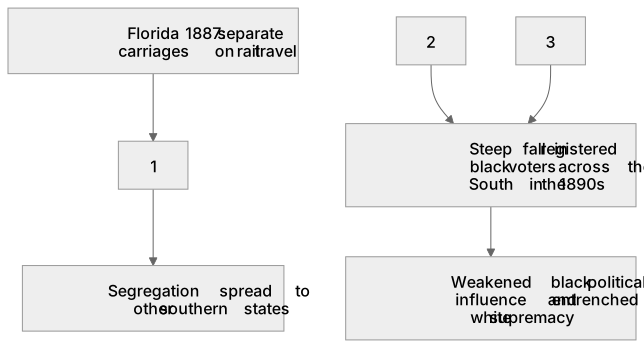
1Box 1
2Box 2
3Box 3
There is more to this lesson
The full lesson goes on to check your understanding and help you earn the marks. Create a free account to carry on, with your progress saved.
A week of Premium from your first lesson · Then the free plan continues · No card, no charge
Test your understanding of Paper 3, Option 39.1: Civil rights and race relations in the USA, 1850–2009 - 2 The triumph of ‘Jim Crow’, 1883–c1900: The spread of Jim Crow Laws: changes to rail travel in Florida 1887; extension of segregation to other social areas and other states. Excluding black voters: discrimination in Mississippi from 1890; Louisiana’s Grandfather clause 1898; impact on voter numbers in the south in the 1890s.
Active recall beats re-reading. Take an instant quiz now to test what you’ve learned and lock it into long-term memory.
A week of Premium from your first lesson · Then the free plan continues · No card, no charge