Pearson Edexcel · A-Level · History
Course version: 9HI0 · Version from Sept 2015
Mass media and social change in Britain, 1882–2004 - 1 The age of the…
Full specification wording
Paper 3, Option 39.2: Mass media and social change in Britain, 1882–2004 - 1 The age of the press barons, 1914–36: The influence of Beaverbrook and Northcliffe; Northcliffe’s stance on conscription and criticisms of some conduct of the war; Beaverbrook’s undermining of Asquith and support for Lloyd George, and involvement in the abdication crisis.
This topic examines how two press barons used mass-circulation newspapers to shape politics between 1914 and 1936.
Checked against the Pearson Edexcel 9HI0 specification (opens in a new tab) on .
- Point 1 of 3
- 4 key terms
Study notes
From the checked teaching notes for this specification point.
The idea
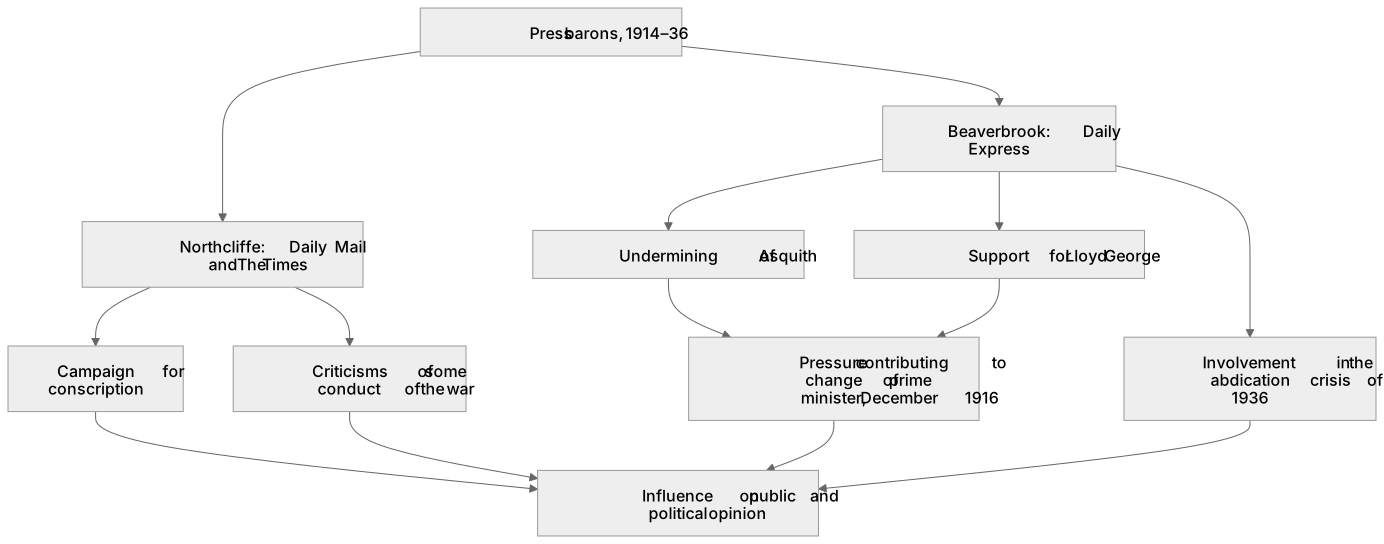
This topic examines how two press barons used mass-circulation newspapers to shape politics between 1914 and 1936. Northcliffe, owner of the Daily Mail and The Times, campaigned for conscription and criticised aspects of the conduct of the war, using his papers to press the government and influence public opinion. Beaverbrook, owner of the Daily Express, undermined Asquith and supported Lloyd George, helping to build the political pressure that contributed to the change of prime minister in December 1916. He later used his press influence during the abdication crisis of 1936, when Edward VIII’s proposed marriage to Wallis Simpson divided opinion. Strong answers assess how far press influence actually changed outcomes, weighing newspaper power against other political, constitutional and social factors.
What earns the marks
- Explains Northcliffe’s stance on conscription, including his campaign through the Daily Mail and The Times for compulsory military service before and during the First World War.
- Analyses Northcliffe’s criticisms of some conduct of the war, such as attacks on shortages of shells and on military and political leadership, and considers their effect on public and political opinion.
- Examines Beaverbrook’s undermining of Asquith, including press criticism of his leadership, and his support for Lloyd George as a more energetic wartime leader.
- Assesses Beaverbrook’s involvement in the abdication crisis, including the stance of the Daily Express and the wider press debate over Edward VIII and Wallis Simpson.
- Evaluates the extent of press baron influence, distinguishing between shaping opinion, reflecting existing opinion and directly causing political outcomes.
- Uses specific evidence from the period 1914–36 to support a judgement on the significance of Beaverbrook and Northcliffe in mass media and social change.
Common mistakes and how to put them right
Claiming the press alone removed Asquith.
Put it right: Present press pressure as one factor alongside party and coalition manoeuvres, military setbacks and the constitutional crisis of 1916.
Confusing the two owners’ papers and campaigns.
Put it right: Attach Northcliffe to the Daily Mail and The Times and Beaverbrook to the Daily Express, and to keep their causes distinct.
Treating newspaper influence as direct control of readers.
Put it right: Discuss persuasion, agenda-setting and the limits of press power in a period of expanding but not universal readership.
Exam tips
- Link each owner to a named paper, a specific campaign and a political consequence, so evidence and argument stay connected.
- Compare the two men explicitly, for example contrasting Northcliffe’s wartime campaigns with Beaverbrook’s role in leadership change and the abdication crisis.
- Qualify claims about influence by referring to other factors such as party politics, the monarchy and public opinion, showing awareness of debate.
Try the lesson
The start of the Paper 3, Option 39.2: Mass media and social change in Britain, 1882–2004 - 1 The age of the press barons, 1914–36: The influence of Beaverbrook and Northcliffe; Northcliffe’s stance on conscription and criticisms of some conduct of the war; Beaverbrook’s undermining of Asquith and support for Lloyd George, and involvement in the abdication crisis. lesson, made from checked teaching notes for this specification point.
Have a go first
Which issue did Northcliffe take a strong stance on during the First World War?
Listen
This topic examines how two press barons used mass-circulation newspapers to shape politics between 1914 and 1936. Northcliffe, owner of the Daily Mail and The Times, campaigned for conscription and criticised aspects of the conduct of the war, using his papers to press the government and influence public opinion. Beaverbrook, owner of the Daily Express, undermined Asquith and supported Lloyd George, helping to build the political pressure that contributed to the change of prime minister in December 1916. He later used his press influence during the abdication crisis of 1936, when Edward VIII’s proposed marriage to Wallis Simpson divided opinion. Strong answers assess how far press influence actually changed outcomes, weighing newspaper power against other political, constitutional and social factors. A strong answer earns marks for these points. Explains Northcliffe’s stance on conscription, including his campaign through the Daily Mail and The Times for compulsory military service before and during the First World War. Analyses Northcliffe’s criticisms of some conduct of the war, such as attacks on shortages of shells and on military and political leadership, and considers their effect on public and political opinion. Examines Beaverbrook’s undermining of Asquith, including press criticism of his leadership, and his support for Lloyd George as a more energetic wartime leader. Assesses Beaverbrook’s involvement in the abdication crisis, including the stance of the Daily Express and the wider press debate over Edward VIII and Wallis Simpson. A common slip: Claiming the press alone removed Asquith. Instead, present press pressure as one factor alongside party and coalition manoeuvres, military setbacks and the constitutional crisis of 1916. Exam tip: Link each owner to a named paper, a specific campaign and a political consequence, so evidence and argument stay connected.
See it
Key words
Say what each word means before you turn the card.
Press and political power
Try answering aloud or in your head before turning the card.
Wartime leadership and conscription
Try answering aloud or in your head before turning the card.
Ownership and public opinion
Try answering aloud or in your head before turning the card.
Constitutional crisis and the monarchy
Try answering aloud or in your head before turning the card.
See every definition
- Press and political power
- Using mass-circulation newspapers to press the government and influence public opinion, shaping politics between 1914 and 1936.
- Wartime leadership and conscription
- Northcliffe campaigned for compulsory military service and criticised aspects of the conduct of the war through his papers.
- Ownership and public opinion
- Northcliffe owned the Daily Mail and The Times, while Beaverbrook owned the Daily Express, using them to influence public opinion.
- Constitutional crisis and the monarchy
- The abdication crisis of 1936, when Edward VIII's proposed marriage to Wallis Simpson divided opinion and Beaverbrook used his press influence.
Label the diagram
Some boxes have lost their names. Pick the right name for each number.
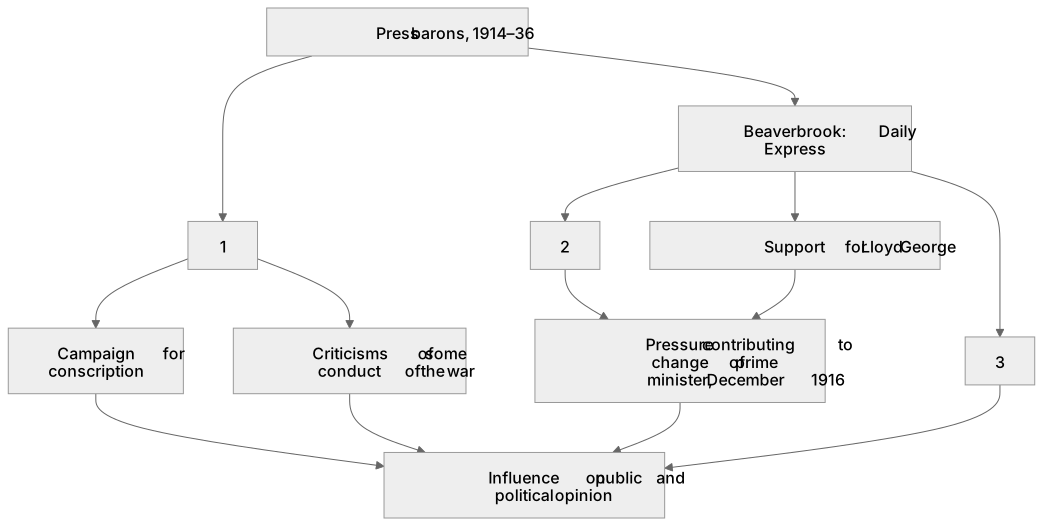
1Box 1
2Box 2
3Box 3
There is more to this lesson
The full lesson goes on to check your understanding and help you earn the marks. Create a free account to carry on, with your progress saved.
A week of Premium from your first lesson · Then the free plan continues · No card, no charge
Test your understanding of Paper 3, Option 39.2: Mass media and social change in Britain, 1882–2004 - 1 The age of the press barons, 1914–36: The influence of Beaverbrook and Northcliffe; Northcliffe’s stance on conscription and criticisms of some conduct of the war; Beaverbrook’s undermining of Asquith and support for Lloyd George, and involvement in the abdication crisis.
Active recall beats re-reading. Take an instant quiz now to test what you’ve learned and lock it into long-term memory.
A week of Premium from your first lesson · Then the free plan continues · No card, no charge