Pearson Edexcel · A-Level · History
Course version: 9HI0 · Version from Sept 2015
Mass media and social change in Britain, 1882–2004 - 1 The age of the…
Full specification wording
Paper 3, Option 39.2: Mass media and social change in Britain, 1882–2004 - 1 The age of the press barons, 1914–36: The importance of Rothermere: his newspaper empire and expansion, the newspaper war, 1928–29; his influence, including support of revisions to First World War treaties, clash with Baldwin in 1931, support for Moseley and the BUF.
Rothermere built a mass-circulation empire, notably the Daily Mail and Daily Mirror, expanding titles and readership.
Checked against the Pearson Edexcel 9HI0 specification (opens in a new tab) on .
- Point 2 of 3
- 4 key terms
Study notes
From the checked teaching notes for this specification point.
The idea
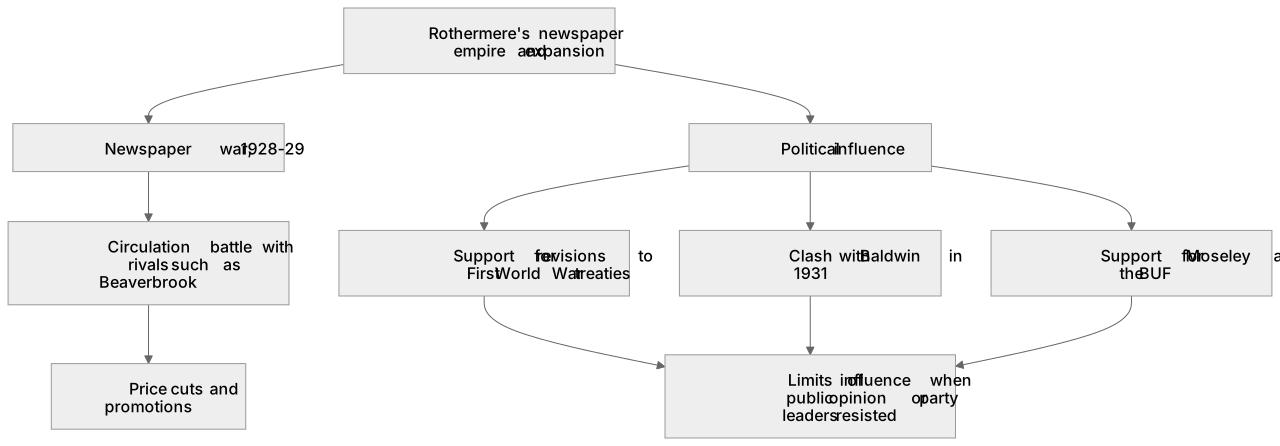
Rothermere built a mass-circulation empire, notably the Daily Mail and Daily Mirror, expanding titles and readership. In the 1928–29 newspaper war he fought rivals such as Beaverbrook, using price cuts and promotions to win circulation. His influence was political: he backed revising First World War treaties, especially against the Versailles settlement, and opposed Baldwin in 1931, helping to force Baldwin to seek a renewed mandate. He also supported Oswald Mosley and the British Union of Fascists, using his papers to promote their ideas.
What earns the marks
- Explains the scale and structure of Rothermere's newspaper empire, including the Daily Mail and Daily Mirror, and how expansion increased his reach.
- Analyses the 1928–29 newspaper war as a circulation battle with rivals such as Beaverbrook, involving price cuts, competitions and promotional tactics.
- Assesses Rothermere's support for revisions to First World War treaties, including opposition to the Versailles settlement and advocacy of treaty change.
- Examines the 1931 clash with Baldwin, including Rothermere's campaign against Baldwin and the political consequences for both men.
- Evaluates Rothermere's support for Moseley and the BUF, and the extent to which his newspapers shaped or reflected fascist support.
- Judges the overall importance of Rothermere by weighing his commercial power against the limits of his political influence.
Common mistakes and how to put them right
Treating Rothermere as identical to Beaverbrook.
Put it right: Distinguish their separate empires, rivalries and political positions.
Assuming the newspaper war was only about prestige.
Put it right: Link it to circulation, advertising revenue and commercial survival.
Claiming Rothermere's support for the BUF gave the party mass electoral success.
Put it right: Note that BUF support remained limited and his backing was controversial.
Confusing Rothermere's treaty revisionism with support for Nazi Germany.
Put it right: Explain his specific calls to revise First World War treaties without equating them with later appeasement.
Exam tips
- Use specific titles, dates and events to support each claim about Rothermere's influence.
- Weigh commercial success against political outcomes to reach a supported judgement on his importance.
- Connect Rothermere's actions to the wider theme of press barons' power in the period.
- Avoid listing facts; group them into empire, newspaper war and political influence.
Try the lesson
The start of the Paper 3, Option 39.2: Mass media and social change in Britain, 1882–2004 - 1 The age of the press barons, 1914–36: The importance of Rothermere: his newspaper empire and expansion, the newspaper war, 1928–29; his influence, including support of revisions to First World War treaties, clash with Baldwin in 1931, support for Moseley and the BUF. lesson, made from checked teaching notes for this specification point.
Have a go first
Which newspaper did Lord Rothermere own and develop as the flagship of his press empire during the 1920s?
Listen
Rothermere built a mass-circulation empire, notably the Daily Mail and Daily Mirror, expanding titles and readership. In the 1928–29 newspaper war he fought rivals such as Beaverbrook, using price cuts and promotions to win circulation. His influence was political: he backed revising First World War treaties, especially against the Versailles settlement, and opposed Baldwin in 1931, helping to force Baldwin to seek a renewed mandate. He also supported Oswald Mosley and the British Union of Fascists, using his papers to promote their ideas. A strong answer earns marks for these points. Explains the scale and structure of Rothermere's newspaper empire, including the Daily Mail and Daily Mirror, and how expansion increased his reach. Analyses the 1928–29 newspaper war as a circulation battle with rivals such as Beaverbrook, involving price cuts, competitions and promotional tactics. Assesses Rothermere's support for revisions to First World War treaties, including opposition to the Versailles settlement and advocacy of treaty change. Examines the 1931 clash with Baldwin, including Rothermere's campaign against Baldwin and the political consequences for both men. A common slip: Treating Rothermere as identical to Beaverbrook. Instead, distinguish their separate empires, rivalries and political positions. Exam tip: Use specific titles, dates and events to support each claim about Rothermere's influence.
See it
Key words
Say what each word means before you turn the card.
Press barons and mass media
Try answering aloud or in your head before turning the card.
Commercial competition and circulation
Try answering aloud or in your head before turning the card.
Political influence and party politics
Try answering aloud or in your head before turning the card.
Fascism and extremism in Britain
Try answering aloud or in your head before turning the card.
See every definition
- Press barons and mass media
- Owners who built mass-circulation newspaper empires, expanding titles and readership to increase their reach.
- Commercial competition and circulation
- Rivalry fought through price cuts and promotions to win readers, as in the 1928–29 newspaper war with rivals such as Beaverbrook.
- Political influence and party politics
- Using newspapers to back revising First World War treaties, oppose Baldwin in 1931 and promote ideas, with limits when public opinion or party leaders resisted.
- Fascism and extremism in Britain
- Support for Oswald Mosley and the British Union of Fascists, whose ideas his papers promoted, though backing remained controversial and support limited.
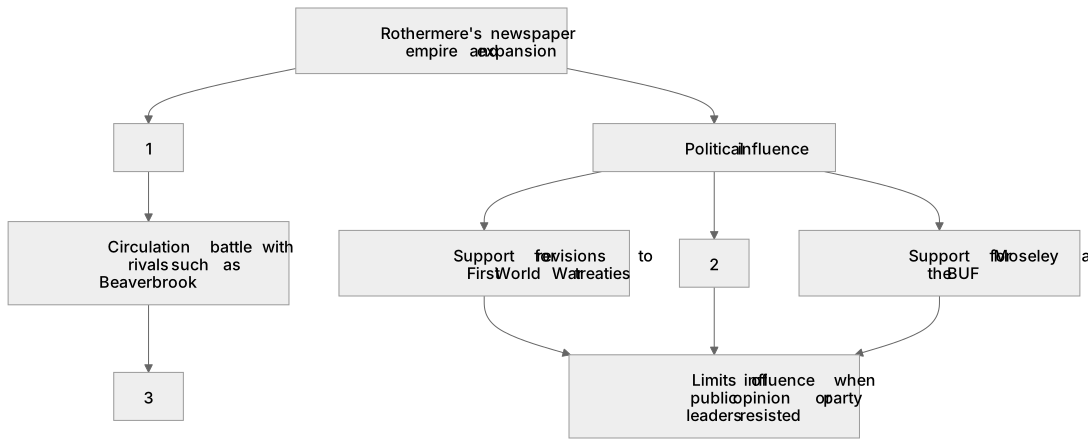
Label the diagram
Some boxes have lost their names. Pick the right name for each number.
1Box 1
2Box 2
3Box 3
There is more to this lesson
The full lesson goes on to check your understanding and help you earn the marks. Create a free account to carry on, with your progress saved.
A week of Premium from your first lesson · Then the free plan continues · No card, no charge
Test your understanding of Paper 3, Option 39.2: Mass media and social change in Britain, 1882–2004 - 1 The age of the press barons, 1914–36: The importance of Rothermere: his newspaper empire and expansion, the newspaper war, 1928–29; his influence, including support of revisions to First World War treaties, clash with Baldwin in 1931, support for Moseley and the BUF.
Active recall beats re-reading. Take an instant quiz now to test what you’ve learned and lock it into long-term memory.
A week of Premium from your first lesson · Then the free plan continues · No card, no charge