Pearson Edexcel · A-Level · History
Course version: 9HI0 · Version from Sept 2015
Mass media and social change in Britain, 1882–2004 - 3 Media in the…
Full specification wording
Paper 3, Option 39.2: Mass media and social change in Britain, 1882–2004 - 3 Media in the sixties: satire image and social change: The importance of film and television in engaging with, and reflecting, social issues and prejudices, including racism, sexism and homelessness; Mary Whitehouse and the NVALA.
Film and television in 1960s Britain reflected and shaped social issues and prejudices.
Checked against the Pearson Edexcel 9HI0 specification (opens in a new tab) on .
- Point 2 of 3
- 4 key terms
Study notes
From the checked teaching notes for this specification point.
The idea
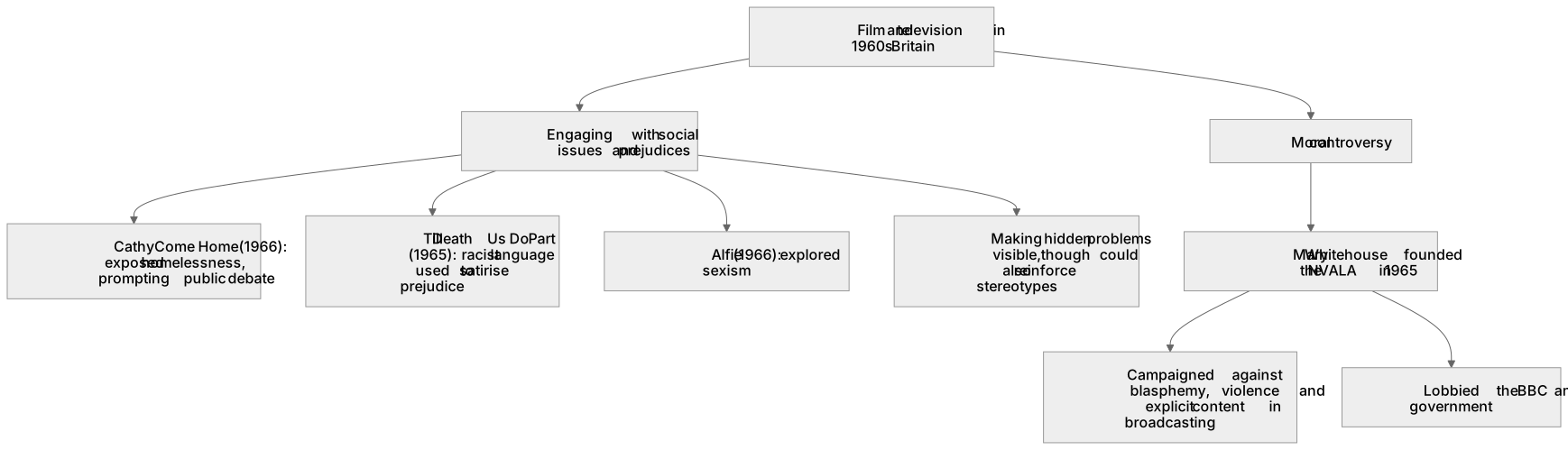
Film and television in 1960s Britain reflected and shaped social issues and prejudices. Programmes like Cathy Come Home (1966) exposed homelessness, prompting public debate. Till Death Us Do Part (1965) used racist language to satirise prejudice, while films like Alfie (1966) explored sexism. These media engaged audiences by making hidden problems visible, though they could also reinforce stereotypes. In response to perceived moral decline, Mary Whitehouse founded the National Viewers' and Listeners' Association (NVALA) in 1965. The NVALA campaigned against blasphemy, violence and explicit content in broadcasting, lobbying the BBC and government. Thus, film and television were central to social commentary and moral controversy.
What earns the marks
- Explains how film and television engaged with social issues such as homelessness, racism and sexism, using specific examples like Cathy Come Home, Till Death Us Do Part and Alfie.
- Analyses how media reflected prejudices, for example through stereotypical representations or satirical exposure that could reinforce or challenge attitudes.
- Assesses the role of Mary Whitehouse and the NVALA in campaigning against perceived moral decline and lobbying for stricter broadcasting standards.
- Evaluates the extent to which media shaped public debate and policy, considering both progressive and conservative responses.
- Uses accurate historical context of 1960s Britain, including changing social attitudes and the moral panic surrounding permissiveness.
Common mistakes and how to put them right
Treating Cathy Come Home as a documentary rather than a drama-documentary.
Put it right: Recognise it as a BBC television play directed by Ken Loach that used documentary style to highlight homelessness.
Assuming Mary Whitehouse opposed all television or successfully passed the 1968 Theatres Act.
Put it right: She targeted specific broadcasting content she deemed offensive, and the 1968 Theatres Act actually abolished theatre censorship, a liberalising measure she opposed.
Claiming Till Death Us Do Part was purely racist without acknowledging its satirical intent.
Put it right: Note that it aimed to mock racist attitudes through the character Alf Garnett, though some viewers missed the irony.
Exam tips
- Integrate specific examples of films and television programmes to support arguments about social issues and prejudices.
- When discussing Mary Whitehouse and the NVALA, focus on their campaigns against the BBC (e.g., Hugh Greene's leadership) and their role in the wider 'moral panic' rather than claiming they passed liberalising legislation.
- Consider both the intended and unintended effects of media representations, and how different audiences might respond.
Try the lesson
The start of the Paper 3, Option 39.2: Mass media and social change in Britain, 1882–2004 - 3 Media in the sixties: satire image and social change: The importance of film and television in engaging with, and reflecting, social issues and prejudices, including racism, sexism and homelessness; Mary Whitehouse and the NVALA. lesson, made from checked teaching notes for this specification point.
Have a go first
Which organisation did Mary Whitehouse lead in her campaign against what she regarded as offensive content on British television?
Listen
Film and television in 1960s Britain reflected and shaped social issues and prejudices. Programmes like Cathy Come Home (1966) exposed homelessness, prompting public debate. Till Death Us Do Part (1965) used racist language to satirise prejudice, while films like Alfie (1966) explored sexism. These media engaged audiences by making hidden problems visible, though they could also reinforce stereotypes. In response to perceived moral decline, Mary Whitehouse founded the National Viewers' and Listeners' Association (NVALA) in 1965. The NVALA campaigned against blasphemy, violence and explicit content in broadcasting, lobbying the BBC and government. Thus, film and television were central to social commentary and moral controversy. A strong answer earns marks for these points. Explains how film and television engaged with social issues such as homelessness, racism and sexism, using specific examples like Cathy Come Home, Till Death Us Do Part and Alfie. Analyses how media reflected prejudices, for example through stereotypical representations or satirical exposure that could reinforce or challenge attitudes. Assesses the role of Mary Whitehouse and the NVALA in campaigning against perceived moral decline and lobbying for stricter broadcasting standards. Evaluates the extent to which media shaped public debate and policy, considering both progressive and conservative responses. A common slip: Treating Cathy Come Home as a documentary rather than a drama-documentary. Instead, Recognise it as a BBC television play directed by Ken Loach that used documentary style to highlight homelessness. Exam tip: Integrate specific examples of films and television programmes to support arguments about social issues and prejudices.
See it
Key words
Say what each word means before you turn the card.
Media as a mirror and shaper of social attitudes
Try answering aloud or in your head before turning the card.
Representation of marginalised groups and social problems
Try answering aloud or in your head before turning the card.
Moral panic and censorship debates
Try answering aloud or in your head before turning the card.
The influence of pressure groups on broadcasting policy
Try answering aloud or in your head before turning the card.
See every definition
- Media as a mirror and shaper of social attitudes
- Film and television reflected social issues and prejudices while also shaping them, making hidden problems visible and prompting public debate.
- Representation of marginalised groups and social problems
- Media engaged audiences by making hidden problems visible, though they could also reinforce stereotypes.
- Moral panic and censorship debates
- Mary Whitehouse founded the NVALA in 1965 in response to perceived moral decline, campaigning against blasphemy, violence and explicit content in broadcasting.
- The influence of pressure groups on broadcasting policy
- The NVALA campaigned against blasphemy, violence and explicit content in broadcasting, lobbying the BBC and government.
Label the diagram
Some boxes have lost their names. Pick the right name for each number.
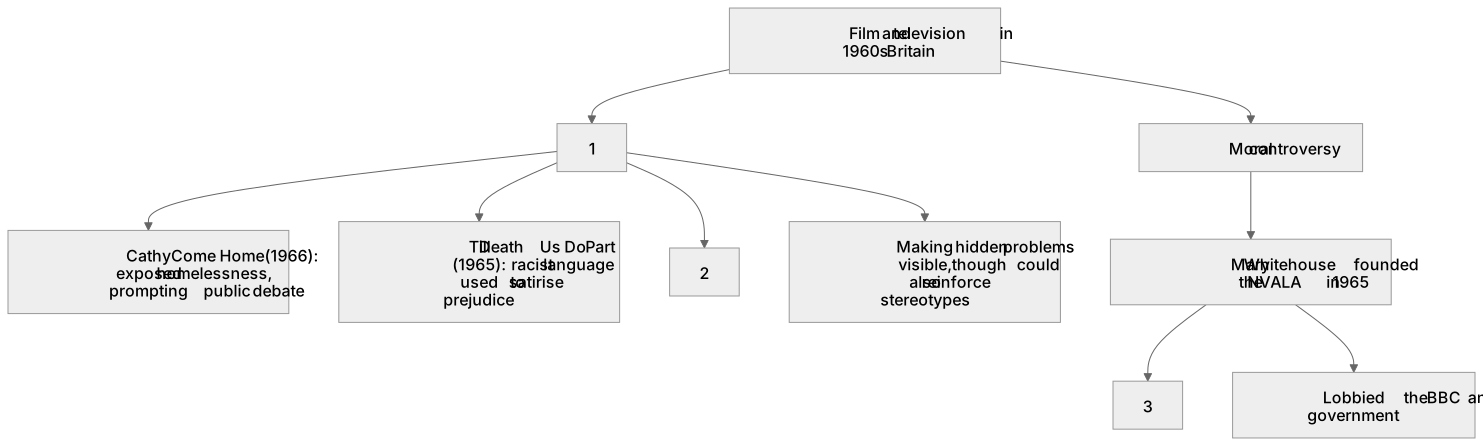
1Box 1
2Box 2
3Box 3
There is more to this lesson
The full lesson goes on to check your understanding and help you earn the marks. Create a free account to carry on, with your progress saved.
A week of Premium from your first lesson · Then the free plan continues · No card, no charge
Test your understanding of Paper 3, Option 39.2: Mass media and social change in Britain, 1882–2004 - 3 Media in the sixties: satire image and social change: The importance of film and television in engaging with, and reflecting, social issues and prejudices, including racism, sexism and homelessness; Mary Whitehouse and the NVALA.
Active recall beats re-reading. Take an instant quiz now to test what you’ve learned and lock it into long-term memory.
A week of Premium from your first lesson · Then the free plan continues · No card, no charge