Pearson Edexcel · A-Level · History
Course version: 9HI0 · Version from Sept 2015
Mass media and social change in Britain, 1882–2004 - 3 Media in the…
Full specification wording
Paper 3, Option 39.2: Mass media and social change in Britain, 1882–2004 - 3 Media in the sixties: satire image and social change: The significance of satire in changing attitudes to government, monarchy and the church.
This topic examines how satire in the 1960s, through television programmes such as That Was The Week That Was and Private Eye magazine, challenged established attitudes towards government, the…
Checked against the Pearson Edexcel 9HI0 specification (opens in a new tab) on .
- Point 1 of 3
Study notes
From the checked teaching notes for this specification point.
The idea
This topic examines how satire in the 1960s, through television programmes such as That Was The Week That Was and Private Eye magazine, challenged established attitudes towards government, the monarchy and the church. Satire mocked politicians' incompetence, royal detachment and religious authority, helping to normalise criticism and reduce deference. Its significance lies in whether it changed public attitudes or merely reflected existing shifts. The key skill is evaluating the extent of satire's influence on attitudes, using evidence of audience response, political reaction and cultural impact, rather than simply describing satirical content.
What earns the marks
- Explains how satire targeted government, monarchy and the church, giving examples from programmes or publications.
- Assesses the extent to which satire changed attitudes, distinguishing between reflecting and causing shifts in public opinion.
- Evaluates the significance of satire in the context of other social and political changes in the 1960s.
- Uses evidence of audience reaction, political response or cultural debate to support judgements about satire's impact.
- Considers limitations, such as satire's appeal to a mainly educated audience or its reinforcement of existing views.
- Compares satire's impact on different institutions, recognising variations in deference and criticism.
Common mistakes and how to put them right
Assuming satire directly caused attitude change without considering other factors.
Put it right: Evaluate satire's role alongside broader social trends and evidence.
Treating all three institutions as equally affected.
Put it right: Compare the extent and nature of satire's challenge to government, monarchy and church separately.
Describing satirical content without assessing its significance.
Put it right: Focus on impact and use evidence to judge how far attitudes shifted.
Overstating satire's audience reach.
Put it right: Recognise that satire often appealed to a minority and may have reinforced rather than converted opinions.
Exam tips
- Structure your answer around the three institutions, ensuring each is addressed with specific examples and an evaluative judgement.
- Use contemporary evidence, such as audience figures, political reactions or quotes, to support claims about satire's significance.
- Consider counterarguments, such as satire reflecting rather than causing change, to strengthen your evaluation.
- Link satire to the wider context of the 1960s to show how it interacted with other forces for social change.
Try the lesson
The start of the Paper 3, Option 39.2: Mass media and social change in Britain, 1882–2004 - 3 Media in the sixties: satire image and social change: The significance of satire in changing attitudes to government, monarchy and the church. lesson, made from checked teaching notes for this specification point.
Have a go first
Which television programme of the early 1960s is most closely associated with the satire boom that mocked politicians and other public figures?
Listen
This topic examines how satire in the 1960s, through television programmes such as That Was The Week That Was and Private Eye magazine, challenged established attitudes towards government, the monarchy and the church. Satire mocked politicians' incompetence, royal detachment and religious authority, helping to normalise criticism and reduce deference. Its significance lies in whether it changed public attitudes or merely reflected existing shifts. The key skill is evaluating the extent of satire's influence on attitudes, using evidence of audience response, political reaction and cultural impact, rather than simply describing satirical content. A strong answer earns marks for these points. Explains how satire targeted government, monarchy and the church, giving examples from programmes or publications. Assesses the extent to which satire changed attitudes, distinguishing between reflecting and causing shifts in public opinion. Evaluates the significance of satire in the context of other social and political changes in the 1960s. Uses evidence of audience reaction, political response or cultural debate to support judgements about satire's impact. A common slip: Assuming satire directly caused attitude change without considering other factors. Instead, evaluate satire's role alongside broader social trends and evidence. Exam tip: Structure your answer around the three institutions, ensuring each is addressed with specific examples and an evaluative judgement.
See it
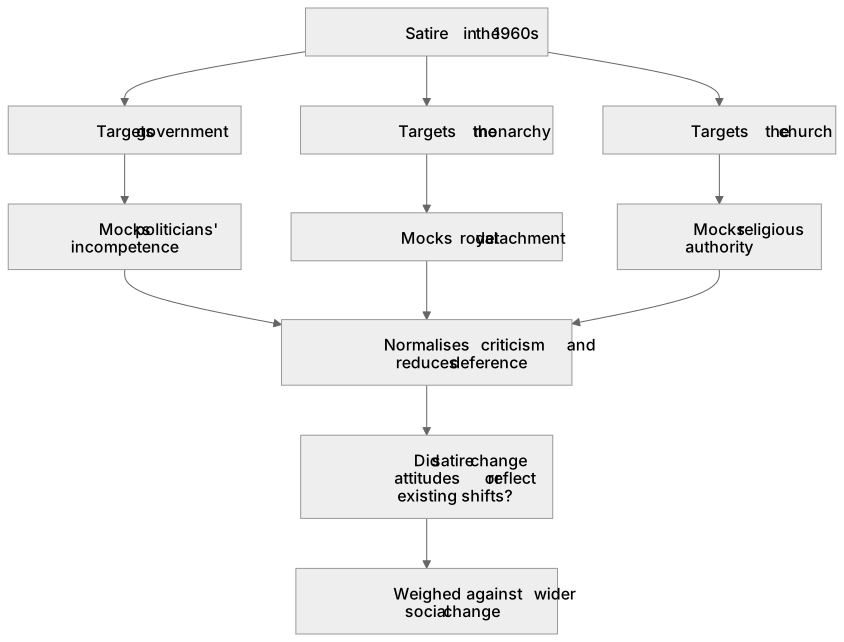
Label the diagram
Some boxes have lost their names. Pick the right name for each number.
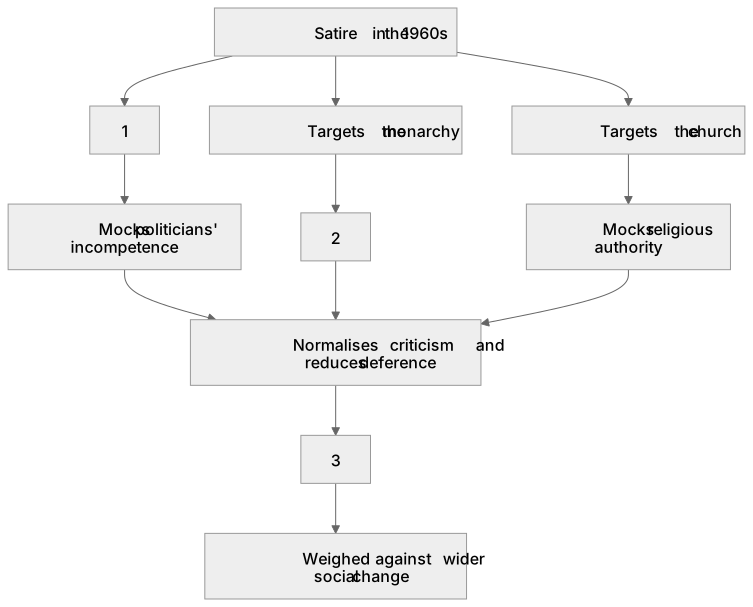
1Box 1
2Box 2
3Box 3
There is more to this lesson
The full lesson goes on to check your understanding and help you earn the marks. Create a free account to carry on, with your progress saved.
A week of Premium from your first lesson · Then the free plan continues · No card, no charge
Test your understanding of Paper 3, Option 39.2: Mass media and social change in Britain, 1882–2004 - 3 Media in the sixties: satire image and social change: The significance of satire in changing attitudes to government, monarchy and the church.
Active recall beats re-reading. Take an instant quiz now to test what you’ve learned and lock it into long-term memory.
A week of Premium from your first lesson · Then the free plan continues · No card, no charge