Pearson Edexcel · A-Level · History
Course version: 9HI0 · Version from Sept 2015
Creation and collapse of the Weimar Republic, 1918–33: creation of a…
Full specification wording
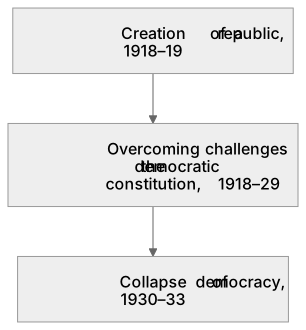
Political and governmental change, 1918–89: Creation and collapse of the Weimar Republic, 1918–33: creation of a republic, 1918–19; overcoming challenges to the democratic constitution, 1918–29; collapse of democracy, 1930–33.
The Weimar Republic was born from defeat and revolution in 1918–19, when the Kaiser abdicated and a democratic constitution was framed at Weimar.
Checked against the Pearson Edexcel 9HI0 specification (opens in a new tab) on .
- Point 1 of 3
- 4 key terms
Study notes
From the checked teaching notes for this specification point.
The idea
The Weimar Republic was born from defeat and revolution in 1918–19, when the Kaiser abdicated and a democratic constitution was framed at Weimar. Its early years were precarious: the Treaty of Versailles, hyperinflation and uprisings tested the new democracy. From 1924, Stresemann's policies brought relative stability, but underlying weaknesses remained. After the Wall Street Crash, economic crisis and presidential intrigue eroded parliamentary government, and by 1933 democracy had collapsed. You must explain how the republic was created, how it survived challenges, and why it failed, using precise evidence and causal links.
What earns the marks
- Evaluates the relative importance of structural weaknesses in the constitution, economic crises, and the role of individuals and elites in the collapse of democracy.
- Uses precise chronological knowledge and historical concepts (causation, consequence, change and continuity) to construct a coherent argument.
Common mistakes and how to put them right
Treating the Weimar Republic as doomed from the start without considering the period of relative stability 1924–29.
Put it right: Weigh both the successes of the Stresemann era and the underlying weaknesses that persisted.
Confusing the dates of key events, such as placing the Kapp Putsch in 1923 instead of 1920.
Put it right: Create a timeline of major events to secure accurate chronological knowledge.
Attributing the collapse of democracy solely to Hitler's actions.
Put it right: Consider the roles of economic crisis, constitutional flaws, and the decisions of conservative elites such as Hindenburg, Papen and Schleicher.
Exam tips
- Practise writing analytical paragraphs that make a clear point, use specific evidence, and explain significance rather than simply narrating events.
- When evaluating causation, explicitly compare factors and reach a substantiated judgement about which was most significant.
- Use past paper questions to practise timing and planning, ensuring you address all parts of the question and maintain a clear line of argument.
Try the lesson
The start of the Political and governmental change, 1918–89: Creation and collapse of the Weimar Republic, 1918–33: creation of a republic, 1918–19; overcoming challenges to the democratic constitution, 1918–29; collapse of democracy, 1930–33. lesson, made from checked teaching notes for this specification point.
Have a go first
Which constitution established the democratic republic in Germany in 1919?
Listen
The Weimar Republic was born from defeat and revolution in 1918–19, when the Kaiser abdicated and a democratic constitution was framed at Weimar. Its early years were precarious: the Treaty of Versailles, hyperinflation and uprisings tested the new democracy. From 1924, Stresemann's policies brought relative stability, but underlying weaknesses remained. After the Wall Street Crash, economic crisis and presidential intrigue eroded parliamentary government, and by 1933 democracy had collapsed. You must explain how the republic was created, how it survived challenges, and why it failed, using precise evidence and causal links. A strong answer earns marks for these points. Explains the creation of the republic in 1918–19: the November Revolution, abdication of the Kaiser, the Council of People's Representatives, the National Assembly at Weimar and the adoption of the Weimar Constitution in August 1919. Analyses challenges to the democratic constitution, 1918–29: the Treaty of Versailles, the 'stab in the back' myth, political extremism (Spartacist uprising, Kapp Putsch, Munich Putsch), hyperinflation in 1923, and the subsequent stabilisation under Stresemann. Explains the collapse of democracy, 1930–33: the impact of the Great Depression, the rise in electoral support for the Nazis and Communists, the use of Article 48 and presidential cabinets (Brüning, Papen, Schleicher), and Hitler's appointment as Chancellor in January 1933. Evaluates the relative importance of structural weaknesses in the constitution, economic crises, and the role of individuals and elites in the collapse of democracy. A common slip: treating the Weimar Republic as doomed from the start without considering the period of relative stability 1924–29. Instead, weigh both the successes of the Stresemann era and the underlying weaknesses that persisted. Exam tip: Practise writing analytical paragraphs that make a clear point, use specific evidence, and explain significance rather than simply narrating events.
See it
Put it in order
Put these steps in the order they happen.
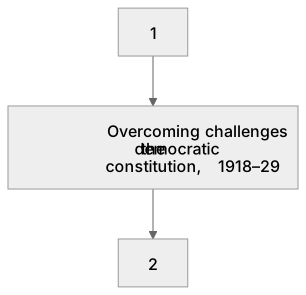
- 1. Overcoming challenges to the democratic constitution, 1918–29
- 2. Collapse of democracy, 1930–33
- 3. Creation of a republic, 1918–19
Key words
Say what each word means before you turn the card.
Democracy and dictatorship
Try answering aloud or in your head before turning the card.
Political extremism and instability
Try answering aloud or in your head before turning the card.
Economic crisis and recovery
Try answering aloud or in your head before turning the card.
The role of individuals and elites
Try answering aloud or in your head before turning the card.
See every definition
- Democracy and dictatorship
- The note frames the period 1918–33 as the creation of a republic and democratic constitution followed by the collapse of democracy by 1933.
- Political extremism and instability
- Uprisings such as the Spartacist uprising, Kapp Putsch and Munich Putsch tested the new democracy in its precarious early years.
- Economic crisis and recovery
- Hyperinflation in 1923 tested the new democracy, and after the Wall Street Crash economic crisis eroded parliamentary government.
- The role of individuals and elites
- The note requires evaluating the role of individuals and elites, including presidential intrigue and the decisions of conservative elites, in the collapse of democracy.
Label the diagram
Some boxes have lost their names. Pick the right name for each number.
1Box 1
2Box 2
There is more to this lesson
The full lesson goes on to check your understanding and help you earn the marks. Create a free account to carry on, with your progress saved.
A week of Premium from your first lesson · Then the free plan continues · No card, no charge
Test your understanding of Political and governmental change, 1918–89: Creation and collapse of the Weimar Republic, 1918–33: creation of a republic, 1918–19; overcoming challenges to the democratic constitution, 1918–29; collapse of democracy, 1930–33.
Active recall beats re-reading. Take an instant quiz now to test what you’ve learned and lock it into long-term memory.
A week of Premium from your first lesson · Then the free plan continues · No card, no charge