Pearson Edexcel · A-Level · History
Course version: 9HI0 · Version from Sept 2015
Nazi dictatorship, 1933–45: establishing a dictatorship, 1933–34; nature…
Full specification wording
Political and governmental change, 1918–89: Nazi dictatorship, 1933–45: establishing a dictatorship, 1933–34; nature of Nazi government, 1934–39; government in wartime, 1939–45.
After Hitler became Chancellor in January 1933, the Nazis rapidly established a dictatorship.
Checked against the Pearson Edexcel 9HI0 specification (opens in a new tab) on .
- Point 2 of 3
- 3 key terms
Study notes
From the checked teaching notes for this specification point.
The idea
After Hitler became Chancellor in January 1933, the Nazis rapidly established a dictatorship. The Reichstag Fire, Enabling Act and Night of the Long Knives removed opposition and consolidated power. From 1934 to 1939, Nazi government was characterised by Hitler's charismatic authority, competing agencies and the SS-police terror system. During the war, radicalisation intensified, with the Holocaust and total war. You must explain how the dictatorship was established, analyse its nature, and assess how government functioned in wartime, using precise evidence and historical debate.
What earns the marks
- Analyses the nature of Nazi government, 1934–39: Hitler's role and style of leadership, the polycratic nature of the regime, the role of the SS and Gestapo, and the extent of terror and propaganda.
- Explains government in wartime, 1939–45: the radicalisation of the regime, the role of Hitler as war leader, the increasing power of the SS, the Holocaust, and the impact of total war on government structures.
- Evaluates different interpretations of Nazi government, such as intentionalist versus structuralist explanations, and the extent to which Hitler was a 'weak dictator' or a master of the Third Reich.
- Uses precise evidence and historical concepts (causation, consequence, change and continuity) to construct a coherent argument.
Common mistakes and how to put them right
Assuming that Nazi government was highly efficient and centrally controlled.
Put it right: Recognise the polycratic and chaotic nature of the regime, with overlapping responsibilities and competing agencies.
Overemphasising Hitler's role while neglecting the contributions of other individuals and organisations, such as Goebbels, Himmler and the SS.
Put it right: Consider the interplay between Hitler's authority and the actions of subordinates.
Treating the Holocaust as a separate topic unrelated to government structures.
Put it right: Integrate the Holocaust into the analysis of wartime radicalisation and the role of the SS and other agencies.
Exam tips
- When discussing interpretations, clearly state the view and support it with evidence, then evaluate its strengths and weaknesses.
- Use specific examples to illustrate the nature of Nazi government, such as the Night of the Long Knives or the Wannsee Conference.
- Practise planning essays that require you to assess change over time, ensuring you cover the whole period 1933–45.
Try the lesson
The start of the Political and governmental change, 1918–89: Nazi dictatorship, 1933–45: establishing a dictatorship, 1933–34; nature of Nazi government, 1934–39; government in wartime, 1939–45. lesson, made from checked teaching notes for this specification point.
Have a go first
Which law gave Hitler the power to make laws without the Reichstag in 1933?
Listen
After Hitler became Chancellor in January 1933, the Nazis rapidly established a dictatorship. The Reichstag Fire, Enabling Act and Night of the Long Knives removed opposition and consolidated power. From 1934 to 1939, Nazi government was characterised by Hitler's charismatic authority, competing agencies and the SS-police terror system. During the war, radicalisation intensified, with the Holocaust and total war. You must explain how the dictatorship was established, analyse its nature, and assess how government functioned in wartime, using precise evidence and historical debate. A strong answer earns marks for these points. Explains how the dictatorship was established in 1933–34: the Reichstag Fire, the Enabling Act, the banning of political parties and trade unions, the Night of the Long Knives, and the merging of the offices of Chancellor and President after Hindenburg's death. Analyses the nature of Nazi government, 1934–39: Hitler's role and style of leadership, the polycratic nature of the regime, the role of the SS and Gestapo, and the extent of terror and propaganda. Explains government in wartime, 1939–45: the radicalisation of the regime, the role of Hitler as war leader, the increasing power of the SS, the Holocaust, and the impact of total war on government structures. Evaluates different interpretations of Nazi government, such as intentionalist versus structuralist explanations, and the extent to which Hitler was a 'weak dictator' or a master of the Third Reich. A common slip: assuming that Nazi government was highly efficient and centrally controlled. Instead, recognise the polycratic and chaotic nature of the regime, with overlapping responsibilities and competing agencies. Exam tip: When discussing interpretations, clearly state the view and support it with evidence, then evaluate its strengths and weaknesses.
See it
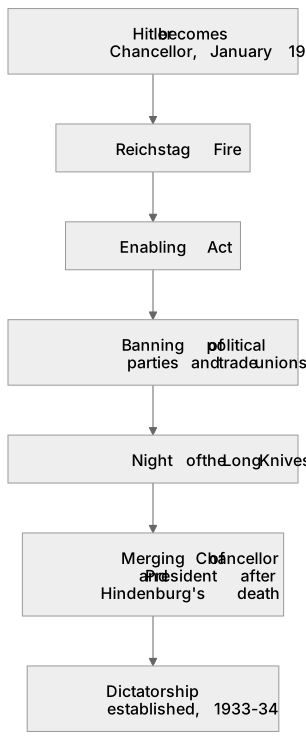
Put it in order
Put these steps in the order they happen.
- 1. Dictatorship established, 1933-34
- 2. Merging of Chancellor and President after Hindenburg's death
- 3. Enabling Act
- 4. Night of the Long Knives
- 5. Hitler becomes Chancellor, January 1933
- 6. Reichstag Fire
- 7. Banning of political parties and trade unions
Key words
Say what each word means before you turn the card.
Terror and propaganda
Try answering aloud or in your head before turning the card.
Polycracy and competing agencies
Try answering aloud or in your head before turning the card.
Radicalisation and war
Try answering aloud or in your head before turning the card.
See every definition
- Terror and propaganda
- A feature of Nazi government whose extent must be analysed when examining the nature of the regime between 1934 and 1939.
- Polycracy and competing agencies
- A characteristic of Nazi government from 1934 to 1939, involving overlapping responsibilities and competing agencies rather than central control.
- Radicalisation and war
- A process that intensified during wartime, 1939–45, alongside the Holocaust and total war.
Label the diagram
Some boxes have lost their names. Pick the right name for each number.
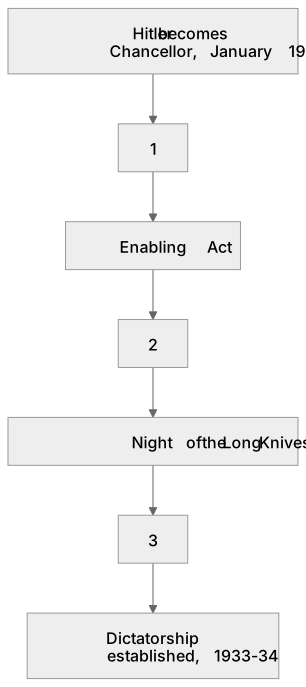
1Box 1
2Box 2
3Box 3
There is more to this lesson
The full lesson goes on to check your understanding and help you earn the marks. Create a free account to carry on, with your progress saved.
A week of Premium from your first lesson · Then the free plan continues · No card, no charge
Test your understanding of Political and governmental change, 1918–89: Nazi dictatorship, 1933–45: establishing a dictatorship, 1933–34; nature of Nazi government, 1934–39; government in wartime, 1939–45.
Active recall beats re-reading. Take an instant quiz now to test what you’ve learned and lock it into long-term memory.
A week of Premium from your first lesson · Then the free plan continues · No card, no charge