Pearson Edexcel · A-Level · History
Course version: 9HI0 · Version from Sept 2015
Central institutions: the Curia Regis; the justiciars and the Chancellor;…
Full specification wording
Reforms in England, 1154–89: Central institutions: the Curia Regis; the justiciars and the Chancellor; the roles of significant individuals, including Richard of Lucy, Bishop Nigel and Thomas Becket.
Henry II governed through the Curia Regis, the royal court that advised the king, heard pleas and issued writs.
Checked against the Pearson Edexcel 9HI0 specification (opens in a new tab) on .
- Point 1 of 4
- 4 key terms
Study notes
From the checked teaching notes for this specification point.
The idea
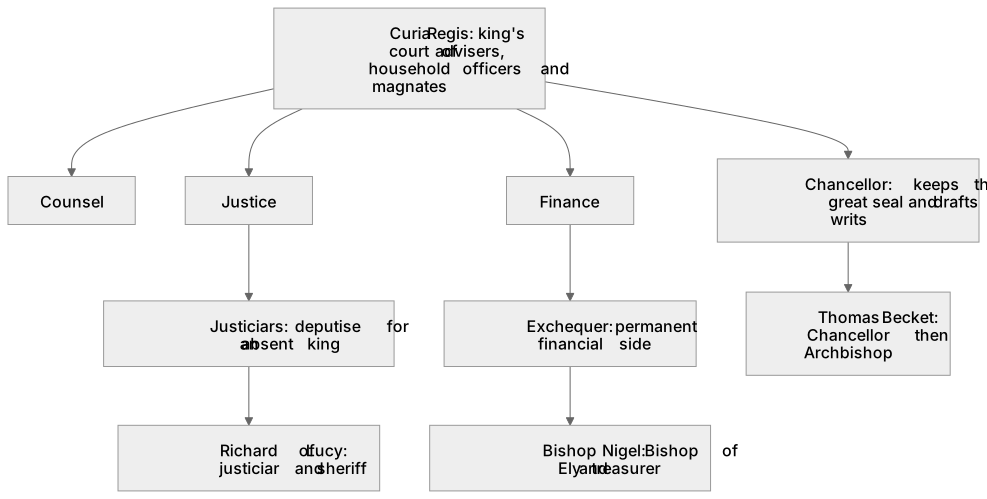
Henry II governed through the Curia Regis, the royal court that advised the king, heard pleas and issued writs. Its permanent financial side became the Exchequer, while its judicial work produced the justiciars, who deputised for an absent king, and the Chancellor, who kept the great seal and drafted writs. Richard of Lucy, Bishop Nigel and Thomas Becket show how office and personality shaped reform. Lucy, as justiciar and sheriff, enforced royal justice and finance; Nigel, as Bishop of Ely and treasurer, organised Exchequer accounting; Becket, as Chancellor then Archbishop, illustrates the tension between royal service and Church loyalty. Assess the relative importance of institutions and individuals.
What earns the marks
- Explains the Curia Regis as the king's court of advisers, household officers and magnates, which handled counsel, justice and finance and spawned specialised offshoots such as the Exchequer.
- Distinguishes the justiciar's role as the king's chief deputy in justice, finance and general government during royal absences from the Chancellor's role in writing, sealing and authenticating royal documents.
- Uses Richard of Lucy to show how a leading justiciar and sheriff could combine judicial, financial and military authority in the localities and at court.
- Uses Bishop Nigel to show how a treasurer-bishop could shape Exchequer procedure and record-keeping, linking Church office to royal financial administration.
- Uses Thomas Becket to show the potential conflict between loyal royal service as Chancellor and the independent authority of the Church as Archbishop of Canterbury.
- Evaluates whether institutional development or individual agency better explains the effectiveness of Angevin government.
Common mistakes and how to put them right
Treating the Curia Regis as a single fixed court with one function.
Put it right: Present it as a flexible royal court whose financial and judicial business increasingly separated into the Exchequer and permanent royal courts.
Confusing the justiciar with the Chancellor.
Put it right: The justiciar deputised for the king in government and justice, whereas the Chancellor headed the writing office and controlled the great seal.
Assuming Becket's quarrel with Henry II was only personal.
Put it right: Explain it as a clash between royal claims over criminous clerks and appeals and Becket's defence of ecclesiastical privilege and papal authority.
Exam tips
- Anchor each individual to a specific institution or reform so the essay answers the roles element rather than drifting into biography.
- When comparing institutions and individuals, use criteria such as durability, scope of authority and dependence on the king's favour.
- Deploy precise terms such as justiciar, Chancellor, writ, plea and Exchequer to show secure contextual knowledge.
Try the lesson
The start of the Reforms in England, 1154–89: Central institutions: the Curia Regis; the justiciars and the Chancellor; the roles of significant individuals, including Richard of Lucy, Bishop Nigel and Thomas Becket. lesson, made from checked teaching notes for this specification point.
Have a go first
Which central institution served Henry II as his permanent royal court, handling both his household business and the great affairs of the realm?
Listen
Henry II governed through the Curia Regis, the royal court that advised the king, heard pleas and issued writs. Its permanent financial side became the Exchequer, while its judicial work produced the justiciars, who deputised for an absent king, and the Chancellor, who kept the great seal and drafted writs. Richard of Lucy, Bishop Nigel and Thomas Becket show how office and personality shaped reform. Lucy, as justiciar and sheriff, enforced royal justice and finance; Nigel, as Bishop of Ely and treasurer, organised Exchequer accounting; Becket, as Chancellor then Archbishop, illustrates the tension between royal service and Church loyalty. Assess the relative importance of institutions and individuals. A strong answer earns marks for these points. Explains the Curia Regis as the king's court of advisers, household officers and magnates, which handled counsel, justice and finance and spawned specialised offshoots such as the Exchequer. Distinguishes the justiciar's role as the king's chief deputy in justice, finance and general government during royal absences from the Chancellor's role in writing, sealing and authenticating royal documents. Uses Richard of Lucy to show how a leading justiciar and sheriff could combine judicial, financial and military authority in the localities and at court. Uses Bishop Nigel to show how a treasurer-bishop could shape Exchequer procedure and record-keeping, linking Church office to royal financial administration. A common slip: Treating the Curia Regis as a single fixed court with one function. Instead, present it as a flexible royal court whose financial and judicial business increasingly separated into the Exchequer and permanent royal courts. Exam tip: Anchor each individual to a specific institution or reform so the essay answers the roles element rather than drifting into biography.
See it
Key words
Say what each word means before you turn the card.
Curia Regis
Try answering aloud or in your head before turning the card.
Justiciars
Try answering aloud or in your head before turning the card.
Chancellor
Try answering aloud or in your head before turning the card.
Institutional growth versus individual agency
Try answering aloud or in your head before turning the card.
See every definition
- Curia Regis
- The royal court that advised the king, heard pleas and issued writs, and whose financial and judicial business increasingly separated into offshoots such as the Exchequer.
- Justiciars
- The king's chief deputies in justice, finance and general government, who deputised for an absent king.
- Chancellor
- The officer who kept the great seal and drafted writs, heading the writing office that sealed and authenticated royal documents.
- Institutional growth versus individual agency
- The question of whether institutional development or individual agency better explains the effectiveness of Angevin government.
Label the diagram
Some boxes have lost their names. Pick the right name for each number.
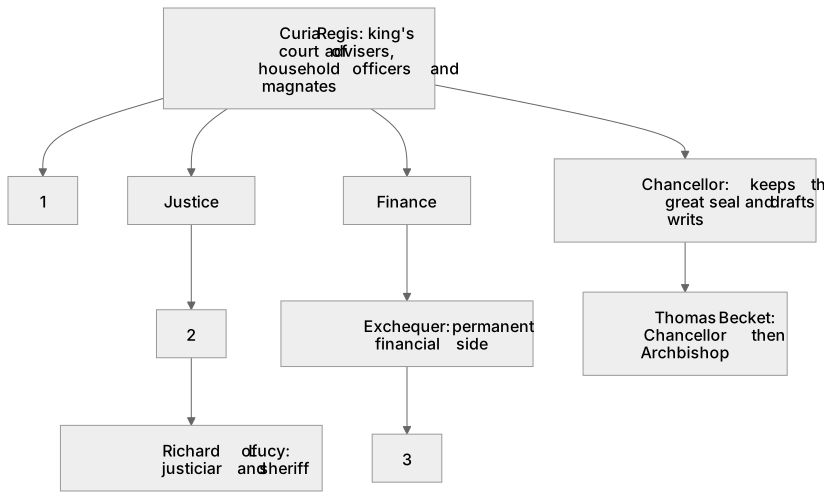
1Box 1
2Box 2
3Box 3
There is more to this lesson
The full lesson goes on to check your understanding and help you earn the marks. Create a free account to carry on, with your progress saved.
A week of Premium from your first lesson · Then the free plan continues · No card, no charge
Test your understanding of Reforms in England, 1154–89: Central institutions: the Curia Regis; the justiciars and the Chancellor; the roles of significant individuals, including Richard of Lucy, Bishop Nigel and Thomas Becket.
Active recall beats re-reading. Take an instant quiz now to test what you’ve learned and lock it into long-term memory.
A week of Premium from your first lesson · Then the free plan continues · No card, no charge