Pearson Edexcel · A-Level · History
Course version: 9HI0 · Version from Sept 2015
Financial reforms: the revival of the Danegeld; restoration of royal…
Full specification wording
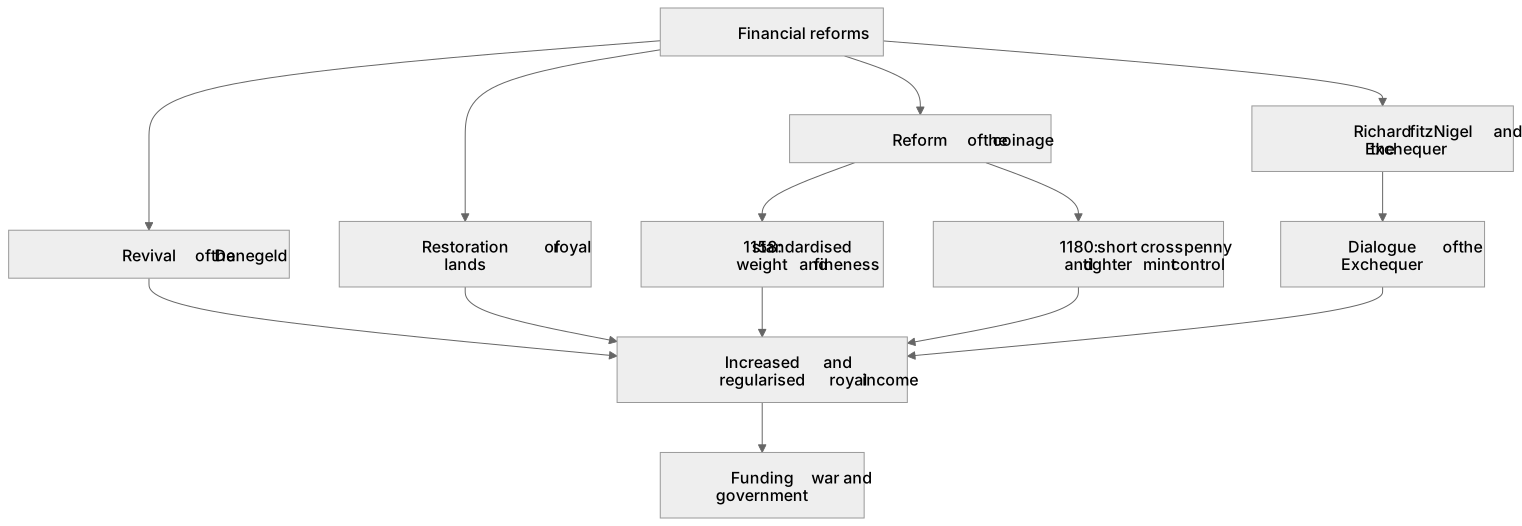
Reforms in England, 1154–89: Financial reforms: the revival of the Danegeld; restoration of royal lands; reform of the coinage in 1158 and 1180; the importance of Richard fitzNigel; the impact of financial reforms on increasing royal income.
Henry II rebuilt royal finance after the anarchy.
Checked against the Pearson Edexcel 9HI0 specification (opens in a new tab) on .
- Point 2 of 4
- 4 key terms
Study notes
From the checked teaching notes for this specification point.
The idea
Henry II rebuilt royal finance after the anarchy. Danegeld, a land tax assessed on hidage, was revived and levied more systematically, though its yield fell later in the reign. Royal lands lost under Stephen were recovered and their revenues accounted for through the Exchequer. Coinage reform in 1158 and 1180 restored sterling quality: the 1158 issue standardised weight and fineness, while the 1180 reform introduced the short cross penny and tighter mint control. Richard fitzNigel, treasurer and author of the Dialogue of the Exchequer, explained and systematised accounting. Together these measures raised and regularised royal income, funding war and government.
What earns the marks
- Explains the revival of Danegeld as a tax on landed wealth assessed by hidage, showing how it was levied and why its relative importance declined.
- Explains the restoration of royal lands as the recovery of estates and rights alienated during Stephen's reign, and links recovered land to higher permanent revenue.
- Distinguishes the coinage reforms of 1158 and 1180: the earlier standardised weight and fineness, the later introduced the short cross type and stricter mint and moneyer control.
- Uses Richard fitzNigel as treasurer and author of the Dialogue of the Exchequer to show how accounting practice, the pipe roll and Exchequer procedure improved financial oversight.
- Assesses the impact of financial reforms on increasing royal income by weighing recovered lands, taxation, coinage and accounting against inflation, war costs and limits on taxable wealth.
- Evaluates how far financial reform strengthened royal power beyond simply raising money, for example by making sheriffs and debtors more accountable.
Common mistakes and how to put them right
Treating Danegeld as a new tax invented by Henry II.
Put it right: It was an existing land tax that Henry revived and administered more effectively.
Confusing the coinage reforms of 1158 and 1180.
Put it right: 1158 restored weight and fineness, while 1180 introduced the short cross penny and reorganised the mints.
Describing Richard fitzNigel only as a writer.
Put it right: He was also a senior royal treasurer whose practical work underpinned the Dialogue of the Exchequer.
Exam tips
- Quantify where possible, for example by noting that the 1180 reform reduced the number of mints and moneyers, to show precise knowledge.
- Link each financial measure to a consequence for royal income or control rather than listing reforms.
- Use the Dialogue of the Exchequer as evidence of both administrative practice and the ideology of accountable kingship.
Try the lesson
The start of the Reforms in England, 1154–89: Financial reforms: the revival of the Danegeld; restoration of royal lands; reform of the coinage in 1158 and 1180; the importance of Richard fitzNigel; the impact of financial reforms on increasing royal income. lesson, made from checked teaching notes for this specification point.
Have a go first
Which tax on land did Henry II revive as part of his financial reforms?
Listen
Henry II rebuilt royal finance after the anarchy. Danegeld, a land tax assessed on hidage, was revived and levied more systematically, though its yield fell later in the reign. Royal lands lost under Stephen were recovered and their revenues accounted for through the Exchequer. Coinage reform in 1158 and 1180 restored sterling quality: the 1158 issue standardised weight and fineness, while the 1180 reform introduced the short cross penny and tighter mint control. Richard fitzNigel, treasurer and author of the Dialogue of the Exchequer, explained and systematised accounting. Together these measures raised and regularised royal income, funding war and government. A strong answer earns marks for these points. Explains the revival of Danegeld as a tax on landed wealth assessed by hidage, showing how it was levied and why its relative importance declined. Explains the restoration of royal lands as the recovery of estates and rights alienated during Stephen's reign, and links recovered land to higher permanent revenue. Distinguishes the coinage reforms of 1158 and 1180: the earlier standardised weight and fineness, the later introduced the short cross type and stricter mint and moneyer control. Uses Richard fitzNigel as treasurer and author of the Dialogue of the Exchequer to show how accounting practice, the pipe roll and Exchequer procedure improved financial oversight. A common slip: Treating Danegeld as a new tax invented by Henry II. Instead, it was an existing land tax that Henry revived and administered more effectively. Exam tip: Quantify where possible, for example by noting that the 1180 reform reduced the number of mints and moneyers, to show precise knowledge.
See it
Key words
Say what each word means before you turn the card.
Danegeld
Try answering aloud or in your head before turning the card.
Coinage reform
Try answering aloud or in your head before turning the card.
Richard fitzNigel
Try answering aloud or in your head before turning the card.
Royal lands
Try answering aloud or in your head before turning the card.
See every definition
- Danegeld
- A land tax assessed on hidage that was revived and levied more systematically, though its yield fell later in the reign.
- Coinage reform
- The 1158 issue standardised weight and fineness, while the 1180 reform introduced the short cross penny and tighter mint control.
- Richard fitzNigel
- Treasurer and author of the Dialogue of the Exchequer, who explained and systematised accounting.
- Royal lands
- Estates lost under Stephen were recovered and their revenues accounted for through the Exchequer.
Label the diagram
Some boxes have lost their names. Pick the right name for each number.
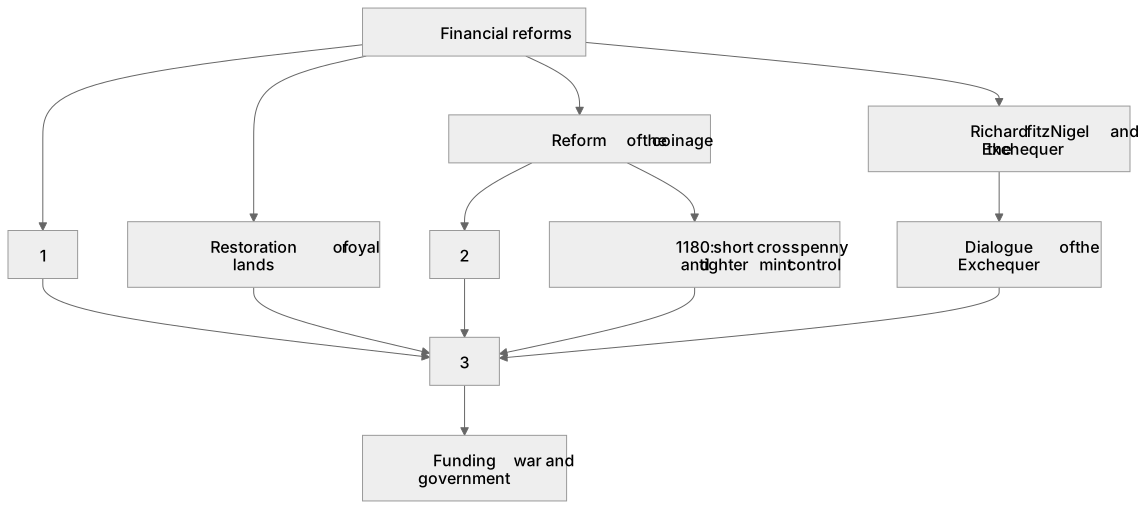
1Box 1
2Box 2
3Box 3
There is more to this lesson
The full lesson goes on to check your understanding and help you earn the marks. Create a free account to carry on, with your progress saved.
A week of Premium from your first lesson · Then the free plan continues · No card, no charge
Test your understanding of Reforms in England, 1154–89: Financial reforms: the revival of the Danegeld; restoration of royal lands; reform of the coinage in 1158 and 1180; the importance of Richard fitzNigel; the impact of financial reforms on increasing royal income.
Active recall beats re-reading. Take an instant quiz now to test what you’ve learned and lock it into long-term memory.
A week of Premium from your first lesson · Then the free plan continues · No card, no charge