Pearson Edexcel · A-Level · History
Course version: 9HI0 · Version from Sept 2015
Breakdown of relations with the king, 1791–92: flight to Varennes and…
Full specification wording
Revolution and the failure of constitutional monarchy, 1789–93: Breakdown of relations with the king, 1791–92: flight to Varennes and counter-revolutionary activity; divisions in the Legislative Assembly; the emergence of Republicanism; the impact of war with Austria and Prussia.
Between 1791 and 1792, the constitutional monarchy collapsed.
Checked against the Pearson Edexcel 9HI0 specification (opens in a new tab) on .
- Point 3 of 4
- 4 key terms
Study notes
From the checked teaching notes for this specification point.
The idea
Between 1791 and 1792, the constitutional monarchy collapsed. In June 1791, Louis XVI fled Paris but was arrested at Varennes, destroying trust in the king and exposing counter-revolutionary activity by émigrés. The Legislative Assembly divided into Feuillants supporting the monarchy, and Jacobins and Girondins opposing it. Republicanism emerged strongly after Varennes, though it was temporarily suppressed by the Champ de Mars massacre in July 1791. In April 1792, France declared war on Austria, with Prussia joining later. Early defeats and the Brunswick Manifesto intensified fears of betrayal, radicalising the revolution and leading to the fall of the monarchy in August 1792.
What earns the marks
- Explains how the flight to Varennes undermined the king's credibility, exposed counter-revolutionary activity, and made constitutional monarchy unworkable.
- Analyses the divisions within the Legislative Assembly between Feuillants, Jacobins and Girondins, and how these shaped political conflict.
- Assesses the emergence of Republicanism after Varennes, noting its temporary suppression following the Champ de Mars massacre.
- Evaluates the impact of war with Austria (declared April 1792) and Prussia, including military defeats and the Brunswick Manifesto, in radicalising the revolution.
Common mistakes and how to put them right
Confusing the Legislative Assembly with the National Assembly.
Put it right by noting the Legislative Assembly was elected in 1791 and had a different composition.
Stating France declared war on both Austria and Prussia in April 1792.
Put it right by specifying war was declared on Austria on 20 April 1792, with Prussia entering later as an ally.
Claiming republicanism flourished immediately after the Champ de Mars massacre.
Put it right by explaining the massacre actually suppressed the republican movement that had grown after Varennes.
Exam tips
- Use precise dates and names to support arguments, such as June 1791 for Varennes and April 1792 for the declaration of war against Austria.
- Link each factor to the breakdown of relations with the king, showing how they reinforced each other.
Try the lesson
The start of the Revolution and the failure of constitutional monarchy, 1789–93: Breakdown of relations with the king, 1791–92: flight to Varennes and counter-revolutionary activity; divisions in the Legislative Assembly; the emergence of Republicanism; the impact of war with Austria and Prussia. lesson, made from checked teaching notes for this specification point.
Have a go first
In June 1791, Louis XVI and his family fled Paris but were arrested at Varennes. What was the immediate political consequence of this flight for the king's position?
Listen
Between 1791 and 1792, the constitutional monarchy collapsed. In June 1791, Louis XVI fled Paris but was arrested at Varennes, destroying trust in the king and exposing counter-revolutionary activity by émigrés. The Legislative Assembly divided into Feuillants supporting the monarchy, and Jacobins and Girondins opposing it. Republicanism emerged strongly after Varennes, though it was temporarily suppressed by the Champ de Mars massacre in July 1791. In April 1792, France declared war on Austria, with Prussia joining later. Early defeats and the Brunswick Manifesto intensified fears of betrayal, radicalising the revolution and leading to the fall of the monarchy in August 1792. A strong answer earns marks for these points. Explains how the flight to Varennes undermined the king's credibility, exposed counter-revolutionary activity, and made constitutional monarchy unworkable. Analyses the divisions within the Legislative Assembly between Feuillants, Jacobins and Girondins, and how these shaped political conflict. Assesses the emergence of Republicanism after Varennes, noting its temporary suppression following the Champ de Mars massacre. Evaluates the impact of war with Austria (declared April 1792) and Prussia, including military defeats and the Brunswick Manifesto, in radicalising the revolution. A common slip: Confusing the Legislative Assembly with the National Assembly. Instead, noting the Legislative Assembly was elected in 1791 and had a different composition. Exam tip: Use precise dates and names to support arguments, such as June 1791 for Varennes and April 1792 for the declaration of war against Austria.
See it
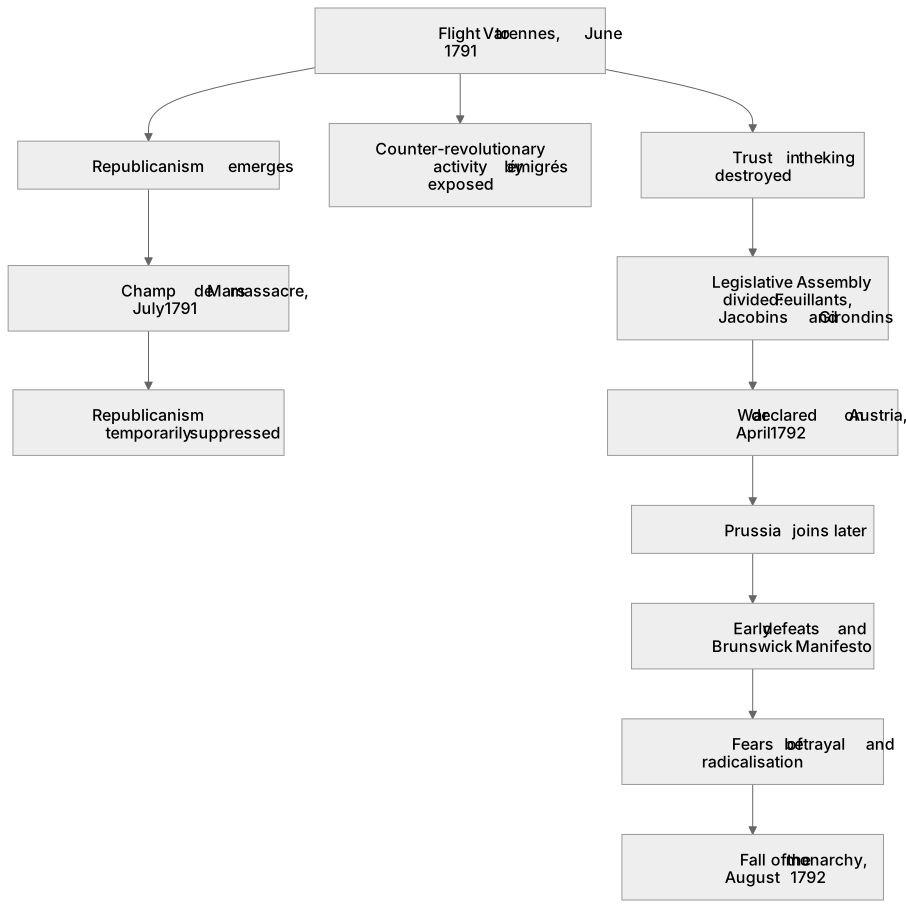
Key words
Say what each word means before you turn the card.
flight to Varennes
Try answering aloud or in your head before turning the card.
Legislative Assembly
Try answering aloud or in your head before turning the card.
Republicanism
Try answering aloud or in your head before turning the card.
Brunswick Manifesto
Try answering aloud or in your head before turning the card.
See every definition
- flight to Varennes
- In June 1791 Louis XVI fled Paris but was arrested at Varennes, destroying trust in the king and exposing counter-revolutionary activity by émigrés.
- Legislative Assembly
- This body divided into Feuillants supporting the monarchy, and Jacobins and Girondins opposing it.
- Republicanism
- This emerged strongly after Varennes, though it was temporarily suppressed by the Champ de Mars massacre in July 1791.
- Brunswick Manifesto
- Together with early defeats, this intensified fears of betrayal, radicalising the revolution and leading to the fall of the monarchy in August 1792.
Label the diagram
Some boxes have lost their names. Pick the right name for each number.
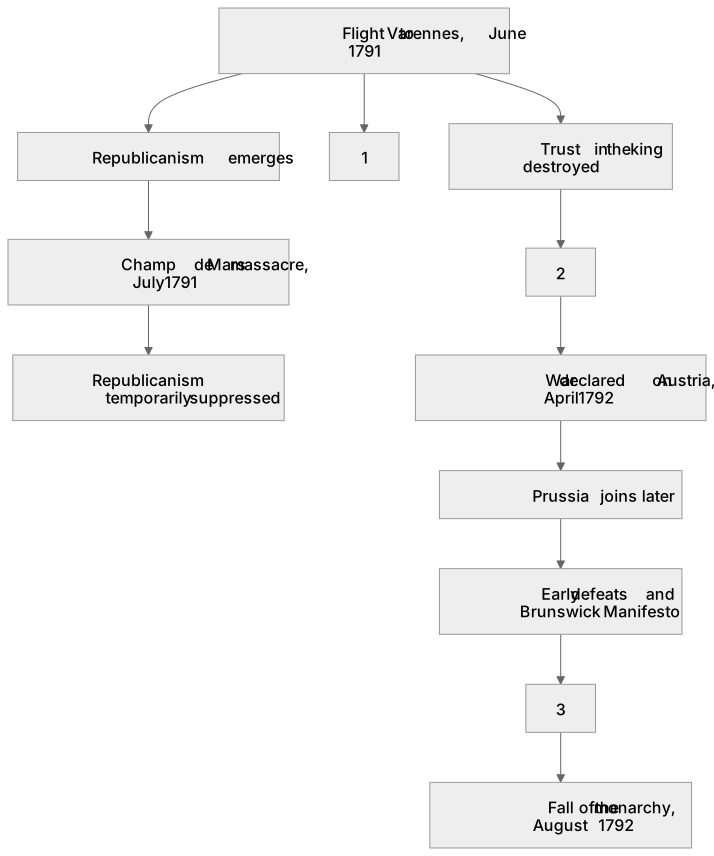
1Box 1
2Box 2
3Box 3
There is more to this lesson
The full lesson goes on to check your understanding and help you earn the marks. Create a free account to carry on, with your progress saved.
A week of Premium from your first lesson · Then the free plan continues · No card, no charge
Test your understanding of Revolution and the failure of constitutional monarchy, 1789–93: Breakdown of relations with the king, 1791–92: flight to Varennes and counter-revolutionary activity; divisions in the Legislative Assembly; the emergence of Republicanism; the impact of war with Austria and Prussia.
Active recall beats re-reading. Take an instant quiz now to test what you’ve learned and lock it into long-term memory.
A week of Premium from your first lesson · Then the free plan continues · No card, no charge