Pearson Edexcel · A-Level · History
Course version: 9HI0 · Version from Sept 2015
The revolution radicalised, 1792–93: the invasion of the Tuileries; the…
Full specification wording
Revolution and the failure of constitutional monarchy, 1789–93: The revolution radicalised, 1792–93: the invasion of the Tuileries; the impact of the state of national emergency; the journée of 10 August; revolutionary government and the September massacres; the creation of the National Convention; the trial and execution of the king.
From 1792 to 1793 the revolution became increasingly radical.
Checked against the Pearson Edexcel 9HI0 specification (opens in a new tab) on .
- Point 4 of 4
- 4 key terms
Study notes
From the checked teaching notes for this specification point.
The idea
From 1792 to 1793 the revolution became increasingly radical. In June 1792 the invasion of the Tuileries by sans-culottes pressured the king, and the state of national emergency, declared in July 1792, gave authorities emergency powers. On 10 August 1792 a journée stormed the Tuileries, suspending the king and ending the constitutional monarchy. In September, revolutionary government and the September massacres saw the killing of prisoners, driven by fear of counter-revolution. The National Convention was elected and declared France a republic on 21 September 1792. In January 1793 Louis XVI was tried and executed, followed by Marie-Antoinette in October, marking a decisive break with the old order.
What earns the marks
- Explains the significance of the invasion of the Tuileries and the state of national emergency in escalating tensions.
- Analyses the journée of 10 August 1792 as a turning point that ended the monarchy.
- Assesses the role of revolutionary government and the September massacres in the radicalisation process.
- Evaluates the creation of the National Convention and the trial and execution of the king as key radical steps.
Common mistakes and how to put them right
Confusing the invasion of the Tuileries in June 1792 with the journée of 10 August.
Put it right: The former was a protest, the latter a violent insurrection.
Believing the September massacres were ordered by the government.
Put it right: They were largely carried out by sans-culottes and fédérés.
Stating that the National Convention was created before the monarchy fell.
Put it right: It was elected after the 10 August insurrection.
Exam tips
- Sequence events clearly to show the progression from constitutional monarchy to republic.
- Use terms like 'journée' and 'sans-culottes' accurately to demonstrate understanding.
- Connect the trial and execution of the king to the wider radicalisation, not just as an isolated event.
Try the lesson
The start of the Revolution and the failure of constitutional monarchy, 1789–93: The revolution radicalised, 1792–93: the invasion of the Tuileries; the impact of the state of national emergency; the journée of 10 August; revolutionary government and the September massacres; the creation of the National Convention; the trial and execution of the king. lesson, made from checked teaching notes for this specification point.
Have a go first
What happened to Louis XVI as a result of the journée of 10 August 1792?
Listen
From 1792 to 1793 the revolution became increasingly radical. In June 1792 the invasion of the Tuileries by sans-culottes pressured the king, and the state of national emergency, declared in July 1792, gave authorities emergency powers. On 10 August 1792 a journée stormed the Tuileries, suspending the king and ending the constitutional monarchy. In September, revolutionary government and the September massacres saw the killing of prisoners, driven by fear of counter-revolution. The National Convention was elected and declared France a republic on 21 September 1792. In January 1793 Louis XVI was tried and executed, followed by Marie-Antoinette in October, marking a decisive break with the old order. A strong answer earns marks for these points. Explains the significance of the invasion of the Tuileries and the state of national emergency in escalating tensions. Analyses the journée of 10 August 1792 as a turning point that ended the monarchy. Assesses the role of revolutionary government and the September massacres in the radicalisation process. Evaluates the creation of the National Convention and the trial and execution of the king as key radical steps. Exam tip: Sequence events clearly to show the progression from constitutional monarchy to republic.
See it
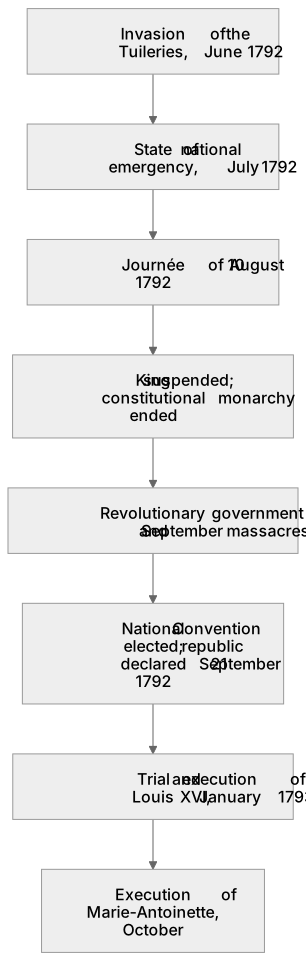
Put it in order
Put these steps in the order they happen.
- 1. Revolutionary government and September massacres
- 2. Execution of Marie-Antoinette, October
- 3. National Convention elected; republic declared 21 September 1792
- 4. Invasion of the Tuileries, June 1792
- 5. State of national emergency, July 1792
- 6. Trial and execution of Louis XVI, January 1793
- 7. Journée of 10 August 1792
- 8. King suspended; constitutional monarchy ended
Key words
Say what each word means before you turn the card.
Popular insurrection and the sans-culottes
Try answering aloud or in your head before turning the card.
The shift from constitutional monarchy to republic
Try answering aloud or in your head before turning the card.
Revolutionary justice and violence
Try answering aloud or in your head before turning the card.
The role of war and emergency in radicalisation
Try answering aloud or in your head before turning the card.
See every definition
- Popular insurrection and the sans-culottes
- The invasion of the Tuileries by sans-culottes pressured the king, and the journée of 10 August was a violent insurrection that stormed the Tuileries.
- The shift from constitutional monarchy to republic
- The journée of 10 August suspended the king and ended the constitutional monarchy, and the National Convention declared France a republic.
- Revolutionary justice and violence
- Revolutionary government and the September massacres saw the killing of prisoners, driven by fear of counter-revolution.
- The role of war and emergency in radicalisation
- The state of national emergency, declared in July 1792, gave authorities emergency powers as the revolution became increasingly radical.
Label the diagram
Some boxes have lost their names. Pick the right name for each number.
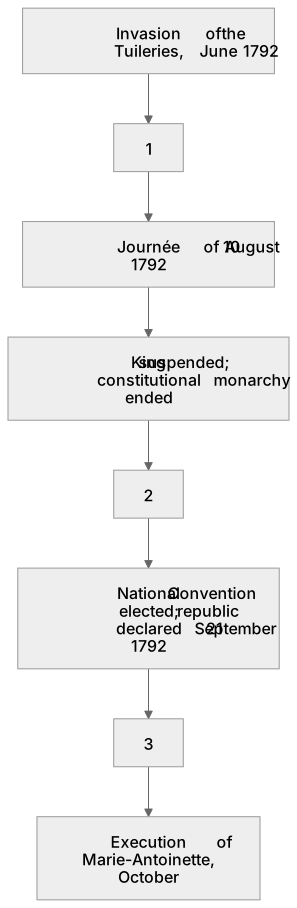
1Box 1
2Box 2
3Box 3
There is more to this lesson
The full lesson goes on to check your understanding and help you earn the marks. Create a free account to carry on, with your progress saved.
A week of Premium from your first lesson · Then the free plan continues · No card, no charge
Test your understanding of Revolution and the failure of constitutional monarchy, 1789–93: The revolution radicalised, 1792–93: the invasion of the Tuileries; the impact of the state of national emergency; the journée of 10 August; revolutionary government and the September massacres; the creation of the National Convention; the trial and execution of the king.
Active recall beats re-reading. Take an instant quiz now to test what you’ve learned and lock it into long-term memory.
A week of Premium from your first lesson · Then the free plan continues · No card, no charge