Pearson Edexcel · A-Level · History
Course version: 9HI0 · Version from Sept 2015
Maurice of Nassau: his military reforms and changes in strategy and…
Full specification wording
Securing the independence of the United Provinces, 1584–1609: Maurice of Nassau: his military reforms and changes in strategy and tactics; siege warfare against fortresses and border towns; the victories at Turnhout 1597 and Nieuwpoort 1600; Maurice as Stadtholder.
Maurice of Nassau, Stadtholder from 1585, transformed the Dutch army by combining Roman discipline with modern firepower.
Checked against the Pearson Edexcel 9HI0 specification (opens in a new tab) on .
- Point 1 of 4
- 4 key terms
Study notes
From the checked teaching notes for this specification point.
The idea
Maurice of Nassau, Stadtholder from 1585, transformed the Dutch army by combining Roman discipline with modern firepower. He standardised infantry into smaller, flexible units, drilled them in volley fire and coordinated cavalry and artillery. Strategically, he avoided pitched battles, preferring sieges to capture fortresses and border towns, which secured the eastern and southern frontiers. His victories at Turnhout (1597) and Nieuwpoort (1600) demonstrated the new tactics, though Nieuwpoort was a costly risk. As Stadtholder, Maurice also wielded political power, balancing military command with provincial interests. His reforms enabled the United Provinces to survive and expand, but they depended on funding and cooperation from the States-General.
What earns the marks
- Maurice's military reforms included standardising infantry into smaller units, such as the 500-strong regiment, and introducing volley fire to increase firepower.
- He changed strategy by prioritising siege warfare against fortresses and border towns, avoiding decisive battles that could destroy his army.
- The victories at Turnhout (1597) and Nieuwpoort (1600) showcased Maurice's tactical innovations, including combined arms and rapid manoeuvre.
- As Stadtholder, Maurice held political authority in several provinces, which allowed him to influence military funding and coordinate campaigns.
- His reforms and sieges secured key border towns, gradually pushing back Spanish control and strengthening the United Provinces' independence.
Common mistakes and how to put them right
Assuming Maurice always sought pitched battles.
Put it right: He generally avoided them, preferring sieges to preserve his army.
Treating the victory at Nieuwpoort as a strategic success.
Put it right: It was a tactical win but a risky and costly engagement that Maurice initially opposed.
Confusing Maurice's role as Stadtholder with that of a purely military commander.
Put it right: He was also a political leader, which shaped his military decisions.
Exam tips
- Use specific examples like the siege of Groningen (1594) or Turnhout to illustrate reforms and strategy.
- Analyse how Maurice's reforms addressed the weaknesses of the Dutch army before 1585, such as lack of discipline and coordination.
- Link Maurice's military actions to the broader aim of securing independence, showing how sieges expanded territory and reduced Spanish influence.
Try the lesson
The start of the Securing the independence of the United Provinces, 1584–1609: Maurice of Nassau: his military reforms and changes in strategy and tactics; siege warfare against fortresses and border towns; the victories at Turnhout 1597 and Nieuwpoort 1600; Maurice as Stadtholder. lesson, made from checked teaching notes for this specification point.
Have a go first
Which battle did Maurice of Nassau win in 1597?
Listen
Maurice of Nassau, Stadtholder from 1585, transformed the Dutch army by combining Roman discipline with modern firepower. He standardised infantry into smaller, flexible units, drilled them in volley fire and coordinated cavalry and artillery. Strategically, he avoided pitched battles, preferring sieges to capture fortresses and border towns, which secured the eastern and southern frontiers. His victories at Turnhout (1597) and Nieuwpoort (1600) demonstrated the new tactics, though Nieuwpoort was a costly risk. As Stadtholder, Maurice also wielded political power, balancing military command with provincial interests. His reforms enabled the United Provinces to survive and expand, but they depended on funding and cooperation from the States-General. A strong answer earns marks for these points. Maurice's military reforms included standardising infantry into smaller units, such as the 500-strong regiment, and introducing volley fire to increase firepower. He changed strategy by prioritising siege warfare against fortresses and border towns, avoiding decisive battles that could destroy his army. The victories at Turnhout (1597) and Nieuwpoort (1600) showcased Maurice's tactical innovations, including combined arms and rapid manoeuvre. As Stadtholder, Maurice held political authority in several provinces, which allowed him to influence military funding and coordinate campaigns. A common slip: assuming Maurice always sought pitched battles. Instead, he generally avoided them, preferring sieges to preserve his army. Exam tip: Use specific examples like the siege of Groningen (1594) or Turnhout to illustrate reforms and strategy.
See it

Put the events in order
Put these events in the order they happened, earliest first.
- 1. Victory at Nieuwpoort
- 2. Maurice of Nassau became Stadtholder
- 3. Victory at Turnhout
- 4. Siege of Groningen
Key words
Say what each word means before you turn the card.
Military innovation and reform
Try answering aloud or in your head before turning the card.
Siege warfare and territorial control
Try answering aloud or in your head before turning the card.
Leadership and political authority
Try answering aloud or in your head before turning the card.
Impact on the Dutch Revolt and independence
Try answering aloud or in your head before turning the card.
See every definition
- Military innovation and reform
- Combining Roman discipline with modern firepower, Maurice standardised infantry into smaller, flexible units and drilled them in volley fire, coordinating cavalry and artillery.
- Siege warfare and territorial control
- Maurice avoided pitched battles, preferring sieges to capture fortresses and border towns, which secured the eastern and southern frontiers.
- Leadership and political authority
- As Stadtholder, Maurice wielded political power, balancing military command with provincial interests and influencing military funding.
- Impact on the Dutch Revolt and independence
- His reforms enabled the United Provinces to survive and expand, strengthening their independence, though they depended on funding and cooperation from the States-General.
Label the diagram
Some boxes have lost their names. Pick the right name for each number.
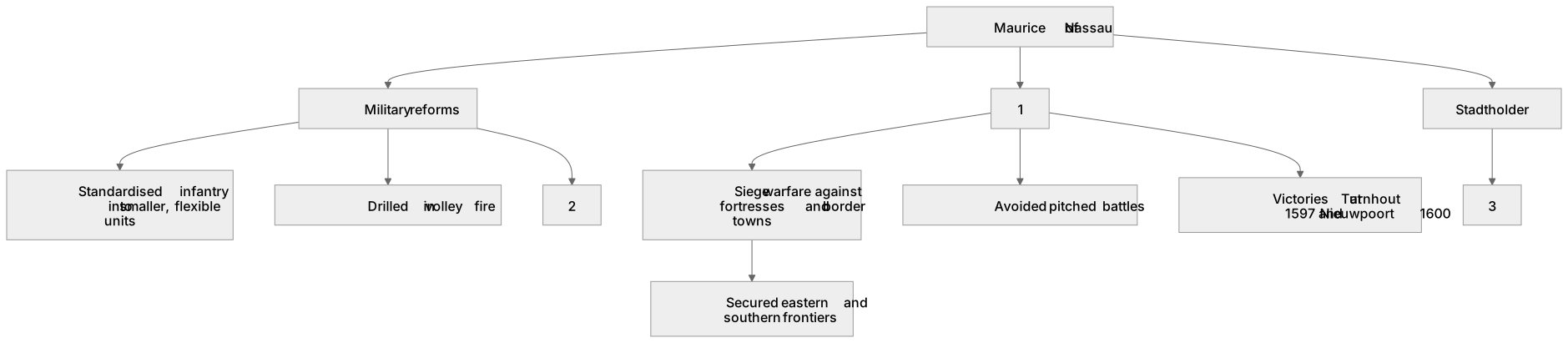
1Box 1
2Box 2
3Box 3
There is more to this lesson
The full lesson goes on to check your understanding and help you earn the marks. Create a free account to carry on, with your progress saved.
A week of Premium from your first lesson · Then the free plan continues · No card, no charge
Test your understanding of Securing the independence of the United Provinces, 1584–1609: Maurice of Nassau: his military reforms and changes in strategy and tactics; siege warfare against fortresses and border towns; the victories at Turnhout 1597 and Nieuwpoort 1600; Maurice as Stadtholder.
Active recall beats re-reading. Take an instant quiz now to test what you’ve learned and lock it into long-term memory.
A week of Premium from your first lesson · Then the free plan continues · No card, no charge