Pearson Edexcel · A-Level · History
Course version: 9HI0 · Version from Sept 2015
Reasons for Spanish failures: support for the United Provinces by…
Full specification wording
Securing the independence of the United Provinces, 1584–1609: Reasons for Spanish failures: support for the United Provinces by Elizabeth I of England; the Treaty of Nonsuch 1585; the diversion of Parma’s troops to support the Spanish Armada 1588; intervention in France 1589.
Spanish efforts to crush the Dutch Revolt failed for several interconnected reasons.
Checked against the Pearson Edexcel 9HI0 specification (opens in a new tab) on .
- Point 2 of 4
- 4 key terms
Study notes
From the checked teaching notes for this specification point.
The idea
Spanish efforts to crush the Dutch Revolt failed for several interconnected reasons. Elizabeth I of England provided diplomatic, financial and military support to the United Provinces, culminating in the Treaty of Nonsuch (1585), which committed English troops and subsidies. This forced Spain to divert resources. In 1588, Parma's troops were redirected to support the Spanish Armada, delaying his campaign in the Netherlands and allowing the Dutch to recover. From 1589, Spanish intervention in the French Wars of Religion further drained men and money, preventing a decisive blow against the Dutch. These diversions, combined with Dutch resilience, ensured that Spain could not reconquer the United Provinces.
What earns the marks
- Elizabeth I's support for the United Provinces included financial subsidies and troops, formalised in the Treaty of Nonsuch (1585).
- The diversion of Parma's troops to support the Spanish Armada in 1588 weakened Spanish military pressure in the Netherlands.
- Spanish intervention in France from 1589 diverted resources and attention away from the Dutch Revolt.
- The Treaty of Nonsuch marked a significant escalation of English involvement, turning the revolt into a wider international conflict.
Common mistakes and how to put them right
Claiming the Treaty of Nonsuch was solely a military alliance.
Put it right: It also provided financial subsidies and political support.
Stating that the Spanish Armada diversion had no impact on the Dutch Revolt.
Put it right: It delayed Parma's campaign and allowed the Dutch to regroup.
Ignoring the French intervention's role.
Put it right: It further stretched Spanish resources and contributed to their inability to crush the revolt.
Exam tips
- Explain the link between each reason and Spanish failure, showing how they interacted cumulatively.
- Use precise dates and names, such as the Treaty of Nonsuch (1585) and Parma's diversion in 1588.
- Assess the relative importance of each factor, but avoid claiming one alone was decisive without evidence.
Try the lesson
The start of the Securing the independence of the United Provinces, 1584–1609: Reasons for Spanish failures: support for the United Provinces by Elizabeth I of England; the Treaty of Nonsuch 1585; the diversion of Parma’s troops to support the Spanish Armada 1588; intervention in France 1589. lesson, made from checked teaching notes for this specification point.
Have a go first
In which year did Elizabeth I of England agree the Treaty of Nonsuch, promising support to the United Provinces?
Listen
Spanish efforts to crush the Dutch Revolt failed for several interconnected reasons. Elizabeth I of England provided diplomatic, financial and military support to the United Provinces, culminating in the Treaty of Nonsuch (1585), which committed English troops and subsidies. This forced Spain to divert resources. In 1588, Parma's troops were redirected to support the Spanish Armada, delaying his campaign in the Netherlands and allowing the Dutch to recover. From 1589, Spanish intervention in the French Wars of Religion further drained men and money, preventing a decisive blow against the Dutch. These diversions, combined with Dutch resilience, ensured that Spain could not reconquer the United Provinces. A strong answer earns marks for these points. Elizabeth I's support for the United Provinces included financial subsidies and troops, formalised in the Treaty of Nonsuch (1585). The diversion of Parma's troops to support the Spanish Armada in 1588 weakened Spanish military pressure in the Netherlands. Spanish intervention in France from 1589 diverted resources and attention away from the Dutch Revolt. The Treaty of Nonsuch marked a significant escalation of English involvement, turning the revolt into a wider international conflict. A common slip: claiming the Treaty of Nonsuch was solely a military alliance. Instead, it also provided financial subsidies and political support. Exam tip: Explain the link between each reason and Spanish failure, showing how they interacted cumulatively.
See it
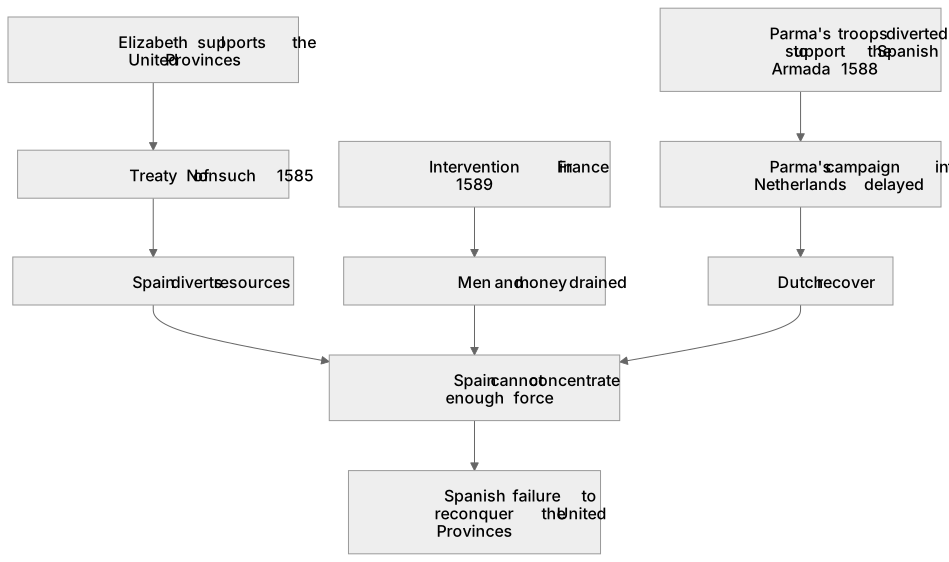
Put the events in order
Put these events in the order they happened, earliest first.
- 1. Treaty of Nonsuch formalised English support for the United Provinces
- 2. Spanish intervention in France diverted resources from the Dutch Revolt
- 3. Parma's troops diverted to support the Spanish Armada
Key words
Say what each word means before you turn the card.
International involvement in the Dutch Revolt
Try answering aloud or in your head before turning the card.
Spanish overstretch and resource diversion
Try answering aloud or in your head before turning the card.
English and French interventions
Try answering aloud or in your head before turning the card.
Causes of Spanish failure
Try answering aloud or in your head before turning the card.
See every definition
- International involvement in the Dutch Revolt
- Support for the United Provinces by Elizabeth I of England, formalised in the Treaty of Nonsuch 1585, turned the revolt into a wider international conflict.
- Spanish overstretch and resource diversion
- Parma's troops were diverted to support the Spanish Armada in 1588, and intervention in France from 1589 further drained men and money.
- English and French interventions
- Elizabeth I provided diplomatic, financial and military support to the United Provinces, while intervention in France from 1589 diverted Spanish resources and attention away from the Dutch Revolt.
- Causes of Spanish failure
- These diversions, combined with Dutch resilience, prevented Spain from concentrating enough force to defeat the Dutch and reconquer the United Provinces.
Label the diagram
Some boxes have lost their names. Pick the right name for each number.
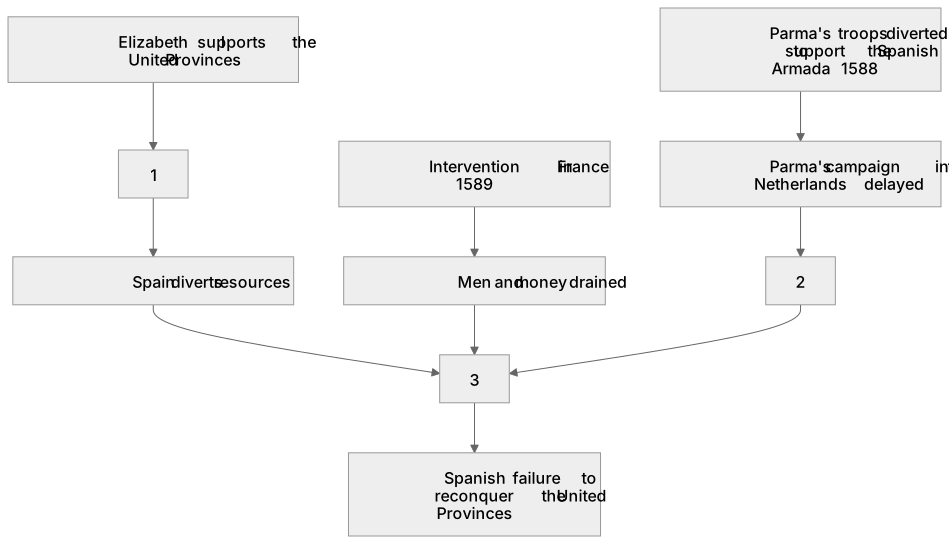
1Box 1
2Box 2
3Box 3
There is more to this lesson
The full lesson goes on to check your understanding and help you earn the marks. Create a free account to carry on, with your progress saved.
A week of Premium from your first lesson · Then the free plan continues · No card, no charge
Test your understanding of Securing the independence of the United Provinces, 1584–1609: Reasons for Spanish failures: support for the United Provinces by Elizabeth I of England; the Treaty of Nonsuch 1585; the diversion of Parma’s troops to support the Spanish Armada 1588; intervention in France 1589.
Active recall beats re-reading. Take an instant quiz now to test what you’ve learned and lock it into long-term memory.
A week of Premium from your first lesson · Then the free plan continues · No card, no charge