Pearson Edexcel · A-Level · History
Course version: 9HI0 · Version from Sept 2015
The declining power of Spain in the Netherlands: Spain’s inability to pay…
Full specification wording
Securing the independence of the United Provinces, 1584–1609: The declining power of Spain in the Netherlands: Spain’s inability to pay its troops; the armistice of 1607; the Truce of Antwerp 1609; Spain’s de facto recognition of the independence of the United Provinces.
This topic examines how Spain’s power in the Netherlands declined, leading to the de facto recognition of the United Provinces’ independence.
Checked against the Pearson Edexcel 9HI0 specification (opens in a new tab) on .
- Point 4 of 4
- 4 key terms
Study notes
From the checked teaching notes for this specification point.
The idea
This topic examines how Spain’s power in the Netherlands declined, leading to the de facto recognition of the United Provinces’ independence. Spain’s chronic inability to pay its troops caused mutinies and undermined military effectiveness, weakening its control. The armistice of 1607 was a preliminary ceasefire that halted fighting and opened negotiations. These talks culminated in the Truce of Antwerp in 1609, also known as the Twelve Years’ Truce, which suspended hostilities for twelve years. Crucially, Spain did not formally renounce its claim to sovereignty, but the truce effectively recognised the United Provinces as an independent political entity, marking a major step towards Dutch independence.
What earns the marks
- Explains how Spain’s financial difficulties, including unpaid troops, contributed to its declining military power in the Netherlands.
- Describes the armistice of 1607 as a preliminary step towards the Truce of Antwerp in 1609.
- Analyses the terms and significance of the Truce of Antwerp, including its duration and impact on the United Provinces.
- Evaluates the extent to which the truce constituted de facto recognition of the United Provinces’ independence.
- Uses specific evidence, such as the date 1609 or the Twelve Years’ Truce, to support arguments.
Common mistakes and how to put them right
Stating that Spain formally recognised Dutch independence in 1609.
Put it right: Explain that the truce was a de facto recognition, as Spain did not formally renounce its sovereignty.
Confusing the armistice of 1607 with the Truce of Antwerp 1609.
Put it right: Distinguish the preliminary ceasefire from the formal twelve-year truce.
Attributing Spain’s decline solely to military defeats.
Put it right: Include financial factors, such as the inability to pay troops, which caused mutinies and weakened Spain’s position.
Exam tips
- Ensure you can define and date both the armistice of 1607 and the Truce of Antwerp 1609, and explain their relationship.
- When discussing de facto recognition, clarify that it meant the United Provinces functioned as an independent state, even if Spain did not formally acknowledge it.
- Use the financial problems of Spain as a causal factor, linking them to mutinies and the need for a truce.
Try the lesson
The start of the Securing the independence of the United Provinces, 1584–1609: The declining power of Spain in the Netherlands: Spain’s inability to pay its troops; the armistice of 1607; the Truce of Antwerp 1609; Spain’s de facto recognition of the independence of the United Provinces. lesson, made from checked teaching notes for this specification point.
Have a go first
In which year was the Truce of Antwerp, which suspended fighting between Spain and the United Provinces, agreed?
Listen
This topic examines how Spain’s power in the Netherlands declined, leading to the de facto recognition of the United Provinces’ independence. Spain’s chronic inability to pay its troops caused mutinies and undermined military effectiveness, weakening its control. The armistice of 1607 was a preliminary ceasefire that halted fighting and opened negotiations. These talks culminated in the Truce of Antwerp in 1609, also known as the Twelve Years’ Truce, which suspended hostilities for twelve years. Crucially, Spain did not formally renounce its claim to sovereignty, but the truce effectively recognised the United Provinces as an independent political entity, marking a major step towards Dutch independence. A strong answer earns marks for these points. Explains how Spain’s financial difficulties, including unpaid troops, contributed to its declining military power in the Netherlands. Describes the armistice of 1607 as a preliminary step towards the Truce of Antwerp in 1609. Analyses the terms and significance of the Truce of Antwerp, including its duration and impact on the United Provinces. Evaluates the extent to which the truce constituted de facto recognition of the United Provinces’ independence. A common slip: stating that Spain formally recognised Dutch independence in 1609. Instead, explain that the truce was a de facto recognition, as Spain did not formally renounce its sovereignty. Exam tip: Ensure you can define and date both the armistice of 1607 and the Truce of Antwerp 1609, and explain their relationship.
See it
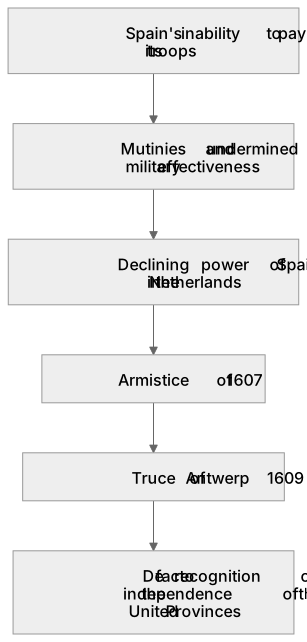
Put it in order
Put these steps in the order they happen.
- 1. Declining power of Spain in the Netherlands
- 2. Mutinies and undermined military effectiveness
- 3. Spain's inability to pay its troops
- 4. De facto recognition of the independence of the United Provinces
- 5. Truce of Antwerp 1609
- 6. Armistice of 1607
Key words
Say what each word means before you turn the card.
Decline of Spanish power
Try answering aloud or in your head before turning the card.
Diplomacy and truce
Try answering aloud or in your head before turning the card.
Financial and military weakness
Try answering aloud or in your head before turning the card.
De facto independence
Try answering aloud or in your head before turning the card.
See every definition
- Decline of Spanish power
- Spain's power in the Netherlands declined, leading to the de facto recognition of the United Provinces' independence.
- Diplomacy and truce
- The armistice of 1607 was a preliminary ceasefire that halted fighting and opened negotiations, culminating in the Truce of Antwerp in 1609.
- Financial and military weakness
- Spain's chronic inability to pay its troops caused mutinies and undermined military effectiveness, weakening its control.
- De facto independence
- The truce effectively recognised the United Provinces as an independent political entity, though Spain did not formally renounce its claim to sovereignty.
Label the diagram
Some boxes have lost their names. Pick the right name for each number.
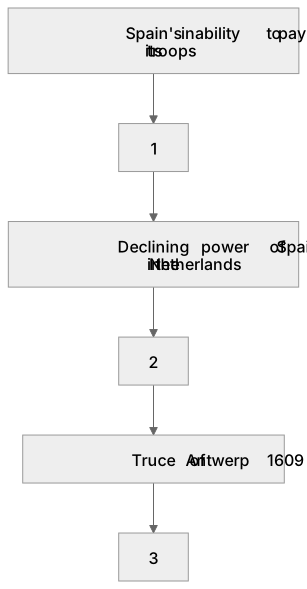
1Box 1
2Box 2
3Box 3
There is more to this lesson
The full lesson goes on to check your understanding and help you earn the marks. Create a free account to carry on, with your progress saved.
A week of Premium from your first lesson · Then the free plan continues · No card, no charge
Test your understanding of Securing the independence of the United Provinces, 1584–1609: The declining power of Spain in the Netherlands: Spain’s inability to pay its troops; the armistice of 1607; the Truce of Antwerp 1609; Spain’s de facto recognition of the independence of the United Provinces.
Active recall beats re-reading. Take an instant quiz now to test what you’ve learned and lock it into long-term memory.
A week of Premium from your first lesson · Then the free plan continues · No card, no charge