Pearson Edexcel · A-Level · History
Course version: 9HI0 · Version from Sept 2015
The growing power of the United Provinces: Oldenbarnevelt’s reforms; the…
Full specification wording
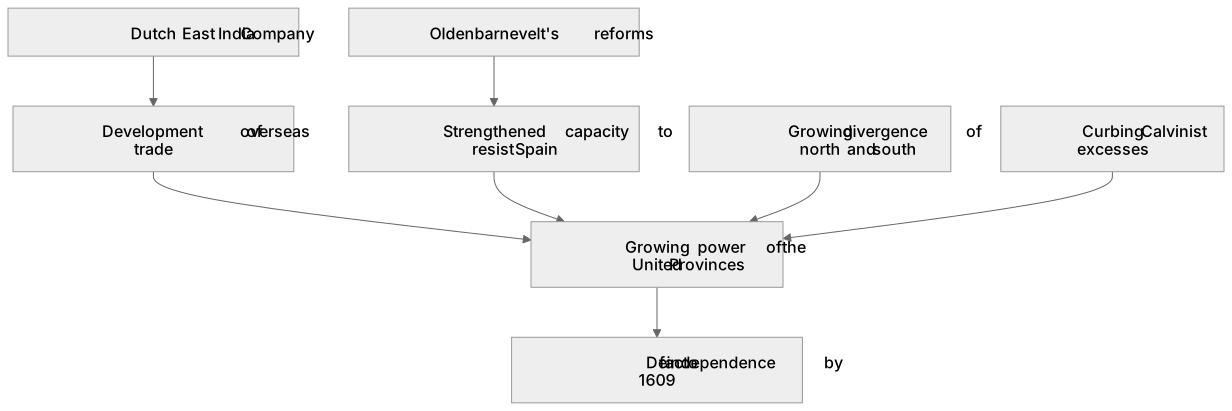
Securing the independence of the United Provinces, 1584–1609: The growing power of the United Provinces: Oldenbarnevelt’s reforms; the Dutch East India Company and the development of overseas trade; the growing divergence of north and south; Oldenbarnevelt’s success in curbing Calvinist excesses.
This topic examines how the United Provinces grew stronger between 1584 and 1609.
Checked against the Pearson Edexcel 9HI0 specification (opens in a new tab) on .
- Point 3 of 4
- 4 key terms
Study notes
From the checked teaching notes for this specification point.
The idea
This topic examines how the United Provinces grew stronger between 1584 and 1609. Johan van Oldenbarnevelt reformed the republic’s finances and administration, helping fund the war against Spain. The Dutch East India Company (VOC), founded in 1602, was privately financed under a state charter to develop overseas trade, challenging Iberian power in Asia. Meanwhile, the northern provinces became increasingly distinct from the southern Netherlands: the north was largely Protestant, commercially dynamic and politically autonomous, while the south remained Catholic, economically weakened and under Spanish control. Oldenbarnevelt also curbed Calvinist excesses by promoting toleration and civic order, preventing strict Calvinists from dominating the state. Together, these developments secured the United Provinces’ de facto independence by 1609.
What earns the marks
- Explains how Oldenbarnevelt’s financial and administrative reforms strengthened the United Provinces’ capacity to resist Spain.
- Analyses the role of the Dutch East India Company in developing overseas trade and its impact on the republic’s power.
- Assesses the growing divergence between the northern and southern Netherlands in religion, economy and political control.
- Evaluates Oldenbarnevelt’s success in curbing Calvinist excesses and its significance for stability and independence.
Common mistakes and how to put them right
Treating the Dutch Revolt as a single unified movement.
Put it right: Recognise the growing divergence between north and south, with different religious, economic and political trajectories.
Assuming the VOC was state-funded.
Put it right: Explain it was privately financed but operated under a state charter with quasi-state powers, including the right to wage war and conclude treaties.
Overstating Oldenbarnevelt’s success in curbing Calvinist excesses as complete religious toleration.
Put it right: Describe it as a pragmatic policy that reduced the political dominance of strict Calvinists while maintaining the Reformed Church’s privileged position.
Exam tips
- Plan essays to address each clause of the statement, ensuring coverage of reforms, trade, divergence and religious policy.
- Use precise dates and names, such as the VOC’s founding in 1602 and Oldenbarnevelt’s role as Land’s Advocate, to demonstrate contextual knowledge.
Try the lesson
The start of the Securing the independence of the United Provinces, 1584–1609: The growing power of the United Provinces: Oldenbarnevelt’s reforms; the Dutch East India Company and the development of overseas trade; the growing divergence of north and south; Oldenbarnevelt’s success in curbing Calvinist excesses. lesson, made from checked teaching notes for this specification point.
Have a go first
Which trading company was founded in 1602 to direct Dutch overseas commerce with Asia?
Listen
This topic examines how the United Provinces grew stronger between 1584 and 1609. Johan van Oldenbarnevelt reformed the republic’s finances and administration, helping fund the war against Spain. The Dutch East India Company (VOC), founded in 1602, was privately financed under a state charter to develop overseas trade, challenging Iberian power in Asia. Meanwhile, the northern provinces became increasingly distinct from the southern Netherlands: the north was largely Protestant, commercially dynamic and politically autonomous, while the south remained Catholic, economically weakened and under Spanish control. Oldenbarnevelt also curbed Calvinist excesses by promoting toleration and civic order, preventing strict Calvinists from dominating the state. Together, these developments secured the United Provinces’ de facto independence by 1609. A strong answer earns marks for these points. Explains how Oldenbarnevelt’s financial and administrative reforms strengthened the United Provinces’ capacity to resist Spain. Analyses the role of the Dutch East India Company in developing overseas trade and its impact on the republic’s power. Assesses the growing divergence between the northern and southern Netherlands in religion, economy and political control. Evaluates Oldenbarnevelt’s success in curbing Calvinist excesses and its significance for stability and independence. A common slip: Treating the Dutch Revolt as a single unified movement. Instead, recognise the growing divergence between north and south, with different religious, economic and political trajectories. Exam tip: Plan essays to address each clause of the statement, ensuring coverage of reforms, trade, divergence and religious policy.
See it
Put the events in order
Put these events in the order they happened, earliest first.
- 1. Start of period securing independence of the United Provinces
- 2. De facto independence of the United Provinces secured
- 3. Founding of the Dutch East India Company
Key words
Say what each word means before you turn the card.
State-building and reform
Try answering aloud or in your head before turning the card.
Overseas trade and empire
Try answering aloud or in your head before turning the card.
Religious toleration and conflict
Try answering aloud or in your head before turning the card.
Growing divergence of north and south
Try answering aloud or in your head before turning the card.
See every definition
- State-building and reform
- Oldenbarnevelt reformed the republic's finances and administration, helping fund the war against Spain and strengthening the United Provinces' capacity to resist.
- Overseas trade and empire
- The Dutch East India Company, privately financed under a state charter, developed overseas trade and challenged Iberian power in Asia.
- Religious toleration and conflict
- Oldenbarnevelt curbed Calvinist excesses by promoting toleration and civic order, preventing strict Calvinists from dominating the state.
- Growing divergence of north and south
- The north was largely Protestant, commercially dynamic and politically autonomous, while the south remained Catholic, economically weakened and under Spanish control.
Label the diagram
Some boxes have lost their names. Pick the right name for each number.
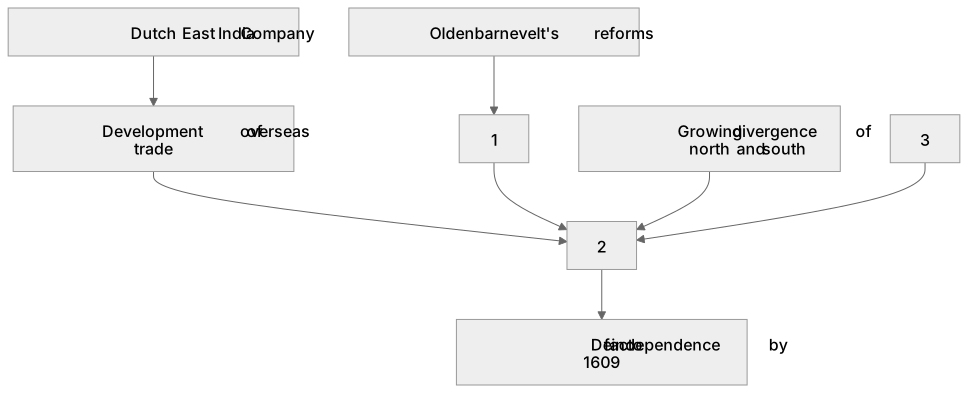
1Box 1
2Box 2
3Box 3
There is more to this lesson
The full lesson goes on to check your understanding and help you earn the marks. Create a free account to carry on, with your progress saved.
A week of Premium from your first lesson · Then the free plan continues · No card, no charge
Test your understanding of Securing the independence of the United Provinces, 1584–1609: The growing power of the United Provinces: Oldenbarnevelt’s reforms; the Dutch East India Company and the development of overseas trade; the growing divergence of north and south; Oldenbarnevelt’s success in curbing Calvinist excesses.
Active recall beats re-reading. Take an instant quiz now to test what you’ve learned and lock it into long-term memory.
A week of Premium from your first lesson · Then the free plan continues · No card, no charge