Pearson Edexcel · A-Level · History
Course version: 9HI0 · Version from Sept 2015
Cultural change: attacks on traditional culture in towns and countryside;…
Full specification wording
Social and cultural changes, 1949–76: Cultural change: attacks on traditional culture in towns and countryside; the role of Jiang Qing; the imposition of revolutionary art and culture.
After 1949 the CCP sought to replace traditional culture with socialist culture.
Checked against the Pearson Edexcel 9HI0 specification (opens in a new tab) on .
- Point 3 of 4
- 3 key terms
Study notes
From the checked teaching notes for this specification point.
The idea
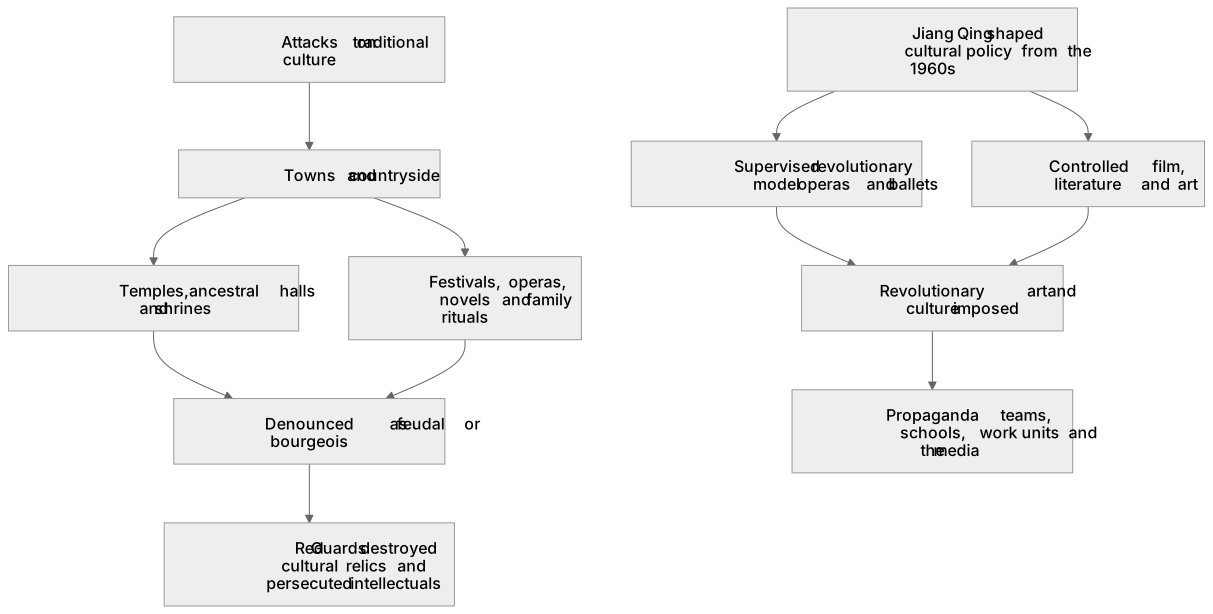
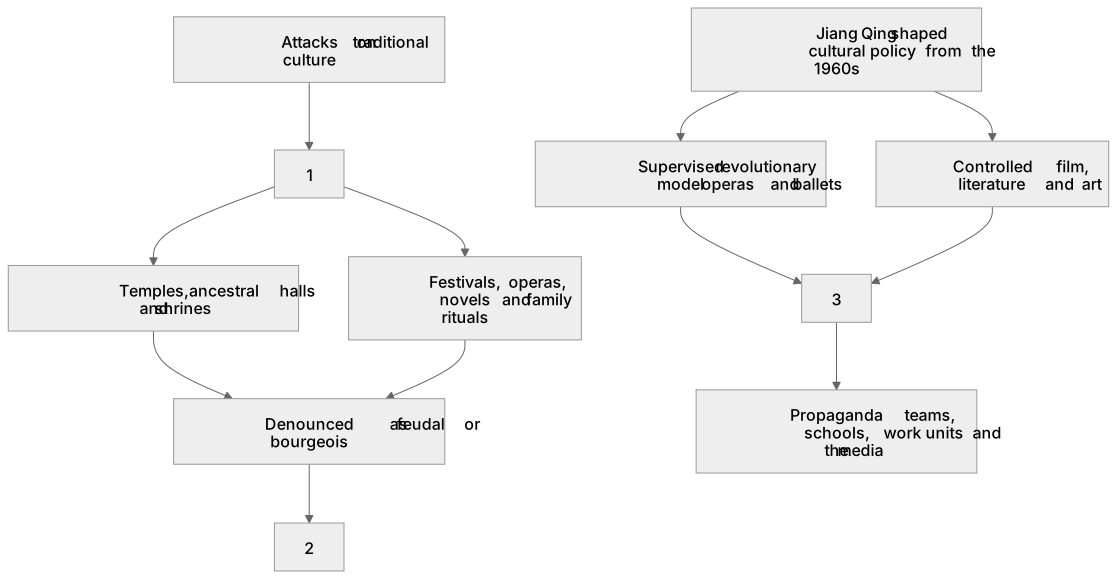
After 1949 the CCP sought to replace traditional culture with socialist culture. Attacks on traditional culture occurred in towns and countryside: temples, ancestral halls, shrines, festivals, operas, novels and family rituals were denounced as feudal or bourgeois. During the Cultural Revolution Red Guards destroyed cultural relics and persecuted intellectuals. Jiang Qing, Mao's wife, shaped cultural policy from the 1960s. She supervised the creation of revolutionary model operas and ballets, and controlled film, literature and art. Revolutionary art and culture were imposed through propaganda teams, schools, work units and the media.
What earns the marks
- Explains that attacks on traditional culture targeted both urban and rural settings, including temples, shrines, ancestral halls, festivals, operas, novels and family rituals.
- Describes the role of Jiang Qing in directing cultural policy, including her supervision of revolutionary model operas and ballets and her influence over film, literature and art.
- Explains how revolutionary art and culture were imposed through propaganda teams, schools, work units, the media and campaigns such as the 'Four Olds'.
- Uses specific examples, such as the eight model operas, the destruction of cultural relics, and the persecution of intellectuals, to support analysis.
- Analyses the impact of these changes on different groups, including urban and rural populations, intellectuals, artists and young people.
- Evaluates the extent to which cultural change was driven by Mao, Jiang Qing or wider Party and social forces.
Common mistakes and how to put them right
Treating attacks on traditional culture as only an urban phenomenon.
Put it right: Recognise that rural areas also experienced attacks on temples, ancestral halls, festivals and rituals.
Presenting Jiang Qing as solely responsible for all cultural change.
Put it right: Explain that she was a key figure but operated within Mao's broader political and ideological campaign.
Describing revolutionary art as merely propaganda without explaining its content or imposition.
Put it right: Give specific examples, such as the model operas, and explain how they were promoted through schools, work units and the media.
Exam tips
- Plan answers around the three clauses: attacks on traditional culture, Jiang Qing's role, and imposition of revolutionary art and culture.
- Use precise examples, such as the eight model operas or the 'Four Olds' campaign, to support each point.
- When evaluating significance, compare the effects on towns and countryside and consider different groups, such as intellectuals, workers and peasants.
Try the lesson
The start of the Social and cultural changes, 1949–76: Cultural change: attacks on traditional culture in towns and countryside; the role of Jiang Qing; the imposition of revolutionary art and culture. lesson, made from checked teaching notes for this specification point.
Have a go first
Which figure was most closely associated with directing the campaign to impose revolutionary art and culture during the Cultural Revolution?
Listen
After 1949 the CCP sought to replace traditional culture with socialist culture. Attacks on traditional culture occurred in towns and countryside: temples, ancestral halls, shrines, festivals, operas, novels and family rituals were denounced as feudal or bourgeois. During the Cultural Revolution Red Guards destroyed cultural relics and persecuted intellectuals. Jiang Qing, Mao's wife, shaped cultural policy from the 1960s. She supervised the creation of revolutionary model operas and ballets, and controlled film, literature and art. Revolutionary art and culture were imposed through propaganda teams, schools, work units and the media. A strong answer earns marks for these points. Explains that attacks on traditional culture targeted both urban and rural settings, including temples, shrines, ancestral halls, festivals, operas, novels and family rituals. Describes the role of Jiang Qing in directing cultural policy, including her supervision of revolutionary model operas and ballets and her influence over film, literature and art. Explains how revolutionary art and culture were imposed through propaganda teams, schools, work units, the media and campaigns such as the 'Four Olds'. Uses specific examples, such as the eight model operas, the destruction of cultural relics, and the persecution of intellectuals, to support analysis. A common slip: treating attacks on traditional culture as only an urban phenomenon. Instead, recognise that rural areas also experienced attacks on temples, ancestral halls, festivals and rituals. Exam tip: Plan answers around the three clauses: attacks on traditional culture, Jiang Qing's role, and imposition of revolutionary art and culture.
See it
Key words
Say what each word means before you turn the card.
Cultural revolution and destruction of tradition
Try answering aloud or in your head before turning the card.
Jiang Qing and revolutionary model operas
Try answering aloud or in your head before turning the card.
Propaganda and imposition of socialist culture
Try answering aloud or in your head before turning the card.
See every definition
- Cultural revolution and destruction of tradition
- Attacks on traditional culture in towns and countryside saw temples, ancestral halls, shrines, festivals, operas, novels and family rituals denounced as feudal or bourgeois.
- Jiang Qing and revolutionary model operas
- Mao's wife shaped cultural policy from the 1960s, supervising the creation of revolutionary model operas and ballets and controlling film, literature and art.
- Propaganda and imposition of socialist culture
- Revolutionary art and culture were imposed through propaganda teams, schools, work units and the media.
Label the diagram
Some boxes have lost their names. Pick the right name for each number.
1Box 1
2Box 2
3Box 3
There is more to this lesson
The full lesson goes on to check your understanding and help you earn the marks. Create a free account to carry on, with your progress saved.
A week of Premium from your first lesson · Then the free plan continues · No card, no charge
Test your understanding of Social and cultural changes, 1949–76: Cultural change: attacks on traditional culture in towns and countryside; the role of Jiang Qing; the imposition of revolutionary art and culture.
Active recall beats re-reading. Take an instant quiz now to test what you’ve learned and lock it into long-term memory.
A week of Premium from your first lesson · Then the free plan continues · No card, no charge