Pearson Edexcel · A-Level · History
Course version: 9HI0 · Version from Sept 2015
Religion: attacks on Buddhism, Confucianism, Christianity, Islam and…
Full specification wording
Social and cultural changes, 1949–76: Religion: attacks on Buddhism, Confucianism, Christianity, Islam and ancestor worship.
From 1949 the CCP promoted atheism and attacked religions as feudal or foreign.
Checked against the Pearson Edexcel 9HI0 specification (opens in a new tab) on .
- Point 4 of 4
- 4 key terms
Study notes
From the checked teaching notes for this specification point.
The idea
From 1949 the CCP promoted atheism and attacked religions as feudal or foreign. Buddhism was suppressed: monasteries closed, monks and nuns laicised, and relics destroyed. Confucianism was attacked as feudal and backward; temples and ancestral halls were destroyed, and Confucian rituals were banned. Christianity was targeted as an imperialist tool; churches closed, foreign missionaries expelled, and believers persecuted. Islam was suppressed: mosques closed, imams harassed, and Islamic practices restricted. Ancestor worship was condemned as superstition; ancestral tablets, graves and halls were destroyed. During the Cultural Revolution attacks intensified.
What earns the marks
- Explains that Buddhism was attacked through closure of monasteries, laicisation of monks and nuns, and destruction of relics.
- Describes attacks on Confucianism as a feudal ideology, including destruction of temples and ancestral halls and banning of rituals.
- Explains that Christianity was targeted as an imperialist tool, with churches closed, missionaries expelled and believers persecuted.
- Describes attacks on Islam, including closure of mosques, harassment of imams and restrictions on Islamic practices.
- Explains that ancestor worship was condemned as superstition, with destruction of ancestral tablets, graves and halls.
- Analyses the reasons for these attacks, such as the CCP's atheist ideology, the desire to eliminate feudal and foreign influences, and the drive for socialist conformity.
- Evaluates the impact of these attacks on religious communities and on Chinese society more broadly.
Common mistakes and how to put them right
Treating all religions as attacked in the same way.
Put it right: Distinguish between the specific methods used against Buddhism, Confucianism, Christianity, Islam and ancestor worship.
Ignoring ancestor worship as a religious practice.
Put it right: Include it as a distinct target, explaining how ancestral tablets, graves and halls were destroyed.
Assuming attacks were only during the Cultural Revolution.
Put it right: Recognise that persecution began in the 1950s and intensified during the Cultural Revolution.
Exam tips
- Organise answers by religion, ensuring each of the five named targets is covered.
- Use specific examples, such as the closure of churches or the destruction of ancestral halls, to illustrate each attack.
- Explain the reasons for attacks, linking them to CCP ideology and political campaigns, to reach higher levels.
Try the lesson
The start of the Social and cultural changes, 1949–76: Religion: attacks on Buddhism, Confucianism, Christianity, Islam and ancestor worship. lesson, made from checked teaching notes for this specification point.
Have a go first
Why did the Cultural Revolution attack Confucianism alongside organised religions such as Buddhism and Christianity?
Listen
From 1949 the CCP promoted atheism and attacked religions as feudal or foreign. Buddhism was suppressed: monasteries closed, monks and nuns laicised, and relics destroyed. Confucianism was attacked as feudal and backward; temples and ancestral halls were destroyed, and Confucian rituals were banned. Christianity was targeted as an imperialist tool; churches closed, foreign missionaries expelled, and believers persecuted. Islam was suppressed: mosques closed, imams harassed, and Islamic practices restricted. Ancestor worship was condemned as superstition; ancestral tablets, graves and halls were destroyed. During the Cultural Revolution attacks intensified. A strong answer earns marks for these points. Explains that Buddhism was attacked through closure of monasteries, laicisation of monks and nuns, and destruction of relics. Describes attacks on Confucianism as a feudal ideology, including destruction of temples and ancestral halls and banning of rituals. Explains that Christianity was targeted as an imperialist tool, with churches closed, missionaries expelled and believers persecuted. Describes attacks on Islam, including closure of mosques, harassment of imams and restrictions on Islamic practices. A common slip: treating all religions as attacked in the same way. Instead, distinguish between the specific methods used against Buddhism, Confucianism, Christianity, Islam and ancestor worship. Exam tip: Organise answers by religion, ensuring each of the five named targets is covered.
See it

Key words
Say what each word means before you turn the card.
Atheist ideology and suppression of religion
Try answering aloud or in your head before turning the card.
Attacks on Buddhism and Confucianism
Try answering aloud or in your head before turning the card.
Persecution of Christianity and Islam
Try answering aloud or in your head before turning the card.
Destruction of ancestor worship and traditional practices
Try answering aloud or in your head before turning the card.
See every definition
- Atheist ideology and suppression of religion
- From 1949 the CCP promoted atheism and attacked religions as feudal or foreign.
- Attacks on Buddhism and Confucianism
- Buddhism was suppressed through closure of monasteries, laicisation of monks and nuns and destruction of relics, while Confucianism was attacked as feudal and backward, with temples and ancestral halls destroyed and rituals banned.
- Persecution of Christianity and Islam
- Christianity was targeted as an imperialist tool, with churches closed, foreign missionaries expelled and believers persecuted, while Islam was suppressed through closure of mosques, harassment of imams and restrictions on Islamic practices.
- Destruction of ancestor worship and traditional practices
- Ancestor worship was condemned as superstition, with ancestral tablets, graves and halls destroyed.
Label the diagram
Some boxes have lost their names. Pick the right name for each number.
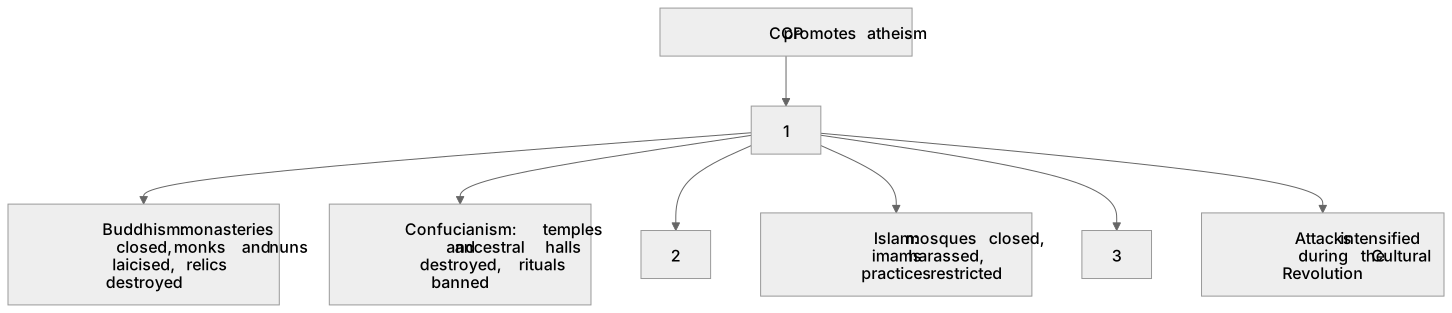
1Box 1
2Box 2
3Box 3
There is more to this lesson
The full lesson goes on to check your understanding and help you earn the marks. Create a free account to carry on, with your progress saved.
A week of Premium from your first lesson · Then the free plan continues · No card, no charge
Test your understanding of Social and cultural changes, 1949–76: Religion: attacks on Buddhism, Confucianism, Christianity, Islam and ancestor worship.
Active recall beats re-reading. Take an instant quiz now to test what you’ve learned and lock it into long-term memory.
A week of Premium from your first lesson · Then the free plan continues · No card, no charge