Pearson Edexcel · A-Level · History
Course version: 9HI0 · Version from Sept 2015
Population: reasons for the increase in population; the impact of…
Full specification wording
Social and intellectual challenge, 1625–88: Population: reasons for the increase in population; the impact of population growth on urban development and rural change; growth of poverty; the Poor Laws and actions against beggars and vagrants.
Between 1625 and 1688 England's population grew modestly, perhaps from about 5 million to 5.5 million, driven by earlier marriage, higher birth rates and falling mortality from plague.
Checked against the Pearson Edexcel 9HI0 specification (opens in a new tab) on .
- Point 1 of 3
- 4 key terms
Study notes
From the checked teaching notes for this specification point.
The idea
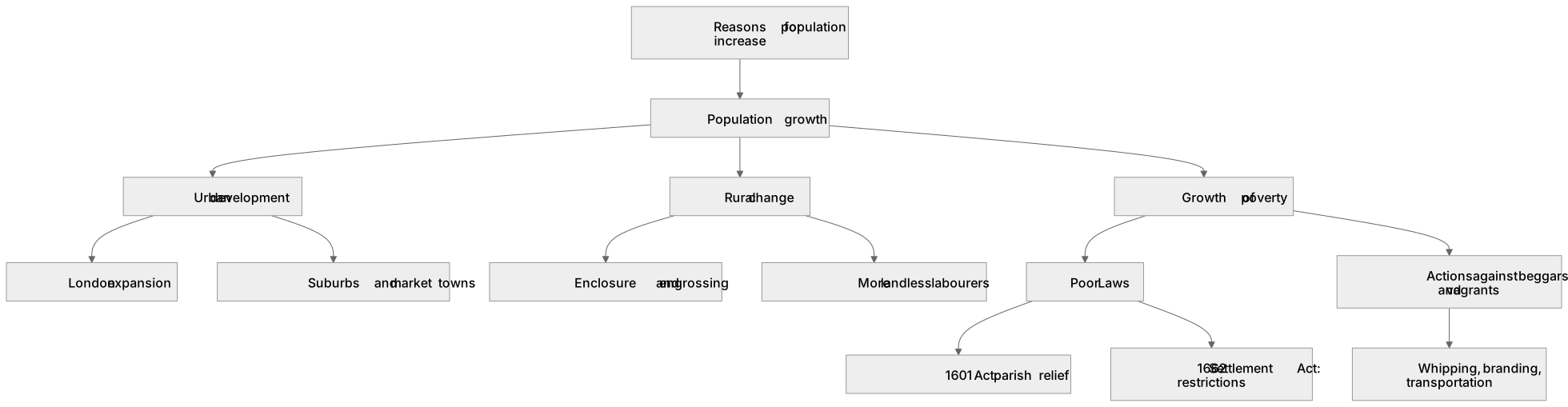
Between 1625 and 1688 England's population grew modestly, perhaps from about 5 million to 5.5 million, driven by earlier marriage, higher birth rates and falling mortality from plague. This growth intensified urban development: London expanded to roughly 500,000 people, stimulating suburbs, trade and migration, while market towns grew as service centres. In rural areas, population pressure combined with enclosure and engrossing to reduce smallholdings, creating more landless labourers and rural poverty. Poverty increased as wages lagged behind prices and harvest failures caused distress. The Poor Laws responded: the 1601 Act made parishes responsible for relief, and the 1662 Settlement Act restricted movement of the poor. Actions against beggars and vagrants included whipping, branding and transportation, reflecting fear of disorder.
What earns the marks
- Explains demographic causes: earlier marriage ages, higher fertility, and reduced plague mortality after 1660s.
- Links population growth to urban development: London's growth, suburban expansion, and the rise of market towns.
- Analyses rural change: enclosure, engrossing, and the decline of smallholding, producing a landless labour force.
- Assesses the growth of poverty: falling real wages, harvest failure, and the increase in vagrancy.
- Evaluates the Poor Laws: the 1601 Act's parish-based relief and the 1662 Settlement Act's restrictions.
- Examines actions against beggars and vagrants: whipping, branding, and transportation as deterrents.
Common mistakes and how to put them right
Assuming population growth was uniform across the period.
Put it right: Growth slowed after 1650 and varied regionally.
Treating the Poor Laws as a single policy.
Put it right: Distinguish between relief measures and punitive measures, and note local variation.
Overlooking the impact of enclosure on rural poverty.
Put it right: Link enclosure to reduced access to land and increased vagrancy.
Exam tips
- Use specific examples, such as the 1662 Settlement Act, to illustrate legal responses to poverty.
- When discussing urban development, refer to London's population growth and its social consequences.
- Analyse both causes and consequences of population change to address the full statement.
Try the lesson
The start of the Social and intellectual challenge, 1625–88: Population: reasons for the increase in population; the impact of population growth on urban development and rural change; growth of poverty; the Poor Laws and actions against beggars and vagrants. lesson, made from checked teaching notes for this specification point.
Have a go first
What was a significant impact of population growth on rural areas in England during the period 1625–88?
Listen
Between 1625 and 1688 England's population grew modestly, perhaps from about 5 million to 5.5 million, driven by earlier marriage, higher birth rates and falling mortality from plague. This growth intensified urban development: London expanded to roughly 500,000 people, stimulating suburbs, trade and migration, while market towns grew as service centres. In rural areas, population pressure combined with enclosure and engrossing to reduce smallholdings, creating more landless labourers and rural poverty. Poverty increased as wages lagged behind prices and harvest failures caused distress. The Poor Laws responded: the 1601 Act made parishes responsible for relief, and the 1662 Settlement Act restricted movement of the poor. Actions against beggars and vagrants included whipping, branding and transportation, reflecting fear of disorder. A strong answer earns marks for these points. Explains demographic causes: earlier marriage ages, higher fertility, and reduced plague mortality after 1660s. Links population growth to urban development: London's growth, suburban expansion, and the rise of market towns. Analyses rural change: enclosure, engrossing, and the decline of smallholding, producing a landless labour force. Assesses the growth of poverty: falling real wages, harvest failure, and the increase in vagrancy. A common slip: assuming population growth was uniform across the period. Instead, growth slowed after 1650 and varied regionally. Exam tip: Use specific examples, such as the 1662 Settlement Act, to illustrate legal responses to poverty.
See it
Key words
Say what each word means before you turn the card.
Demographic change
Try answering aloud or in your head before turning the card.
Urbanisation
Try answering aloud or in your head before turning the card.
Rural economy
Try answering aloud or in your head before turning the card.
Poverty and social policy
Try answering aloud or in your head before turning the card.
See every definition
- Demographic change
- Population grew modestly, driven by earlier marriage, higher birth rates and falling mortality from plague.
- Urbanisation
- Population growth intensified urban development, with London expanding and market towns growing as service centres.
- Rural economy
- Population pressure combined with enclosure and engrossing to reduce smallholdings, creating more landless labourers and rural poverty.
- Poverty and social policy
- The Poor Laws responded, with the 1601 Act making parishes responsible for relief and the 1662 Settlement Act restricting movement of the poor.
Label the diagram
Some boxes have lost their names. Pick the right name for each number.
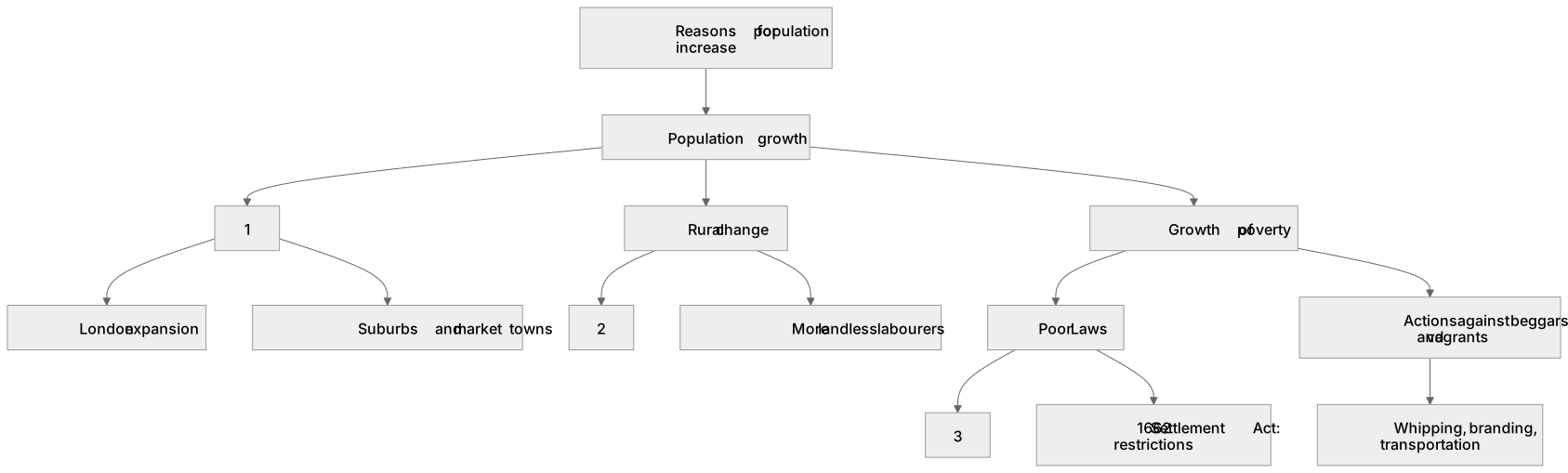
1Box 1
2Box 2
3Box 3
There is more to this lesson
The full lesson goes on to check your understanding and help you earn the marks. Create a free account to carry on, with your progress saved.
A week of Premium from your first lesson · Then the free plan continues · No card, no charge
Test your understanding of Social and intellectual challenge, 1625–88: Population: reasons for the increase in population; the impact of population growth on urban development and rural change; growth of poverty; the Poor Laws and actions against beggars and vagrants.
Active recall beats re-reading. Take an instant quiz now to test what you’ve learned and lock it into long-term memory.
A week of Premium from your first lesson · Then the free plan continues · No card, no charge