Pearson Edexcel · A-Level · History
Course version: 9HI0 · Version from Sept 2015
The changing structure of society: the power of the nobility; the changing…
Full specification wording
Social and intellectual challenge, 1625–88: The changing structure of society: the power of the nobility; the changing gentry class; urbanisation and the growth of the professional and merchant classes; the impact of religious and legal changes on the status of women.
Between 1625 and 1688 the English social structure shifted.
Checked against the Pearson Edexcel 9HI0 specification (opens in a new tab) on .
- Point 2 of 3
- 4 key terms
Study notes
From the checked teaching notes for this specification point.
The idea
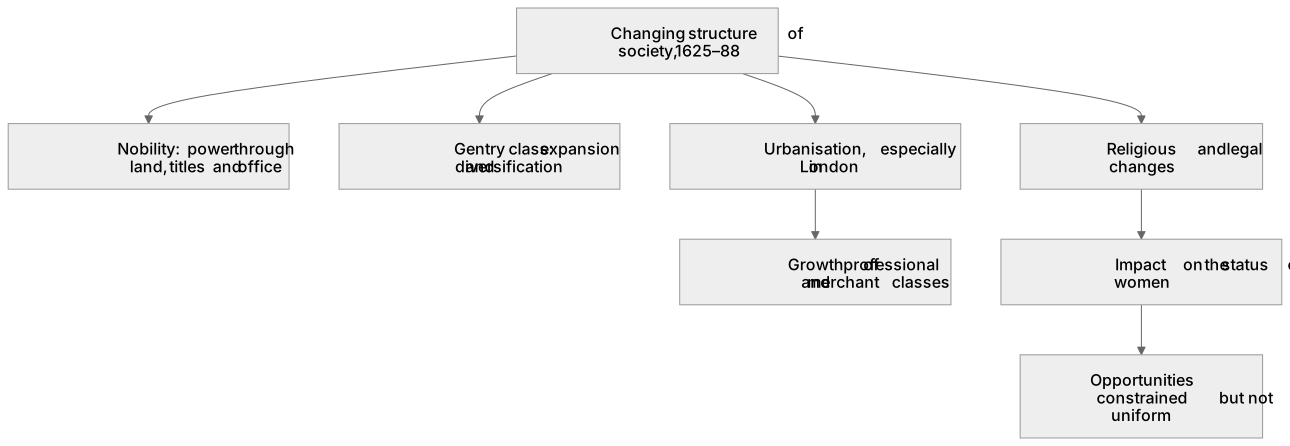
Between 1625 and 1688 the English social structure shifted. The nobility retained great power through landownership, titles and office, but their political dominance was challenged by civil war and the rise of new wealth. The gentry class expanded and diversified: many profited from land, office and trade, becoming a dynamic force in local government and Parliament. Urbanisation, especially in London, fostered professional and merchant classes—lawyers, doctors, financiers and overseas traders—whose wealth and influence grew. Religious and legal changes affected women's status: Protestant emphasis on companionate marriage and the abolition of ecclesiastical courts during the Interregnum altered marriage and property rights, while the common law doctrine of coverture limited married women's legal independence. Overall, women's opportunities remained constrained but not uniform.
What earns the marks
- Explains the enduring power of the nobility: land, titles, and office-holding.
- Analyses the changing gentry class: expansion, diversification, and role in local and national politics.
- Links urbanisation to the growth of professional and merchant classes, especially in London.
- Assesses the impact of religious changes on women: Protestant ideals of marriage and the abolition of church courts.
- Evaluates legal changes affecting women: coverture, property rights, and the Interregnum's reforms.
- Discusses regional and social variation in women's experiences.
Common mistakes and how to put them right
Assuming the nobility's power declined uniformly.
Put it right: Many nobles retained significant influence through land and patronage.
Treating the gentry as a homogeneous group.
Put it right: Recognise differences in wealth, religion, and political allegiance.
Overstating improvements in women's status.
Put it right: Note that legal and religious changes had mixed effects, often reinforcing patriarchal structures.
Exam tips
- Use specific examples, such as the growth of London's legal profession, to illustrate class changes.
- When discussing women, refer to both religious and legal developments, such as the abolition of church courts.
- Compare the experiences of different social groups to show understanding of a changing structure.
Try the lesson
The start of the Social and intellectual challenge, 1625–88: The changing structure of society: the power of the nobility; the changing gentry class; urbanisation and the growth of the professional and merchant classes; the impact of religious and legal changes on the status of women. lesson, made from checked teaching notes for this specification point.
Have a go first
Which group in the period 1625–88 is generally described by historians as growing in numbers and influence as a result of the sale of land and offices?
Listen
Between 1625 and 1688 the English social structure shifted. The nobility retained great power through landownership, titles and office, but their political dominance was challenged by civil war and the rise of new wealth. The gentry class expanded and diversified: many profited from land, office and trade, becoming a dynamic force in local government and Parliament. Urbanisation, especially in London, fostered professional and merchant classes—lawyers, doctors, financiers and overseas traders—whose wealth and influence grew. Religious and legal changes affected women's status: Protestant emphasis on companionate marriage and the abolition of ecclesiastical courts during the Interregnum altered marriage and property rights, while the common law doctrine of coverture limited married women's legal independence. Overall, women's opportunities remained constrained but not uniform. A strong answer earns marks for these points. Explains the enduring power of the nobility: land, titles, and office-holding. Analyses the changing gentry class: expansion, diversification, and role in local and national politics. Links urbanisation to the growth of professional and merchant classes, especially in London. Assesses the impact of religious changes on women: Protestant ideals of marriage and the abolition of church courts. A common slip: assuming the nobility's power declined uniformly. Instead, many nobles retained significant influence through land and patronage. Exam tip: Use specific examples, such as the growth of London's legal profession, to illustrate class changes.
See it
Key words
Say what each word means before you turn the card.
Social hierarchy
Try answering aloud or in your head before turning the card.
Class mobility
Try answering aloud or in your head before turning the card.
Urbanisation
Try answering aloud or in your head before turning the card.
Gender and law
Try answering aloud or in your head before turning the card.
See every definition
- Social hierarchy
- The structure of society in which the nobility retained great power through landownership, titles and office, while the gentry class expanded and diversified.
- Class mobility
- The shifting of social groups as the gentry expanded and diversified and urbanisation fostered professional and merchant classes whose wealth and influence grew.
- Urbanisation
- Growth especially in London, which fostered professional and merchant classes such as lawyers, doctors, financiers and overseas traders.
- Gender and law
- Religious and legal changes affected women's status, including the abolition of ecclesiastical courts during the Interregnum and the common law doctrine of coverture.
Label the diagram
Some boxes have lost their names. Pick the right name for each number.
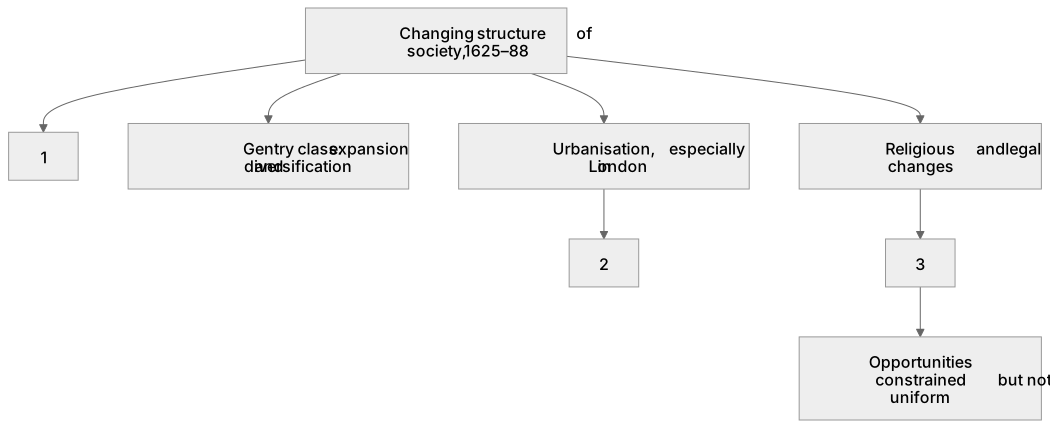
1Box 1
2Box 2
3Box 3
There is more to this lesson
The full lesson goes on to check your understanding and help you earn the marks. Create a free account to carry on, with your progress saved.
A week of Premium from your first lesson · Then the free plan continues · No card, no charge
Test your understanding of Social and intellectual challenge, 1625–88: The changing structure of society: the power of the nobility; the changing gentry class; urbanisation and the growth of the professional and merchant classes; the impact of religious and legal changes on the status of women.
Active recall beats re-reading. Take an instant quiz now to test what you’ve learned and lock it into long-term memory.
A week of Premium from your first lesson · Then the free plan continues · No card, no charge