Pearson Edexcel · A-Level · History
Course version: 9HI0 · Version from Sept 2015
Social security: full employment, housing and social benefits, 1917–53.…
Full specification wording
Social developments, 1917–85: Social security: full employment, housing and social benefits, 1917–53. Khrushchev, Brezhnev and the promotion of a stable society, 1953–85.
This topic covers Soviet social security from 1917 to 1985.
Checked against the Pearson Edexcel 9HI0 specification (opens in a new tab) on .
- Point 1 of 3
Study notes
From the checked teaching notes for this specification point.
The idea
This topic covers Soviet social security from 1917 to 1985. In 1917–53, the state claimed to guarantee full employment, but housing was often cramped and social benefits were limited. After 1953, Khrushchev promoted a stable society through mass housing and welfare expansion, while Brezhnev emphasised stability and modest improvements. Key examples include the 1920s housing crisis, the 1930s labour policies, Khrushchev's housing programme, and Brezhnev's social contract.
What earns the marks
- Explains the meaning and reality of full employment in the Soviet Union, including the role of state planning and labour direction.
- Describes housing conditions and policies from 1917 to 1953, such as communal apartments and the 1930s construction drives.
- Explains social benefits such as pensions, healthcare and education, and their limitations before 1953.
- Analyses Khrushchev's attempts to promote a stable society, including the 1956 housing programme and welfare reforms.
- Evaluates Brezhnev's promotion of stability, including the social contract, and the extent to which it improved social security.
Common mistakes and how to put them right
Assuming full employment meant prosperity.
Put it right: Wages were low and shortages of consumer goods were common, so employment did not guarantee a high standard of living.
Believing that housing improved steadily after 1917.
Put it right: Urban housing remained severely overcrowded until the mass construction programmes of the 1950s and 1960s.
Confusing Khrushchev's and Brezhnev's approaches.
Put it right: Khrushchev pursued ambitious reforms and targets, while Brezhnev prioritised stability and gradual improvement.
Exam tips
- Use specific policies and statistics, such as the 1956 housing decree or pension reforms, to support your arguments.
- Compare the periods 1917–53 and 1953–85 to show change and continuity in social security.
- Consider both state aims and popular experiences when assessing the promotion of a stable society.
Try the lesson
The start of the Social developments, 1917–85: Social security: full employment, housing and social benefits, 1917–53. Khrushchev, Brezhnev and the promotion of a stable society, 1953–85. lesson, made from checked teaching notes for this specification point.
Have a go first
Which social benefit was a central promise of the Soviet welfare system in the period 1917–53?
Listen
This topic covers Soviet social security from 1917 to 1985. In 1917–53, the state claimed to guarantee full employment, but housing was often cramped and social benefits were limited. After 1953, Khrushchev promoted a stable society through mass housing and welfare expansion, while Brezhnev emphasised stability and modest improvements. Key examples include the 1920s housing crisis, the 1930s labour policies, Khrushchev's housing programme, and Brezhnev's social contract. A strong answer earns marks for these points. Explains the meaning and reality of full employment in the Soviet Union, including the role of state planning and labour direction. Describes housing conditions and policies from 1917 to 1953, such as communal apartments and the 1930s construction drives. Explains social benefits such as pensions, healthcare and education, and their limitations before 1953. Analyses Khrushchev's attempts to promote a stable society, including the 1956 housing programme and welfare reforms. A common slip: Assuming full employment meant prosperity. Instead, wages were low and shortages of consumer goods were common, so employment did not guarantee a high standard of living. Exam tip: Use specific policies and statistics, such as the 1956 housing decree or pension reforms, to support your arguments.
See it
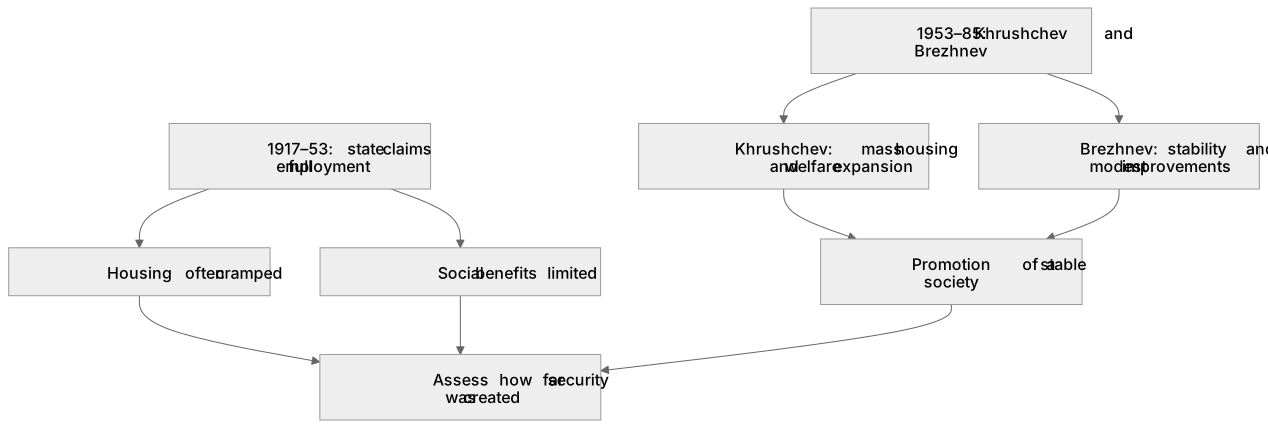
Label the diagram
Some boxes have lost their names. Pick the right name for each number.
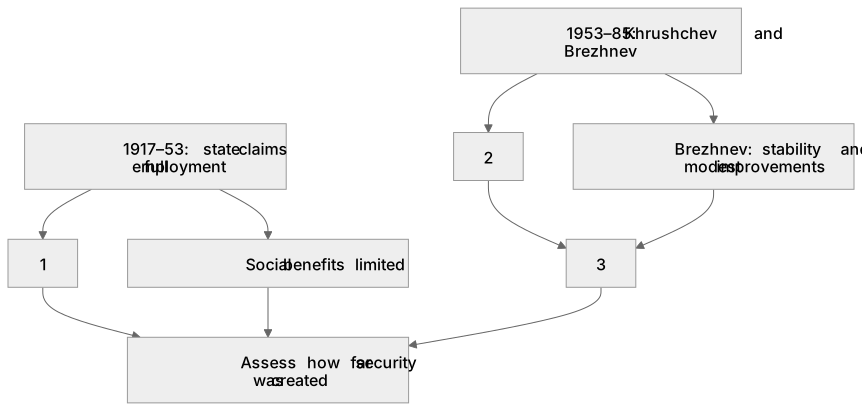
1Box 1
2Box 2
3Box 3
There is more to this lesson
The full lesson goes on to check your understanding and help you earn the marks. Create a free account to carry on, with your progress saved.
A week of Premium from your first lesson · Then the free plan continues · No card, no charge
Test your understanding of Social developments, 1917–85: Social security: full employment, housing and social benefits, 1917–53. Khrushchev, Brezhnev and the promotion of a stable society, 1953–85.
Active recall beats re-reading. Take an instant quiz now to test what you’ve learned and lock it into long-term memory.
A week of Premium from your first lesson · Then the free plan continues · No card, no charge