Pearson Edexcel · A-Level · History
Course version: 9HI0 · Version from Sept 2015
Women and the family: the changing status of different groups of women in…
Full specification wording
Social developments, 1917–85: Women and the family: the changing status of different groups of women in towns and countryside; changing government attitudes towards the family as a social unit.
This topic examines how the status of women in Soviet Russia changed between 1917 and 1985, distinguishing between different groups of women in towns and in the countryside, and how government…
Checked against the Pearson Edexcel 9HI0 specification (opens in a new tab) on .
- Point 2 of 3
Study notes
From the checked teaching notes for this specification point.
The idea
This topic examines how the status of women in Soviet Russia changed between 1917 and 1985, distinguishing between different groups of women in towns and in the countryside, and how government attitudes towards the family as a social unit shifted over time. You need to compare the experiences of, for example, urban professional women, female industrial workers, and peasant women, and explain how policies such as the 1918 Family Code, the 1936 abortion ban, and post-war pronatalism affected them differently. You should also trace changing government attitudes: from early Bolshevik attempts to weaken the traditional family, through Stalinist reinforcement of the family, to later Soviet attempts to support working mothers. A strong answer uses specific evidence, such as the 1920 legalisation of abortion, the 1936 ban, and the 1944 Family Law, and explains continuity and change.
What earns the marks
- Explains how the status of women differed between towns and countryside, using examples such as literacy campaigns, access to education and employment, and the persistence of traditional peasant family structures.
- Analyses changing government attitudes towards the family, from the early Bolshevik view of the family as a bourgeois institution to Stalinist policies that reinforced marriage and motherhood.
- Uses specific legislation and policies as evidence, such as the 1918 Family Code, the 1920 legalisation of abortion, the 1936 ban on abortion, and the 1944 Family Law.
- Evaluates the impact of government policies on different groups of women, for example female industrial workers, party activists, and peasant women, showing how experiences diverged.
- Discusses the tension between ideology and practical needs, such as the need for female labour during industrialisation and war, and the pronatalist drive to increase birth rates.
- Shows awareness of change over time, including the post-Stalin period when divorce and abortion were legalised again and the state offered more support to working mothers.
Common mistakes and how to put them right
Treating women as a single homogeneous group.
Put it right: Distinguish between urban and rural women, and between different social classes, and explain how policies affected them differently.
Assuming that government attitudes were consistent.
Put it right: Identify shifts, such as the move from radical social experimentation in the 1920s to conservative pronatalism under Stalin, and later partial liberalisation.
Ignoring the countryside; instead, include evidence about peasant women, such as the impact of collectivisation, the persistence of traditional gender roles, and lower access to education and healthcare.
Confusing the chronology of key policies.
Put it right: Check dates such as the 1918 Family Code, 1920 legalisation of abortion, 1936 ban, and 1944 Family Law, and place them in the correct period.
Exam tips
- Plan your answer around the two strands in the statement: changing status of different groups of women, and changing government attitudes towards the family.
- Use precise evidence, such as the 1920 legalisation of abortion and the 1936 ban, to support your arguments about government attitudes.
- Compare the experiences of urban and rural women explicitly, and explain reasons for differences, such as economic policy, cultural norms, and state capacity.
- When discussing government attitudes, link them to broader political and economic contexts, such as industrialisation, war, and the need for population growth.
Try the lesson
The start of the Social developments, 1917–85: Women and the family: the changing status of different groups of women in towns and countryside; changing government attitudes towards the family as a social unit. lesson, made from checked teaching notes for this specification point.
Have a go first
Which development of the 1930s most directly increased the number of women working in Soviet towns?
Listen
This topic examines how the status of women in Soviet Russia changed between 1917 and 1985, distinguishing between different groups of women in towns and in the countryside, and how government attitudes towards the family as a social unit shifted over time. You need to compare the experiences of, for example, urban professional women, female industrial workers, and peasant women, and explain how policies such as the 1918 Family Code, the 1936 abortion ban, and post-war pronatalism affected them differently. You should also trace changing government attitudes: from early Bolshevik attempts to weaken the traditional family, through Stalinist reinforcement of the family, to later Soviet attempts to support working mothers. A strong answer uses specific evidence, such as the 1920 legalisation of abortion, the 1936 ban, and the 1944 Family Law, and explains continuity and change. A strong answer earns marks for these points. Explains how the status of women differed between towns and countryside, using examples such as literacy campaigns, access to education and employment, and the persistence of traditional peasant family structures. Analyses changing government attitudes towards the family, from the early Bolshevik view of the family as a bourgeois institution to Stalinist policies that reinforced marriage and motherhood. Uses specific legislation and policies as evidence, such as the 1918 Family Code, the 1920 legalisation of abortion, the 1936 ban on abortion, and the 1944 Family Law. Evaluates the impact of government policies on different groups of women, for example female industrial workers, party activists, and peasant women, showing how experiences diverged. A common slip: Treating women as a single homogeneous group. Instead, distinguish between urban and rural women, and between different social classes, and explain how policies affected them differently. Exam tip: Plan your answer around the two strands in the statement: changing status of different groups of women, and changing government attitudes towards the family.
See it
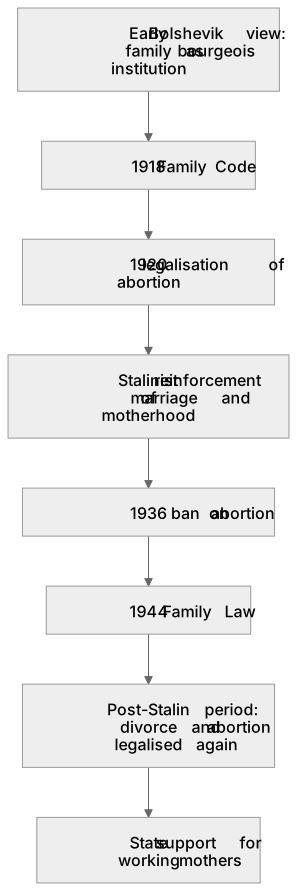
Put it in order
Put these steps in the order they happen.
- 1. 1936 ban on abortion
- 2. State support for working mothers
- 3. 1944 Family Law
- 4. Early Bolshevik view: family as bourgeois institution
- 5. 1918 Family Code
- 6. Post-Stalin period: divorce and abortion legalised again
- 7. 1920 legalisation of abortion
- 8. Stalinist reinforcement of marriage and motherhood
Label the diagram
Some boxes have lost their names. Pick the right name for each number.
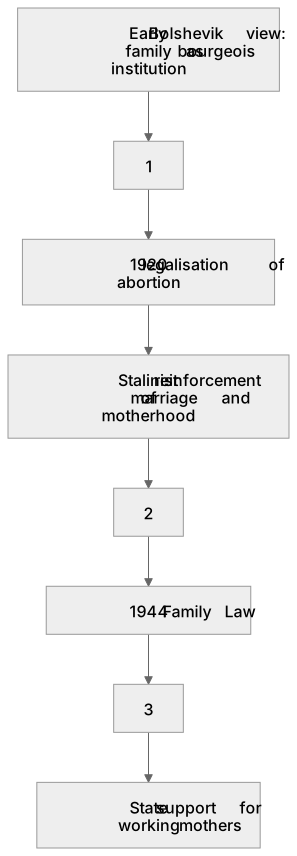
1Box 1
2Box 2
3Box 3
There is more to this lesson
The full lesson goes on to check your understanding and help you earn the marks. Create a free account to carry on, with your progress saved.
A week of Premium from your first lesson · Then the free plan continues · No card, no charge
Test your understanding of Social developments, 1917–85: Women and the family: the changing status of different groups of women in towns and countryside; changing government attitudes towards the family as a social unit.
Active recall beats re-reading. Take an instant quiz now to test what you’ve learned and lock it into long-term memory.
A week of Premium from your first lesson · Then the free plan continues · No card, no charge