Pearson Edexcel · A-Level · History
Course version: 9HI0 · Version from Sept 2015
Reasons for the success of Parma, 1577–84: re-establishing Spanish rule in…
Full specification wording
Spain and the reconquest, 1573–84: Reasons for the success of Parma, 1577–84: re-establishing Spanish rule in the south; the Union of Arras 1579 and its religious and political significance; Parma’s diplomacy, military tactics and strategy; the fall of Antwerp 1584.
Parma succeeded by combining military skill with political and religious diplomacy.
Checked against the Pearson Edexcel 9HI0 specification (opens in a new tab) on .
- Point 2 of 4
- 4 key terms
Study notes
From the checked teaching notes for this specification point.
The idea
Parma succeeded by combining military skill with political and religious diplomacy. He re-established Spanish rule in the south by defeating rebel forces, securing key cities, and offering reconciliation to Catholic nobles. The Union of Arras (1579) united loyal Catholic provinces, recognising Spanish authority and Catholicism while demanding respect for privileges; it split the revolt and isolated the Calvinist north. Parma’s diplomacy exploited divisions, his military tactics included sieges and bridge-building, and his strategy focused on the southern provinces first. The siege of Antwerp began in 1584 (often cited as the fall of Antwerp 1584 in the specification, though it formally surrendered in 1585). Using a pontoon bridge to block the Scheldt, this decisive victory secured Spanish control of the south and demonstrated Parma’s effectiveness.
What earns the marks
- Explains how Parma re-established Spanish rule in the south through military campaigns, sieges, and reconciliation with Catholic elites.
- Describes the Union of Arras (1579) as a union of Catholic provinces loyal to Spain, and explains its religious and political significance in dividing the Netherlands.
- Analyses Parma’s diplomacy, including offers of pardon and respect for privileges, which won over nobles and towns.
- Evaluates Parma’s military tactics and strategy, such as siege warfare, use of bridges, and prioritising the south.
- Explains the fall of Antwerp (besieged from 1584 and falling in 1585) as a result of Parma’s blockade, including the pontoon bridge across the Scheldt.
Common mistakes and how to put them right
Treating the Union of Arras as a Calvinist union.
Put it right: It was a Catholic union loyal to Spain, while the Union of Utrecht was the Calvinist counterpart.
Claiming Parma only used force.
Put it right: He combined military pressure with diplomacy, offering pardons and respecting privileges to win loyalty.
Describing the fall of Antwerp as a quick victory.
Put it right: It was a prolonged siege beginning in 1584, and Parma’s pontoon bridge was crucial in cutting off the city before its 1585 surrender.
Exam tips
- Use specific dates: Union of Arras (1579), and note that the siege of Antwerp began in 1584 (as per the specification) before concluding in 1585.
- Explain how Parma’s diplomacy and military tactics worked together, not separately.
Try the lesson
The start of the Spain and the reconquest, 1573–84: Reasons for the success of Parma, 1577–84: re-establishing Spanish rule in the south; the Union of Arras 1579 and its religious and political significance; Parma’s diplomacy, military tactics and strategy; the fall of Antwerp 1584. lesson, made from checked teaching notes for this specification point.
Have a go first
How did the Duke of Parma secure the fall of Antwerp, completing his reconquest of Flanders and Brabant?
Listen
Parma succeeded by combining military skill with political and religious diplomacy. He re-established Spanish rule in the south by defeating rebel forces, securing key cities, and offering reconciliation to Catholic nobles. The Union of Arras (1579) united loyal Catholic provinces, recognising Spanish authority and Catholicism while demanding respect for privileges; it split the revolt and isolated the Calvinist north. Parma’s diplomacy exploited divisions, his military tactics included sieges and bridge-building, and his strategy focused on the southern provinces first. The siege of Antwerp began in 1584 (often cited as the fall of Antwerp 1584 in the specification, though it formally surrendered in 1585). Using a pontoon bridge to block the Scheldt, this decisive victory secured Spanish control of the south and demonstrated Parma’s effectiveness. A strong answer earns marks for these points. Explains how Parma re-established Spanish rule in the south through military campaigns, sieges, and reconciliation with Catholic elites. Describes the Union of Arras (1579) as a union of Catholic provinces loyal to Spain, and explains its religious and political significance in dividing the Netherlands. Analyses Parma’s diplomacy, including offers of pardon and respect for privileges, which won over nobles and towns. Evaluates Parma’s military tactics and strategy, such as siege warfare, use of bridges, and prioritising the south. A common slip: Treating the Union of Arras as a Calvinist union. Instead, it was a Catholic union loyal to Spain, while the Union of Utrecht was the Calvinist counterpart. Exam tip: Use specific dates: Union of Arras (1579), and note that the siege of Antwerp began in 1584 (as per the specification) before concluding in 1585.
See it

Put the events in order
Put these events in the order they happened, earliest first.
- 1. Parma begins re-establishing Spanish rule in the south
- 2. Siege of Antwerp begins under Parma
- 3. Union of Arras unites loyal Catholic provinces
Key words
Say what each word means before you turn the card.
Union of Arras
Try answering aloud or in your head before turning the card.
Parma's diplomacy
Try answering aloud or in your head before turning the card.
Parma's military tactics
Try answering aloud or in your head before turning the card.
Fall of Antwerp
Try answering aloud or in your head before turning the card.
See every definition
- Union of Arras
- A union of loyal Catholic provinces in 1579 that recognised Spanish authority and Catholicism while demanding respect for privileges, splitting the revolt and isolating the Calvinist north.
- Parma's diplomacy
- Offers of pardon and respect for privileges which won over nobles and towns, exploiting divisions rather than relying on force alone.
- Parma's military tactics
- Siege warfare and bridge-building, including the pontoon bridge used to block the Scheldt during the siege of Antwerp.
- Fall of Antwerp
- A prolonged siege beginning in 1584 in which Parma's pontoon bridge cut off the city before its 1585 surrender, securing Spanish control of the south.
Label the diagram
Some boxes have lost their names. Pick the right name for each number.
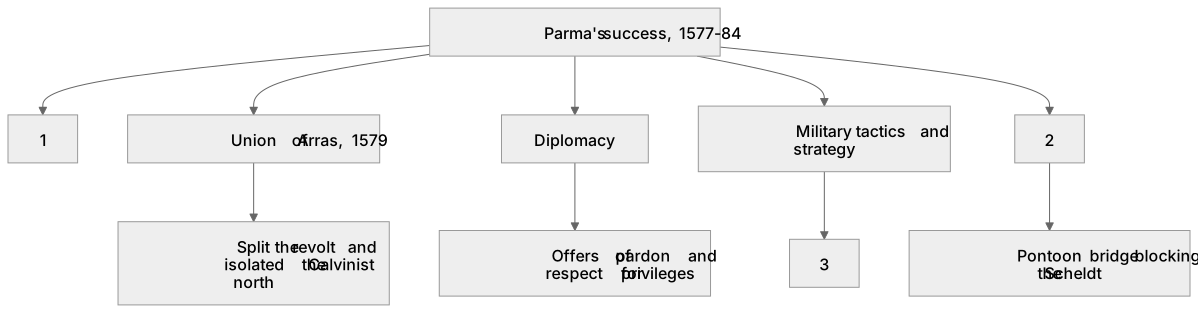
1Box 1
2Box 2
3Box 3
There is more to this lesson
The full lesson goes on to check your understanding and help you earn the marks. Create a free account to carry on, with your progress saved.
A week of Premium from your first lesson · Then the free plan continues · No card, no charge
Test your understanding of Spain and the reconquest, 1573–84: Reasons for the success of Parma, 1577–84: re-establishing Spanish rule in the south; the Union of Arras 1579 and its religious and political significance; Parma’s diplomacy, military tactics and strategy; the fall of Antwerp 1584.
Active recall beats re-reading. Take an instant quiz now to test what you’ve learned and lock it into long-term memory.
A week of Premium from your first lesson · Then the free plan continues · No card, no charge