Pearson Edexcel · A-Level · History
Course version: 9HI0 · Version from Sept 2015
Foreign intervention in the Netherlands: Orange’s decision to seek foreign…
Full specification wording
Spain and the reconquest, 1573–84: Foreign intervention in the Netherlands: Orange’s decision to seek foreign help; the invitation to the Duke of Anjou 1578; the Duke’s unpopularity and his withdrawal in 1583.
After 1576, the revolt against Spain lacked a strong native leader and reliable army, prompting Orange's decision to seek foreign help.
Checked against the Pearson Edexcel 9HI0 specification (opens in a new tab) on .
- Point 3 of 4
- 2 key terms
Study notes
From the checked teaching notes for this specification point.
The idea
After 1576, the revolt against Spain lacked a strong native leader and reliable army, prompting Orange's decision to seek foreign help. He judged that a foreign prince with troops could unite the provinces against Parma, viewing France as the best source of foreign intervention. In 1578, the States-General issued an invitation to the Duke of Anjou to become ‘Defender of the Liberty of the Low Countries’. Anjou arrived in 1582 and was made Duke of Brabant, but his Catholicism, French entourage, and ambition caused immense unpopularity among Calvinists. In January 1583, he attempted a coup, seizing Antwerp; this ‘French Fury’ failed, leading to his withdrawal in 1583.
What earns the marks
- Explains Orange’s decision to seek foreign help due to the military superiority of Parma’s Army of Flanders and the need for a figure who could unite Catholics and Protestants.
- Identifies the invitation to the Duke of Anjou in 1578 as a decision of the States-General, with Orange’s encouragement, to secure French support.
- Explains Anjou’s arrival in 1582 and his status as Duke of Brabant, noting that his authority was heavily limited by the provinces.
- Analyses the causes of the Duke’s unpopularity: his Catholicism, his French advisers, his demands for greater power, and resentment from Calvinists and provincial particularists.
- Explains the ‘French Fury’ of January 1583, when Anjou tried to seize Antwerp, and the consequences: his withdrawal in 1583 and the collapse of the French option.
Common mistakes and how to put them right
Treating Anjou as a Spanish or Habsburg candidate.
Put it right: He was a French prince, brother of Henry III, invited by the rebel States-General.
Confusing the invitation to the Duke of Anjou in 1578 with his actual arrival.
Put it right: Keep the invitation (1578), arrival (1582), and withdrawal (1583) as separate dated stages.
Assuming the Duke’s unpopularity was only religious.
Put it right: It also rested on his foreign status, his political ambition, and provincial particularism.
Exam tips
- Anchor each stage to its correct date: invitation 1578, arrival and title 1582, French Fury and withdrawal 1583.
- Use the episode to discuss the wider problem of foreign intervention in the Netherlands, not just Anjou’s personality.
Try the lesson
The start of the Spain and the reconquest, 1573–84: Foreign intervention in the Netherlands: Orange’s decision to seek foreign help; the invitation to the Duke of Anjou 1578; the Duke’s unpopularity and his withdrawal in 1583. lesson, made from checked teaching notes for this specification point.
Have a go first
In 1578 William of Orange invited which foreign prince to become the protector of the Netherlands?
Listen
After 1576, the revolt against Spain lacked a strong native leader and reliable army, prompting Orange's decision to seek foreign help. He judged that a foreign prince with troops could unite the provinces against Parma, viewing France as the best source of foreign intervention. In 1578, the States-General issued an invitation to the Duke of Anjou to become ‘Defender of the Liberty of the Low Countries’. Anjou arrived in 1582 and was made Duke of Brabant, but his Catholicism, French entourage, and ambition caused immense unpopularity among Calvinists. In January 1583, he attempted a coup, seizing Antwerp; this ‘French Fury’ failed, leading to his withdrawal in 1583. A strong answer earns marks for these points. Explains Orange’s decision to seek foreign help due to the military superiority of Parma’s Army of Flanders and the need for a figure who could unite Catholics and Protestants. Identifies the invitation to the Duke of Anjou in 1578 as a decision of the States-General, with Orange’s encouragement, to secure French support. Explains Anjou’s arrival in 1582 and his status as Duke of Brabant, noting that his authority was heavily limited by the provinces. Analyses the causes of the Duke’s unpopularity: his Catholicism, his French advisers, his demands for greater power, and resentment from Calvinists and provincial particularists. A common slip: Treating Anjou as a Spanish or Habsburg candidate. Instead, he was a French prince, brother of Henry III, invited by the rebel States-General. Exam tip: Anchor each stage to its correct date: invitation 1578, arrival and title 1582, French Fury and withdrawal 1583.
See it
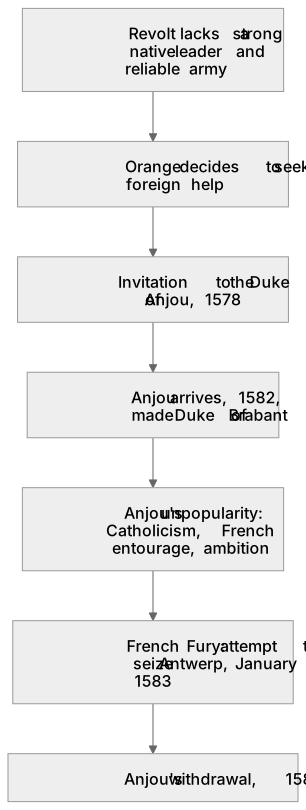
Put it in order
Put these steps in the order they happen.
- 1. Anjou's withdrawal, 1583
- 2. French Fury: attempt to seize Antwerp, January 1583
- 3. Invitation to the Duke of Anjou, 1578
- 4. Anjou's unpopularity: Catholicism, French entourage, ambition
- 5. Revolt lacks a strong native leader and reliable army
- 6. Orange decides to seek foreign help
- 7. Anjou arrives, 1582, made Duke of Brabant
Put the events in order
Put these events in the order they happened, earliest first.
- 1. States-General invited the Duke of Anjou to become Defender of the Liberty
- 2. Anjou attempted a coup in Antwerp and withdrew
- 3. Anjou arrived and was made Duke of Brabant
Key words
Say what each word means before you turn the card.
Duke of Anjou
Try answering aloud or in your head before turning the card.
French Fury
Try answering aloud or in your head before turning the card.
See every definition
- Duke of Anjou
- A foreign prince invited by the States-General in 1578 to become 'Defender of the Liberty of the Low Countries', who arrived in 1582 and was made Duke of Brabant.
- French Fury
- Anjou's attempt in January 1583 to seize Antwerp by coup, which failed and led to his withdrawal in 1583.
Label the diagram
Some boxes have lost their names. Pick the right name for each number.
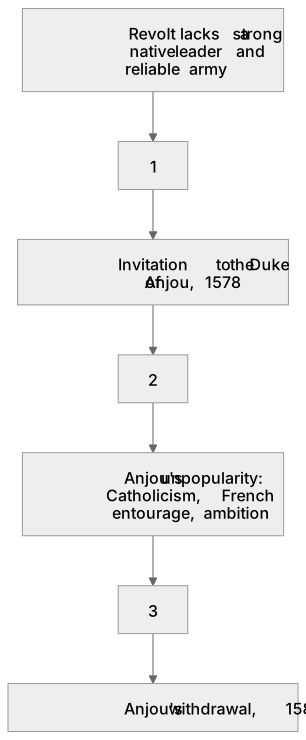
1Box 1
2Box 2
3Box 3
There is more to this lesson
The full lesson goes on to check your understanding and help you earn the marks. Create a free account to carry on, with your progress saved.
A week of Premium from your first lesson · Then the free plan continues · No card, no charge
Test your understanding of Spain and the reconquest, 1573–84: Foreign intervention in the Netherlands: Orange’s decision to seek foreign help; the invitation to the Duke of Anjou 1578; the Duke’s unpopularity and his withdrawal in 1583.
Active recall beats re-reading. Take an instant quiz now to test what you’ve learned and lock it into long-term memory.
A week of Premium from your first lesson · Then the free plan continues · No card, no charge