Pearson Edexcel · A-Level · History
Course version: 9HI0 · Version from Sept 2015
The growing independence of the northern provinces: the Union of Utrecht…
Full specification wording
Spain and the reconquest, 1573–84: The growing independence of the northern provinces: the Union of Utrecht 1579; the Act of Abjuration 1581 and the establishing of the Republic of the United Provinces; the declining influence of Orange; his assassination in 1584.
From 1579 the northern provinces moved from revolt to statehood.
Checked against the Pearson Edexcel 9HI0 specification (opens in a new tab) on .
- Point 4 of 4
- 4 key terms
Study notes
From the checked teaching notes for this specification point.
The idea
From 1579 the northern provinces moved from revolt to statehood. The Union of Utrecht, signed in January 1579, bound Holland, Zeeland, Utrecht and their allies into a defensive league against Spanish rule and against the Catholic Union of Arras; it became the constitutional basis of the Dutch Republic. In 1581 the States-General issued the Act of Abjuration, formally deposing Philip II and declaring the provinces free of their oath of allegiance. This created the Republic of the United Provinces, though its institutions were still fragile and sovereignty remained contested. Orange’s influence declined as the war continued, Anjou failed and provincial particularism reasserted itself. In 1584 William of Orange was assassinated at Delft by Balthasar Gérard, a Catholic sympathiser, leaving the revolt without its leading figure.
What earns the marks
- Explains the Union of Utrecht of 1579 as a defensive league of northern provinces, its relationship to the Union of Arras, and its role as a foundation document of the Republic.
- Explains the Act of Abjuration of 1581 as a formal deposition of Philip II and a declaration of independence, and links it to the establishing of the Republic of the United Provinces.
- Analyses the nature of the new Republic: provincial sovereignty, the States-General, the stadholderate, and the unresolved tension between particularism and central authority.
- Explains the declining influence of Orange after 1579: the failure of the Anjou experiment, provincial resistance to his authority, and his reduced room for manoeuvre.
- Explains the assassination of Orange in 1584 at Delft by Balthasar Gérard, and its consequences for the leadership of the revolt.
- Evaluates the extent to which the northern provinces had achieved independence by 1584, distinguishing formal claims from practical realities.
Common mistakes and how to put them right
Treating the Union of Utrecht as a declaration of independence.
Put it right: It was a defensive league, while the Act of Abjuration of 1581 was the formal deposition of Philip II.
Assuming the Republic of the United Provinces was a centralised state from 1581.
Put it right: Provincial sovereignty and particularism remained strong.
Confusing the declining influence of Orange with his complete loss of office.
Put it right: He remained a leading figure, but his authority was increasingly contested before his assassination in 1584.
Exam tips
- Keep the Union of Utrecht 1579, the Act of Abjuration 1581 and the assassination of 1584 as distinct dated stages.
- Use the Act of Abjuration to discuss the theory of resistance and the practical limits of the new Republic.
- Link Orange’s declining influence to the wider problem of leadership in the revolt.
Try the lesson
The start of the Spain and the reconquest, 1573–84: The growing independence of the northern provinces: the Union of Utrecht 1579; the Act of Abjuration 1581 and the establishing of the Republic of the United Provinces; the declining influence of Orange; his assassination in 1584. lesson, made from checked teaching notes for this specification point.
Have a go first
Which agreement of 1579 united the northern provinces against Spanish rule?
Listen
From 1579 the northern provinces moved from revolt to statehood. The Union of Utrecht, signed in January 1579, bound Holland, Zeeland, Utrecht and their allies into a defensive league against Spanish rule and against the Catholic Union of Arras; it became the constitutional basis of the Dutch Republic. In 1581 the States-General issued the Act of Abjuration, formally deposing Philip II and declaring the provinces free of their oath of allegiance. This created the Republic of the United Provinces, though its institutions were still fragile and sovereignty remained contested. Orange’s influence declined as the war continued, Anjou failed and provincial particularism reasserted itself. In 1584 William of Orange was assassinated at Delft by Balthasar Gérard, a Catholic sympathiser, leaving the revolt without its leading figure. A strong answer earns marks for these points. Explains the Union of Utrecht of 1579 as a defensive league of northern provinces, its relationship to the Union of Arras, and its role as a foundation document of the Republic. Explains the Act of Abjuration of 1581 as a formal deposition of Philip II and a declaration of independence, and links it to the establishing of the Republic of the United Provinces. Analyses the nature of the new Republic: provincial sovereignty, the States-General, the stadholderate, and the unresolved tension between particularism and central authority. Explains the declining influence of Orange after 1579: the failure of the Anjou experiment, provincial resistance to his authority, and his reduced room for manoeuvre. A common slip: Treating the Union of Utrecht as a declaration of independence. Instead, it was a defensive league, while the Act of Abjuration of 1581 was the formal deposition of Philip II. Exam tip: Keep the Union of Utrecht 1579, the Act of Abjuration 1581 and the assassination of 1584 as distinct dated stages.
See it
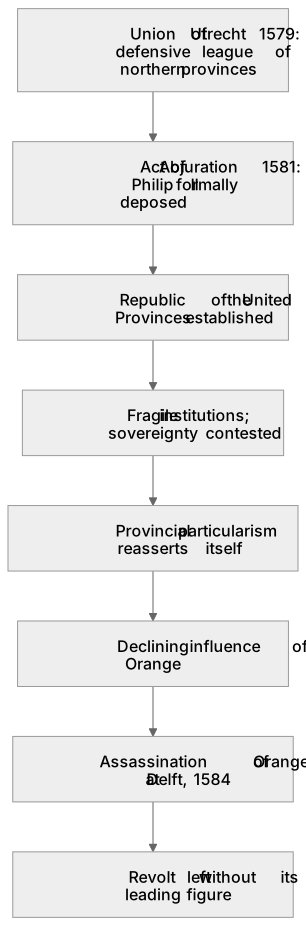
Put it in order
Put these steps in the order they happen.
- 1. Provincial particularism reasserts itself
- 2. Revolt left without its leading figure
- 3. Declining influence of Orange
- 4. Union of Utrecht 1579: defensive league of northern provinces
- 5. Act of Abjuration 1581: Philip II formally deposed
- 6. Assassination of Orange at Delft, 1584
- 7. Republic of the United Provinces established
- 8. Fragile institutions; sovereignty contested
Put the events in order
Put these events in the order they happened, earliest first.
- 1. Union of Utrecht signed by northern provinces
- 2. William of Orange assassinated at Delft
- 3. Act of Abjuration issued by the States-General
Key words
Say what each word means before you turn the card.
Union of Utrecht
Try answering aloud or in your head before turning the card.
Act of Abjuration
Try answering aloud or in your head before turning the card.
Provincial particularism
Try answering aloud or in your head before turning the card.
Assassination of Orange
Try answering aloud or in your head before turning the card.
See every definition
- Union of Utrecht
- A defensive league signed in January 1579 by Holland, Zeeland, Utrecht and their allies against Spanish rule and the Catholic Union of Arras, becoming the constitutional basis of the Dutch Republic.
- Act of Abjuration
- Issued by the States-General in 1581, it formally deposed Philip II and declared the provinces free of their oath of allegiance, creating the Republic of the United Provinces.
- Provincial particularism
- The reassertion of provincial interests which, with fragile institutions and contested sovereignty, limited central authority in the new Republic.
- Assassination of Orange
- The killing of William of Orange at Delft in 1584 by Balthasar Gérard, a Catholic sympathiser, which left the revolt without its leading figure.
Label the diagram
Some boxes have lost their names. Pick the right name for each number.
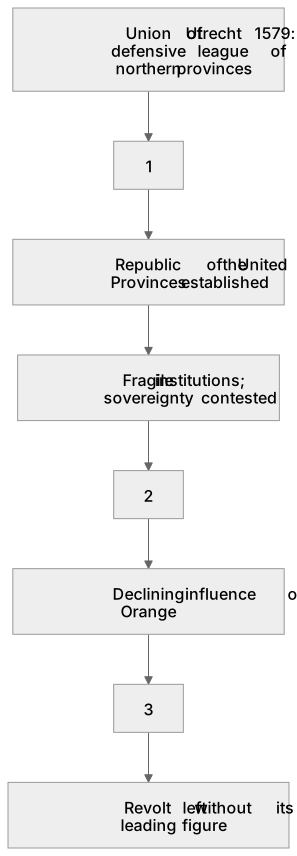
1Box 1
2Box 2
3Box 3
There is more to this lesson
The full lesson goes on to check your understanding and help you earn the marks. Create a free account to carry on, with your progress saved.
A week of Premium from your first lesson · Then the free plan continues · No card, no charge
Test your understanding of Spain and the reconquest, 1573–84: The growing independence of the northern provinces: the Union of Utrecht 1579; the Act of Abjuration 1581 and the establishing of the Republic of the United Provinces; the declining influence of Orange; his assassination in 1584.
Active recall beats re-reading. Take an instant quiz now to test what you’ve learned and lock it into long-term memory.
A week of Premium from your first lesson · Then the free plan continues · No card, no charge