Pearson Edexcel · A-Level · History
Course version: 9HI0 · Version from Sept 2015
Changes in towns and villages: towns and trading patterns; village life,…
Full specification wording
State, church and society, 1066–1106: Changes in towns and villages: towns and trading patterns; village life, royal forests and the forest laws; the gradual disappearance of slavery.
After 1066 the Norman kings reshaped settlement and economy.
Checked against the Pearson Edexcel 9HI0 specification (opens in a new tab) on .
- Point 3 of 4
- 4 key terms
Study notes
From the checked teaching notes for this specification point.
The idea
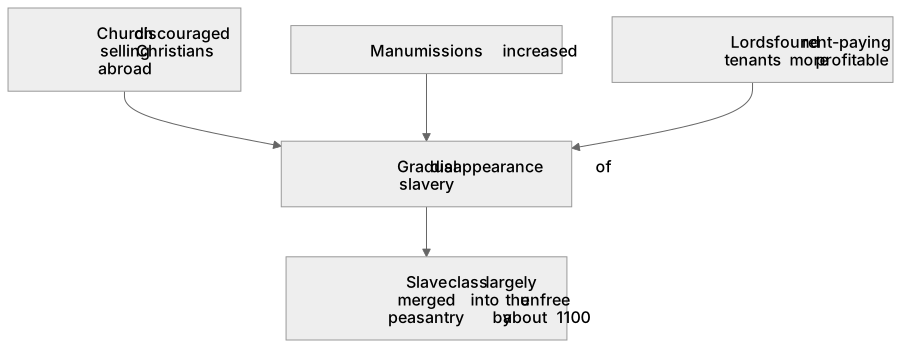
After 1066 the Norman kings reshaped settlement and economy. Towns grew as fortified centres and markets; trade linked England to Normandy and the Low Countries through ports such as London, Southampton and Chester, exporting wool and importing wine and cloth. In villages, the manor and open-field strips organised peasant labour, with villeins owing week-work and boon-work. The king claimed vast royal forests as hunting reserves, governed by forest law enforced in forest courts; offences such as poaching venison or clearing woodland brought heavy fines, and forest boundaries could displace villagers. Slavery declined gradually: the Church discouraged selling Christians abroad, manumissions increased, and lords found rent-paying tenants more profitable, so by about 1100 the slave class had largely merged into the unfree peasantry.
What earns the marks
- Explains how towns functioned as markets, mints and fortified centres, and how overseas trade connected England with Normandy and the Low Countries.
- Describes village life: the manor, open-field strips, villein tenures, week-work and boon-work, and the role of the lord's court.
- Explains that royal forests were legal hunting reserves under forest law, not simply woodland, and that forest courts imposed fines for offences such as poaching or assarting.
- Accounts for the gradual disappearance of slavery through Church teaching, manumission, and lords' preference for rent-paying tenants.
- Uses specific places or commodities, such as London, Southampton, Chester, wool, wine or cloth, to support the explanation.
Common mistakes and how to put them right
Treating 'royal forest' as any wooded area.
Put it right by explaining it was a legal jurisdiction reserved for the king's hunting, which could include fields and villages.
Assuming slavery ended instantly by royal decree.
Put it right by describing gradual decline through manumission, Church pressure and economic change.
Confusing villeins with slaves.
Put it right by noting villeins held land and owed labour services, whereas slaves were property with no land tenure.
Exam tips
- Link each economic change to its cause or consequence, for example trade growth to urban markets, rather than listing features.
- Use precise terms such as manor, week-work, forest court and manumission to show secure knowledge.
- When discussing forest law, refer to enforcement and penalties to demonstrate understanding of its impact on ordinary people.
Try the lesson
The start of the State, church and society, 1066–1106: Changes in towns and villages: towns and trading patterns; village life, royal forests and the forest laws; the gradual disappearance of slavery. lesson, made from checked teaching notes for this specification point.
Have a go first
What was the primary impact of the introduction of the forest laws by the Norman kings?
Listen
After 1066 the Norman kings reshaped settlement and economy. Towns grew as fortified centres and markets; trade linked England to Normandy and the Low Countries through ports such as London, Southampton and Chester, exporting wool and importing wine and cloth. In villages, the manor and open-field strips organised peasant labour, with villeins owing week-work and boon-work. The king claimed vast royal forests as hunting reserves, governed by forest law enforced in forest courts; offences such as poaching venison or clearing woodland brought heavy fines, and forest boundaries could displace villagers. Slavery declined gradually: the Church discouraged selling Christians abroad, manumissions increased, and lords found rent-paying tenants more profitable, so by about 1100 the slave class had largely merged into the unfree peasantry. A strong answer earns marks for these points. Explains how towns functioned as markets, mints and fortified centres, and how overseas trade connected England with Normandy and the Low Countries. Describes village life: the manor, open-field strips, villein tenures, week-work and boon-work, and the role of the lord's court. Explains that royal forests were legal hunting reserves under forest law, not simply woodland, and that forest courts imposed fines for offences such as poaching or assarting. Accounts for the gradual disappearance of slavery through Church teaching, manumission, and lords' preference for rent-paying tenants. A common slip: Treating 'royal forest' as any wooded area. Instead, explaining it was a legal jurisdiction reserved for the king's hunting, which could include fields and villages. Exam tip: Link each economic change to its cause or consequence, for example trade growth to urban markets, rather than listing features.
See it
Key words
Say what each word means before you turn the card.
Royal forests
Try answering aloud or in your head before turning the card.
Forest law
Try answering aloud or in your head before turning the card.
Manumission
Try answering aloud or in your head before turning the card.
Villeins
Try answering aloud or in your head before turning the card.
See every definition
- Royal forests
- Legal hunting reserves claimed by the king, governed by forest law and enforced in forest courts, which were not simply woodland.
- Forest law
- Law enforced in forest courts under which offences such as poaching venison or clearing woodland brought heavy fines.
- Manumission
- The freeing of slaves, which increased and, together with Church discouragement of selling Christians abroad, contributed to slavery's gradual decline.
- Villeins
- Peasants who held land and owed labour services such as week-work and boon-work, unlike slaves who were property with no land tenure.
Label the diagram
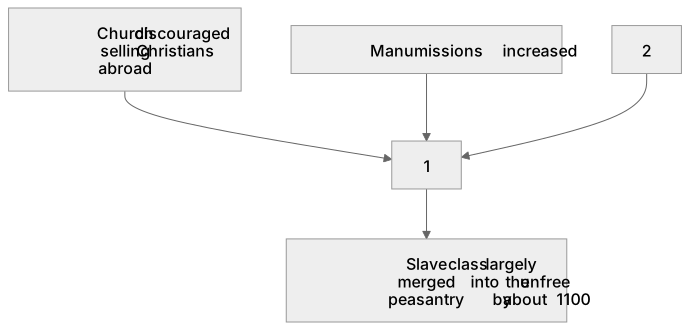
Some boxes have lost their names. Pick the right name for each number.
1Box 1
2Box 2
There is more to this lesson
The full lesson goes on to check your understanding and help you earn the marks. Create a free account to carry on, with your progress saved.
A week of Premium from your first lesson · Then the free plan continues · No card, no charge
Test your understanding of State, church and society, 1066–1106: Changes in towns and villages: towns and trading patterns; village life, royal forests and the forest laws; the gradual disappearance of slavery.
Active recall beats re-reading. Take an instant quiz now to test what you’ve learned and lock it into long-term memory.
A week of Premium from your first lesson · Then the free plan continues · No card, no charge